
How Gymnastics Creates Better Athletes: The Cross-Training Benefits for Every Sport
Introduction
Parents often ask, "Does gymnastics help kids perform better in other sports?"
The answer is yes.
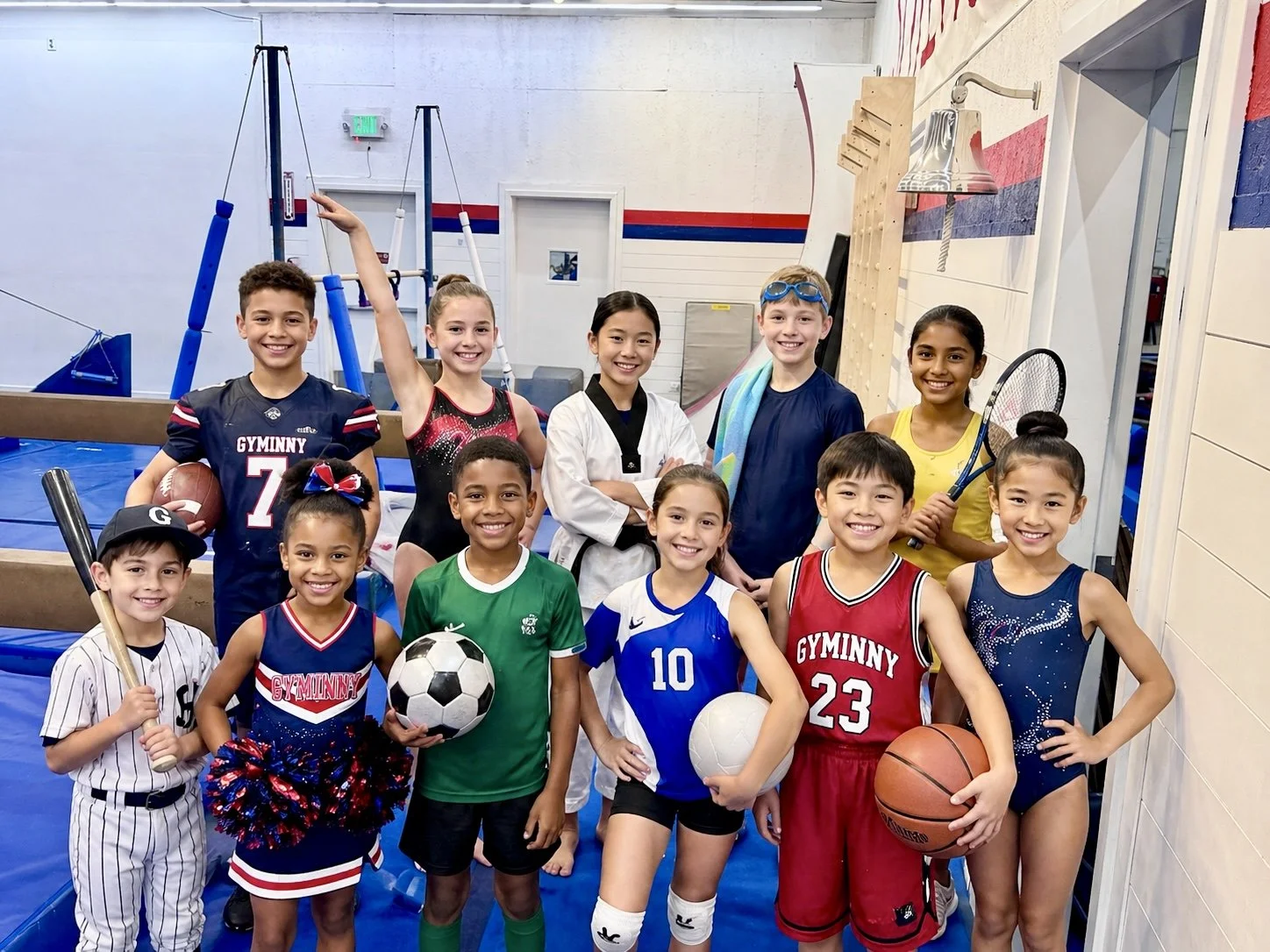
Gymnastics builds the physical foundation that almost every sport depends on. Before a child becomes a better soccer player, basketball player, swimmer, dancer, martial artist, baseball player, volleyball player, or football player, they first need body control, balance, strength, coordination, flexibility, agility, confidence, and the ability to follow instructions.
That is why we often say:
Gymnastics is the foundation for all sports. Start with gymnastics, go anywhere!
At North County Gymnastics & The Gyminny Kids, we see this every day. Some children stay in gymnastics long-term. Others use gymnastics classes for kids as a stepping stone into another sport. Either way, the skills they build in the gym do not stay there.
They show up everywhere.
On the field. On the court. In the pool. At school. At home. And later in life.
Why is gymnastics such a powerful cross-training
Cross-training means using one type of training to improve performance in another activity. For young athletes, gymnastics may be one of the most complete cross-training tools available because it develops the whole child.
The CDC recommends that children and adolescents engage in regular aerobic activity and muscle- and bone-strengthening activities each week. Gymnastics fits naturally into that kind of well-rounded physical development because kids jump, climb, balance, support their body weight, roll, land, swing, and move through different positions in space.
That matters because young athletes should not only train for one narrow movement pattern.
A soccer player needs footwork and balance. A swimmer needs endurance, as well as shoulder strength and core control. A basketball player needs speed, but also coordination and landing mechanics. A baseball player needs power, but also rotational control. A dancer needs flexibility, but also strength and stability.
Gymnastics helps build all of it.
1. Gymnastics builds balance and body control
Balance is one of the most important athletic skills a child can develop.
In gymnastics, kids learn how to control their bodies while standing, jumping, landing, rolling, balancing, swinging, and moving upside down. That kind of body awareness is called proprioception, which means the ability to understand where your body is in space.
This is huge for other sports.
A soccer player needs balance while changing direction. A basketball player needs balance while landing from a rebound. A baseball player needs balance while rotating through a swing. A football player needs balance while cutting, stopping, and absorbing contact. A surfer needs balance while adjusting to an unstable surface.
Gymnastics teaches children how to control their bodies before speed and pressure are added.
That is a major advantage.
2. Gymnastics improves coordination
Coordination is not automatic for every child. It has to be developed.
In a kids' gymnastics class, children learn to connect different body parts simultaneously. They may be running, jumping, reaching, landing, rolling, or swinging in one sequence. Over time, their brain and body learn how to work together more efficiently.
That carries into nearly every sport.
Throwing, catching, kicking, swimming, skating, jumping, serving, batting, and sprinting all require coordination.
Gymnastics gives kids hundreds of opportunities to practice coordinated physical activity in a structured, coached environment.
3. Gymnastics builds strength without traditional weightlifting
One of the best parts of gymnastics is that children build strength using their own body weight.
They climb. They hang. They support themselves on their hands. They jump. They hold shapes. They push. They pull. They land. They get back up.
The National Strength and Conditioning Association supports properly supervised youth strength training as part of long-term athletic development, especially when coaching, technique, and age-appropriate progressions are emphasized.
Gymnastics does this in a natural, kid-friendly way.
A child does not need to be in a weight room to get stronger. In gymnastics, strength is built through skill development, repetition, and proper progressions.
That strength helps athletes in every sport.
4. Gymnastics develops flexibility and mobility
Flexibility matters, but so does control.
A child who is flexible but weak may struggle with stability. A child who is strong but stiff may struggle with range of motion. Gymnastics helps develop both.
In gymnastics classes, kids work on shapes, stretches, bridges, splits, shoulder mobility, hip mobility, and active control. They learn how to move through a larger range of motion with strength and awareness.
That can help athletes in sports like:
Soccer, Dance, Cheer, Martial arts, Baseball, Basketball, Volleyball, Swimming, Diving, Track and field.
Flexibility is not about forcing positions. Quality gymnastics programs build mobility through proper progressions, safe coaching, and consistency.
5. Gymnastics teaches safe landing mechanics
This is one of the most overlooked benefits of gymnastics.
Kids in gymnastics learn how to land.
They learn to bend their knees. They learn to absorb force. They learn to control their arms. They learn to finish balanced. They learn to land with awareness rather than crash.
That matters in almost every sport.
Jumping and landing occur frequently in basketball, volleyball, soccer, football, cheer, dance, parkour-style training, and playground activities. Poor landing mechanics can increase the risk of injury over time.
Research on youth resistance and neuromuscular training has shown that strength and conditioning can reduce injury risk and improve performance when done properly.
Gymnastics gives children repeated practice in controlled landings, a skill many young athletes never formally learn.
6. Gymnastics builds agility and quickness
Agility is the ability to move, stop, turn, react, and change direction.
Gymnastics builds agility because children are constantly adjusting their bodies. They may move from a run to a jump, from a roll to a stand, from a balance to a dismount, or from one station to another.
This helps with:
Cutting in soccer, changing direction in football, reacting in basketball, moving around the bases in baseball, exploding off the blocks in swimming, quick footwork in tennis, and fast transitions in martial arts
Agility is not only about speed. It is about control at speed.
Gymnastics teaches that.
7. Gymnastics builds confidence under pressure
Athletic development is not only physical.
Kids need confidence. They need to learn how to try hard things. They need to handle mistakes. They need to recover after falling. They need to keep going when a skill feels difficult.
Gymnastics gives children a safe place to practice that.
A child may be nervous about climbing higher, walking across a beam, trying a cartwheel, swinging on bars, or performing in front of others. With coaching and repetition, they learn that fear does not have to stop them.
That confidence transfers.
A child who learns to keep trying in gymnastics is often more willing to try hard things in other sports, too.
8. Gymnastics teaches discipline and coachability
Every sport requires coachability.
Can the athlete listen? Can they follow directions? Can they wait their turn? Can they make corrections? Can they stay focused when something is difficult?
Gymnastics classes are structured around these habits.
Children learn to rotate through stations, listen to instructions, respect safety rules, work with coaches, and repeat skills until they improve. That structure builds discipline in a very practical way.
The American Academy of Pediatrics notes that organized sports can support children's physical, mental, and social development when the environment is age-appropriate and focused on healthy participation.
That is one of the reasons recreational gymnastics classes can be so valuable, even for children who never plan to compete.
9. Recreational gymnastics classes are great for multi-sport athletes
Not every child needs competitive gymnastics.
For many kids, recreational gymnastics classes are the perfect option. They build athletic ability without requiring a child to specialize too early.
A recreational class can help kids improve:
Balance, Coordination, Strength, Flexibility, Listening skills, Confidence, Body control, Social skills, Focus, Resilience.
That makes recreational gymnastics a smart choice for families who want their child to become a better overall athlete.
10. Gymnastics helps children become physically literate
Physical literacy means a child has the confidence, competence, and motivation to move well.
That is bigger than one sport.
A physically literate child can run, jump, climb, balance, roll, land, throw, catch, and move with confidence. Gymnastics supports that kind of development because it exposes children to so many different physical challenges.
The CDC also emphasizes that regular physical activity benefits children's muscular fitness, bone strength, brain health, academic performance, and long-term health.
That is why gymnastics is not only about cartwheels and handstands.
It is about building a body and a mind ready for life.
Why families choose Gyminny Kids
At North County Gymnastics & The Gyminny Kids, our goal is to help children build confidence, strength, coordination, and a lifelong love for physical activity.
We offer gymnastics classes for kids of many ages and ability levels, from toddlers and preschoolers to recreational athletes and competitive gymnasts.
Families choose Gyminny Kids because we focus on:
Professional coaching, Safe progressions, Clean, well-maintained facilities, Age-appropriate instruction, Positive class structure, Unlimited makeups, No registration, membership, or annual fees, Flexible class options, Programs for toddlers, preschoolers, recreational athletes, adaptive athletes, and competitive gymnasts.
Whether your child wants to become a gymnast or use gymnastics to become better at another sport, the foundation matters.
Proudly Serving Families In:
• 4S Ranch
• Poway
• Carlsbad
• La Costa
Quick Links
• Register for a free trial class today→]
• Adaptive gymnastics classes at Gyminny Kids→]
• Learn more about GK's no registration or annual fees pricing model→]
• Competitive gymnastics training→]
• Gymnastics mindset training→]
• Why Families Choose Gyminny Kids→]
Byline
By Daniel Gundert, Owner of North County Gymnastics & The Gyminny Kids, former gymnast, lifelong coach, national gymnastics judge, best-selling author, and father of five competitive gymnasts.
FAQs
Does gymnastics help kids perform better in other sports?
Yes. Gymnastics builds balance, coordination, strength, flexibility, agility, body control, confidence, and coachability. These skills transfer directly into many other sports.
What sports benefit from gymnastics training?
Almost every sport can benefit from gymnastics training, including soccer, basketball, baseball, football, swimming, volleyball, dance, cheer, martial arts, tennis, diving, and track and field.
Are recreational gymnastics classes helpful for athletes?
Yes. Recreational gymnastics classes are one of the best ways to build a strong athletic foundation without requiring early specialization.
Is gymnastics good for toddlers?
Yes, when taught in an age-appropriate environment. Gymnastics classes for toddlers can help young children develop balance, coordination, listening skills, confidence, and basic physical awareness.
Does my child need to compete to benefit from gymnastics?
No. Many children benefit from gymnastics without ever competing. Recreational gymnastics classes can support athletic development, confidence, fitness, and physical literacy.
Why is gymnastics called the foundation for all sports?
Gymnastics develops the core athletic skills that most sports depend on, including strength, balance, flexibility, coordination, agility, discipline, and body control.