
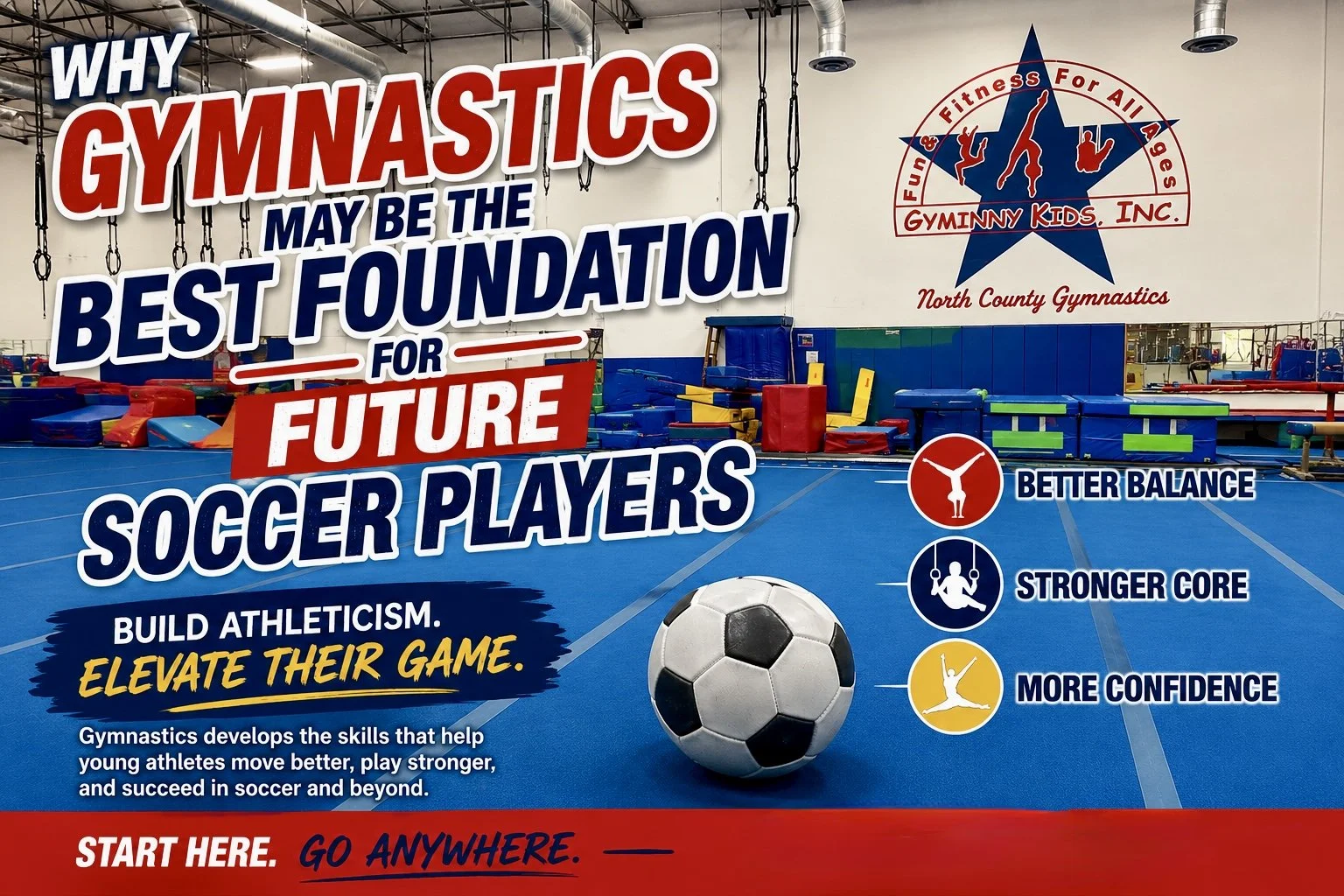
Why Gymnastics Is the Best Foundation for Current & Future Soccer Players
By Daniel Gundert, Owner & CEO of Gyminny Kids
Every four years, the FIFA World Cup captures the attention of millions of children around the globe. Kids head into the backyard, pretending they're scoring the game-winning goal, wearing their favorite player's jersey, and dreaming about one day competing on soccer's biggest stage.
As a father of six children and someone who has spent more than 30 years coaching gymnastics, I absolutely love seeing kids become passionate about sports. Whether it's soccer, football, baseball, basketball, swimming, or volleyball, every sport teaches valuable life lessons.
But after coaching thousands of children over the past three decades, I've noticed something interesting.
Many of the athletes who excel in soccer often have one thing in common:
They developed exceptional body awareness, balance, coordination, and confidence long before they ever stepped onto a soccer field.
That's exactly what gymnastics develops.
At North County Gymnastics & The Gyminny Kids, we often tell parents that gymnastics isn't just another sport. It's the foundation that prepares children for almost every athletic pursuit they'll encounter later in life.
In fact, USA Gymnastics has long embraced the phrase:
"Start Here. Go Anywhere."
I couldn't agree more.
As we've continued our series exploring how gymnastics complements other sports, soccer is one of the clearest examples of why developing a complete athlete before specializing can pay enormous dividends for years to come.
Why Building the Athlete Matters More Than Building the Soccer Player
Parents naturally want to help their children improve.
When a child falls in love with soccer, it's tempting to sign them up for year-round leagues, private lessons, club teams, speed training, and additional practices.
While those opportunities certainly have their place, there's an important question worth asking:
What if the fastest way to become a better soccer player isn't actually playing more soccer?
That might sound surprising, but research on long-term athletic development consistently shows that children benefit from developing broad fundamental movement skills before specializing in a single sport.
Gymnastics teaches children how to move.
Not just how to kick.
Not just how to run.
But how to control every part of their body.
That foundation becomes incredibly valuable once sport-specific skills are layered on later.
Instead of teaching one movement pattern repeatedly, gymnastics exposes children to hundreds of different movement challenges every single week.
Jumping.
Landing.
Climbing.
Balancing.
Swinging.
Rotating.
Crawling.
Supporting their own body weight.
Changing direction.
Generating power.
Absorbing force.
Every one of these movements builds athletic intelligence that carries directly into soccer.
Gymnastics Develops Athleticism That Transfers to Soccer
One of my favorite parts of owning Gyminny Kids is watching children discover new passions.
Some continue in gymnastics for years.
Others eventually transition into soccer, baseball, basketball, football, dance, martial arts, swimming, or dozens of other activities.
What's remarkable is how often those athletes seem to adapt faster than their peers.
It's not because gymnastics teaches soccer skills.
It's because gymnastics teaches movement and coordination.
And movement is the common language shared by every sport.
1. Balance Creates Better Ball Control
Watch any elite soccer player closely.
Whether they're receiving a pass, shielding a defender, dribbling through traffic, or finishing a shot, everything begins with balance.
The player who stays under control usually keeps possession.
Gymnastics develops balance from the very first class.
Young athletes learn to control their center of gravity while walking on balance beams, landing jumps, performing obstacle courses, climbing equipment, and moving through constantly changing positions.
Over time, these activities strengthen the stabilizing muscles throughout the ankles, knees, hips, and core.
Those same muscles become incredibly valuable on the soccer field.
Better balance helps players:
Stay on their feet after contact
Maintain control while dribbling
Improve first-touch accuracy
Change direction more efficiently
Recover quickly after unexpected collisions
Run fast with quick-twitch muscle
Parents often think of balance as simply "not falling over."
In reality, balance is one of the hidden skills behind nearly every successful soccer play.
2. Coordination Makes Every Skill Easier to Learn
Children aren't born coordinated.
Coordination is developed through experience.
One reason gymnastics stands apart from many sports is the incredible variety of movement children experience every week.
Instead of repeating the same drill over and over, gymnasts constantly solve new physical challenges.
They learn to synchronize their arms and legs.
They develop rhythm.
Timing.
Spatial awareness.
Body control.
Reaction speed.
Those qualities make learning soccer skills much easier.
When coaches introduce dribbling patterns, passing techniques, shooting mechanics, or defensive footwork, coordinated athletes often adapt more quickly because they've already built an extensive movement vocabulary.
This is one reason gymnastics has become such a valuable cross-training activity for young athletes.
You're not just teaching specific skills.
You're teaching children how to learn movement itself.
3. Agility Helps Players React Faster
Soccer is one of the most dynamic sports in the world.
Rarely does a player run in a perfectly straight line for very long. Instead, they're constantly accelerating, decelerating, cutting, pivoting, shuffling, jumping, and reacting to opponents in real time.
Gymnastics naturally develops these same movement patterns.
Every class at Gyminny Kids incorporates activities that challenge children to move in multiple directions while maintaining control. Whether they're navigating obstacle courses, tumbling, vaulting, swinging, or participating in ninja-style activities, they're constantly improving their agility.
This type of movement training helps soccer players:
Change direction more efficiently
React faster to the ball
Stay balanced while defending
Create separation from defenders
Improve foot speed and overall movement quality
While soccer teaches sport-specific agility, gymnastics develops general athletic agility that transfers to nearly every sport.
4. Core Strength Is the Engine Behind Every Movement
When parents think about soccer, they usually picture strong legs.
But the truth is, nearly every movement on the field starts with the core.
A strong core allows athletes to:
Generate more power when kicking
Stay balanced while running
Absorb contact from opponents
Maintain proper posture during long matches
Improve overall body control
Gymnastics may be one of the best core-strengthening activities available for young athletes.
Unlike traditional workouts that isolate muscles, gymnastics challenges the core during nearly every skill. Hanging on bars, climbing ropes, supporting body weight, swinging, handstands, and controlled landings all require tremendous trunk stability.
One of the things I've always appreciated about gymnastics is that children develop this strength naturally while having fun. They're not thinking about doing core exercises. They're simply playing, exploring, and learning new skills.
The result is a stronger athlete, without the workout ever feeling like one.
5. Flexibility Improves Movement Efficiency
Flexibility often gets overlooked in youth sports.
Many children become increasingly tight as they spend more time specializing in one activity.
Gymnastics places a strong emphasis on maintaining healthy mobility throughout the body.
Good flexibility can help soccer players:
Improve kicking mechanics
Increase stride efficiency
Move more fluidly
Reduce unnecessary muscle tension
Maintain better posture during athletic movements
Reduce the risk of injury
It's important to note that flexibility alone doesn't prevent injuries, but when combined with strength, coordination, and proper movement mechanics, it contributes to healthier overall movement patterns.
6. Learning How to Fall Safely
Soccer is a contact sport.
Players collide.
They slide.
They trip.
They get bumped.
One benefit of gymnastics that often goes unnoticed is its ability to teach children how to fall with greater body awareness.
Gymnasts spend years learning controlled landings and developing spatial awareness.
Rather than panicking when they lose their balance, they become comfortable adjusting their bodies in motion.
That confidence often carries over into soccer, where athletes are constantly recovering from unexpected situations.
7. Confidence Is One of the Greatest Competitive Advantages
One of the biggest transformations I witness at Gyminny Kids has nothing to do with physical ability.
Children arrive unsure of themselves.
Maybe they're afraid to try something new.
Maybe they lack confidence in their own abilities.
Then something incredible happens.
They learn a forward roll.
Then a cartwheel.
Then a pull-over.
Then they climb higher than they ever thought possible.
Little by little, they begin believing in themselves.
That confidence doesn't stay inside the gym.
It follows them onto the soccer field.
It follows them into the classroom and the playground.
It follows them through life.
Sports teach far more than athletic skills.
They teach resilience.
Perseverance.
Courage.
Problem-solving.
Those lessons become part of who children are long after the season ends.
What I've Learned Raising Six Active Kids
As both a gymnastics coach and a father of six children, I've had a front-row seat to athletic development.
While several of my children have remained deeply involved in gymnastics, I've also watched firsthand how the physical and mental skills they developed carried over into other activities.
One lesson has become incredibly clear over the years.
Children who develop broad athletic abilities early tend to adapt more quickly no matter what they choose later.
I've seen stronger balance.
Better coordination.
Greater confidence.
Faster learning.
More body awareness.
And perhaps most importantly, a willingness to embrace challenges rather than avoid them.
That's exactly what gymnastics encourages.
At Gyminny Kids, we often tell parents that we're not just teaching cartwheels and handstands.
We're helping children become capable, confident athletes who are prepared for whatever opportunities come next.
Whether that's soccer, football, baseball, basketball, volleyball, swimming, dance, martial arts, or simply living an active, healthy life, gymnastics provides an incredible foundation.
The Research Supports Multi-Sport Development
Over the past decade, many youth sports organizations have shifted away from encouraging early specialization.
Instead, experts increasingly recommend exposing children to a variety of movement experiences during their developmental years.
The American Academy of Pediatrics has noted that early sport specialization may increase the risk of overuse injuries and burnout while limiting broader athletic development.
Similarly, the American Orthopedic Society for Sports Medicine recommends allowing children to develop a range of movement skills before focusing exclusively on a single sport.
Gymnastics naturally supports this philosophy because it develops nearly every component of athleticism, including:
Balance
Coordination
Agility
Strength
Flexibility
Body awareness
Confidence
Spatial awareness
Motor control
These are qualities every soccer player benefits from, regardless of position or level of play.
That's one reason gymnastics has become such a valuable complement to soccer rather than a competitor.
Build the Athlete First. The Soccer Player Will Follow.
Parents often ask me which sport their child should start with.
My answer is almost always the same.
Start with the sport that develops the whole athlete.
Soccer is a wonderful game that teaches teamwork, perseverance, communication, and resilience. But before children master the technical skills of soccer, they benefit tremendously from learning how to move their bodies efficiently and confidently.
That's exactly what gymnastics provides.
At Gyminny Kids, our mission has always been bigger than teaching gymnastics skills.
We're helping children develop confidence.
We're teaching perseverance.
We're building strength, coordination, body awareness, and character.
Those qualities don't stay inside our gyms.
They follow children into every classroom, every playground, every soccer field, and eventually into adulthood.
Whether your child dreams of playing in the World Cup, competing in college athletics, or simply staying active and healthy for life, gymnastics provides an incredible foundation that prepares them for success.
As I've often said after coaching for nearly three decades, gymnastics isn't just preparing kids for gymnastics.
It's preparing them for life.
And no matter where their athletic journey takes them next, they'll always carry those lessons with them.
If your child loves soccer, that's fantastic.
Help them become the best soccer player they can be by first helping them become the best athlete they can be.
At Gyminny Kids, we'd love to be part of that journey.
Every sport teaches valuable lessons. Gymnastics teaches the skills that make learning every other sport easier.
Frequently Asked Questions
Does gymnastics help soccer players?
Yes. Gymnastics develops balance, coordination, agility, flexibility, body awareness, core strength, and confidence. These athletic qualities translate directly to soccer and can help young athletes move more efficiently while learning new skills more quickly.
At what age should soccer players start gymnastics?
Children can begin gymnastics as toddlers in parent-and-me classes as early as 9 months old and continue progressing through preschool and recreational gymnastics. Building these fundamental movement skills early provides a strong athletic foundation before sport-specific training becomes more demanding.
Should my child do gymnastics and soccer at the same time?
Absolutely. Many families successfully combine gymnastics with soccer because the two sports complement one another. Gymnastics develops overall athleticism while soccer builds sport-specific skills.
Can gymnastics help prevent soccer injuries?
No activity can completely prevent injuries, but gymnastics develops strength, coordination, balance, flexibility, and body awareness that may help improve movement quality and reduce certain injury risks when combined with proper coaching, conditioning, and recovery.
Does gymnastics improve footwork for soccer?
While gymnastics doesn't teach soccer footwork directly, it develops balance, agility, coordination, and lower-body control that often make learning footwork drills easier and more efficient.
Why do so many elite athletes have gymnastics backgrounds?
Gymnastics develops fundamental athletic skills that transfer to nearly every sport. Many professional athletes credit gymnastics with helping them build body control, flexibility, coordination, balance, confidence, and spatial awareness early in life.
Quick Links
• Register for a free trial class today→]
• How Gymnastics Supplements Football →]
• Competitive gymnastics training→]
• How Gymnastics Teaches Teamwork→]
• Recreational versus team: which is better for my child?→]
• Learn more about GK's no registration or annual fees pricing model→]
• Gymnastics mindset training→]
• Why Families Choose Gyminny Kids→]
Where does North County Gymnastics train competitive athletes?
North County Gymnastics & The Gyminny Kids trains competitive gymnastics athletes at multiple San Diego locations, including:
Proudly Serving Families In:
• 4S Ranch
• Poway
• Carlsbad
• La Costa
References
American Academy of Pediatrics. Sports Specialization and Intensive Training in Young Athletes.
American Orthopedic Society for Sports Medicine. Early Sport Specialization Consensus Statement.
USA Gymnastics. Athlete Development Resources.
National Strength and Conditioning Association. Long-Term Athletic Development Position Statements.
Lloyd, R. S., & Oliver, J. L. Strength and Conditioning for Young Athletes.
About the Author
Daniel Gundert is the Owner and CEO of Gyminny Kids, one of Southern California's largest youth gymnastics organizations, serving thousands of children each week across six locations in San Diego County.
With more than 30 years of experience as a gymnast, coach, business owner, and father of six children, Daniel is passionate about helping families understand how gymnastics builds confidence, character, and lifelong athletic ability. His mission is to show parents that gymnastics is more than a sport; it's one of the strongest foundations a child can have for success in athletics and in life.