
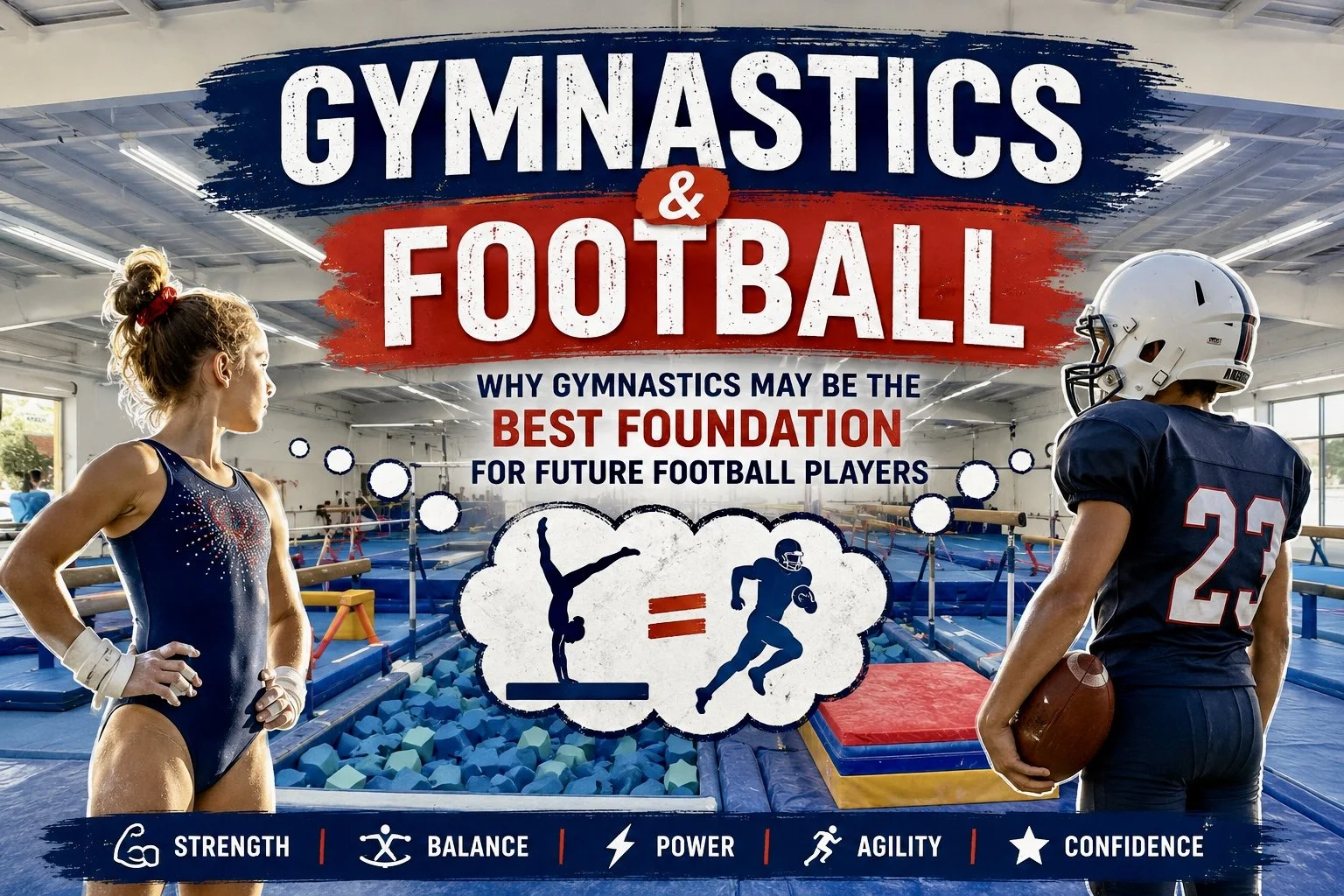
Gymnastics and Football: Why Gymnastics May Be the Best Foundation for Future Football Players

Gymnastics for Football Players | How Gymnastics Builds Better Athletes | Gyminny Kids
Gymnastics Is the Foundation of Football
When most people picture the path to becoming a great football player, they imagine youth football leagues, strength training, speed camps, and countless hours on the field.
What they often don’t picture is a gymnastics gym.
Yet year after year at Gyminny Kids, we see something interesting.
Many current and former professional football players choose to enroll their children in gymnastics long before they ever put on shoulder pads.
One example is legendary NFL quarterback Philip Rivers, a longtime Gyminny Kids family. Philip and his family brought their children through our programs beginning with our Parent & Tot classes and progressing into higher-level gymnastics because they understood something many elite athletes already know:
Great football players are first great movers.
Before a child learns to throw a spiral, make a tackle, or explode off the line of scrimmage, they first need balance, coordination, strength, flexibility, confidence, and body awareness.
That’s exactly what gymnastics develops.
In fact, after nearly 30 years coaching thousands of young athletes, I’ve become convinced that gymnastics isn’t just another sport.
It’s one of the best athletic foundations for nearly every sport, especially football.
This article is the first in our series exploring how gymnastics creates better athletes across a variety of sports.
Today, we’re looking at football.
Why NFL Families Choose Gymnastics First
Professional athletes understand something that’s often overlooked.
The earliest years of athletic development shouldn’t focus on sport-specific skills.
Instead, they should focus on building athleticism itself.
Research from organizations like the American Academy of Pediatrics, USA Football, and the National Strength and Conditioning Association consistently emphasizes the importance of developing fundamental movement skills before early sport specialization.
Gymnastics naturally develops these skills through climbing, swinging, rolling, balancing, jumping, landing, rotating, and supporting body weight in hundreds of different ways.
These experiences build athletic intelligence that carries into football for years to come.
How Gymnastics Directly Improves Football Performance
1. Body Awareness (Proprioception)
One of the biggest differences between average athletes and elite athletes is body awareness.
Football players constantly have to know where every part of their body is without looking.
Quarterbacks feel pressure while keeping their eyes downfield.
Wide receivers adjust midair.
Running backs change direction instantly.
Defensive players stay balanced while shedding blockers.
Gymnastics develops proprioception through:
Forward and backward rolls
Cartwheels
Balance beam
Swinging
Tumbling
Inverted movements
The result is athletes who naturally move with greater control and efficiency.
2. Explosive Power
Football is a game of short bursts.
Gymnastics develops explosive power through:
Vault
Sprinting
Broad jumps
Vertical jumps
Tumbling
Plyometric drills
Rope climbs
These movements improve:
First-step quickness
Vertical jump
Acceleration
Overall power output
Exactly what football players need.
3. Core Strength
Almost every movement in football begins with the core.
Quarterbacks generate throwing power.
Linemen transfer force.
Receivers stabilize while catching.
Running backs absorb contact.
Gymnastics trains the core every single practice through:
Hollow holds
Arch positions
Rope climbs
Hanging drills
Handstands
Bar work
Instead of isolating the abdominal muscles, gymnastics teaches the body to work as a single, connected system.
4. Shoulder Stability
Football places tremendous stress on the shoulders.
Gymnastics strengthens them differently than traditional weight training.
Athletes spend time supporting their own body weight on:
Parallel bars
Rings
Uneven bars
Handstands
Floor skills
This develops shoulder stability, coordination, and joint control that can help athletes tolerate the physical demands of football.
5. Balance Under Pressure
Football rarely happens in perfect conditions.
Players get bumped.
They get hit.
They have to cut at full speed.
Gymnastics constantly challenges balance through:
Beam work
Locomotor
Dynamic landings
Rotational skills
Uneven surfaces
Better balance often leads to better performance.
6. Mobility and Flexibility
Football players need mobility.
Gymnastics naturally improves:
Hip mobility
Hamstring flexibility
Shoulder mobility
Ankle mobility
Thoracic spine movement
Range of motion
This allows athletes to move more efficiently while reducing unnecessary movement restrictions and reducing injury.
7. Safe Landing Mechanics
One of the most overlooked benefits of gymnastics is learning how to land and fall safely.
Every gymnastics practice includes dozens, often hundreds, of controlled landings.
Athletes learn to:
Absorb force
Bend correctly
Protect joints
Control momentum
Pull the arms in when falling (being tackled)
Fall and roll correctly to minimize injury
These movement patterns may transfer to many athletic situations where controlled deceleration is important.
How Gymnastics Supports Football at Every Age
Parent & Tot (Walking Through Age 3)
The goal isn’t football.
The goal is movement, physical fitness, and confidence.
Children learn to:
Climb
Crawl
Balance
Jump
Swing
Explore safely
These experiences build the neurological foundation for future athletic success.
Preschool Gymnastics
During these years, children rapidly develop:
Coordination
Confidence
Spatial awareness
Rhythm
Motor planning
These are the exact qualities coaches later rely on in youth football.
School-Age Recreational Gymnastics
As athletes grow, gymnastics becomes more advanced.
Students develop:
Pulling strength
Pushing strength
Grip strength
Rotational control
Landing mechanics
Flexibility
Agility
These skills transition naturally into football movement.
Competitive Gymnastics
Competitive athletes build:
Exceptional work ethic
Explosive power
High-level body control
Advanced coordination
Many of these qualities are exactly what football coaches look for in older athletes.
Gymnastics Skills That Translate to Football
Gymnastics Skill
Football Benefit
Handstands
Shoulder stability and body control
Rope Climbing
Grip and upper-body strength
Tumbling
Spatial awareness and safe falling
Vault
Explosive acceleration
Quick-twitch muscle development
Beam
Balance and ankle stability
Rings
Grip strength, core strength, and shoulder control
Floor Exercise
Agility, coordination, and power
Trampoline
Body awareness, air awareness, safe landings, and reaction time
More Than Physical Development
One of the greatest gifts gymnastics gives future football players isn’t physical.
It’s mental.
Gymnastics teaches athletes to:
Solve problems
Handle failure
Practice with discipline
Build confidence
Stay coachable
Trust the process
Football rewards these same qualities.
Start With Gymnastics, Go Anywhere
USA Gymnastics has long promoted the idea:
“Start with gymnastics. Go anywhere.”
After coaching for nearly three decades, I couldn’t agree more.
Very few children will become elite gymnasts.
That’s perfectly okay.
Many will become football players.
Others will become baseball players, wrestlers, soccer players, basketball players, dancers, volleyball players, firefighters, military personnel, or simply active, healthy adults.
Gymnastics gives every child a foundation that lasts long after they leave the gym.
Whether your child dreams of playing under Friday night lights or becoming a confident athlete, gymnastics is one of the smartest places to begin.
At Gyminny Kids, we’ve had the privilege of watching over 100,000 families to date walk through our doors and build that foundation, including children whose parents competed at the highest levels of professional sports.
And every year we’re reminded of the same truth:
The best football players don’t just train for football. They first learn how to move.
Quick Links
• Register for a free trial class today→]
• Competitive gymnastics training→]
• How Gymnastics Teaches Teamwork→]
• Recreational versus team: which is better for my child?→]
• Learn more about GK's no registration or annual fees pricing model→]
• Gymnastics mindset training→]
• Why Families Choose Gyminny Kids→]
Where does North County Gymnastics train competitive athletes?
North County Gymnastics & The Gyminny Kids trains competitive gymnastics athletes at multiple San Diego locations, including:
Proudly Serving Families In:
• 4S Ranch
• Poway
• Carlsbad
• La Costa
Frequently Asked Questions
Is gymnastics good for football players?
Yes. Gymnastics develops balance, coordination, agility, body awareness, strength, flexibility, and confidence that directly support performance in football at every position.
Should football players do gymnastics in the offseason?
Many coaches encourage athletes to participate in multiple sports during childhood. Gymnastics is an excellent offseason activity because it develops athletic qualities without repeating the same football movements year-round.
At what age should football players start gymnastics?
Children can begin Parent & Tot classes as toddlers and continue progressing through preschool and school-age gymnastics before choosing to specialize in football later.
Does gymnastics improve speed?
Gymnastics improves explosive power, coordination, and efficient movement mechanics, all of which contribute to athletic speed and acceleration.
Can gymnastics help reduce sports injuries?
While no activity can prevent all injuries, gymnastics develops balance, body control, strength, landing mechanics, and mobility that may help athletes move more efficiently and tolerate athletic demands.
References
American Academy of Pediatrics. Recommendations on youth sports participation and multi-sport development.
USA Football. Athlete development guidance and youth football best practices.
National Strength and Conditioning Association. Long-Term Athletic Development principles.
USA Gymnastics. Youth athletic development resources and “Start with gymnastics. Go anywhere.” initiative.
American College of Sports Medicine. Youth resistance training and physical literacy research.