
Safe Ways to Practice Balance and Flexibility at Home (Without Ruining the Living Room)
Important Safety Notice: This article is intended to provide general ideas for safe, age-appropriate movement activities that families may enjoy together at home. It is not intended to teach gymnastics skills or replace instruction from a qualified coach. Every child develops differently, and parents or guardians are responsible for determining what activities are appropriate for their child based on their age, ability, maturity, available space, and level of supervision.
Gyminny Kids does not recommend practicing gymnastics skills at home. Skills such as cartwheels, handstands, walkovers, handsprings, aerials, flips, and similar gymnastics movements should only be learned and practiced in a properly equipped gymnastics facility under the supervision of trained coaches using appropriate equipment and progressions.
Before participating in any physical activity, ensure the area is free of hazards, provide close adult supervision, and stop any activity immediately if a child experiences pain, dizziness, discomfort, or appears unable to perform the activity safely. The information in this article is provided for general educational purposes only and is not individualized medical, coaching, or safety advice.
If you've ever walked into your living room only to find your child attempting a flip on the couch, bouncing from cushion to cushion, or trying to turn the furniture or street curb into a balance beam, you're not alone.
For many parents, the phrase "Stop flipping on the couch!" becomes part of the daily routine.
The good news is that your child's desire to move is actually a healthy sign. Children naturally want to climb, balance, jump, crawl, stretch, and explore how their bodies work. These instincts help build confidence, coordination, strength, and body awareness.
The challenge is helping them channel that energy safely.
At Gyminny Kids, we encourage children to stay active between classes, but we also recognize that a home is not a gymnastics gym. Most homes don't have spring floors, landing mats, spotting blocks, or trained coaches. That's why we encourage parents to focus on activities that build the foundations of gymnastics rather than practicing gymnastics skills themselves.
Why Kids Love to Flip on the Furniture
Movement is one of the primary ways children learn.
Whether they're pretending to be superheroes, pirates, or circus performers, they're developing important physical skills like:
Balance
Coordination
Core strength
Body awareness (proprioception)
Motor planning
Confidence
The problem isn't that kids love movement.
The problem is that couches, beds, coffee tables, and hard floors weren't designed for gymnastics.
According to the American Academy of Pediatrics, falls from furniture are one of the leading causes of injuries among young children. What seems like harmless play can quickly become dangerous when gymnastics skills are attempted in an environment that wasn't designed for them.
Our Philosophy at Gyminny Kids
One of the biggest misconceptions parents have is that children need to practice gymnastics skills at home to improve.
They don't.
In fact, we prefer they don't.
Gymnastics skills are taught using carefully designed progressions, specialized equipment, padded surfaces, and trained coaches who know when a child is physically ready for the next step.
Instead, we recommend developing the same athletic qualities through safe, home-appropriate activities.
We Do Not Recommend Practicing:
Cartwheels
Roundoffs
Handstands without professional instruction
Walkovers
Handsprings
Flips
Aerials
Skills on furniture
Skills on beds
Skills from elevated surfaces
Those belong in the gym.
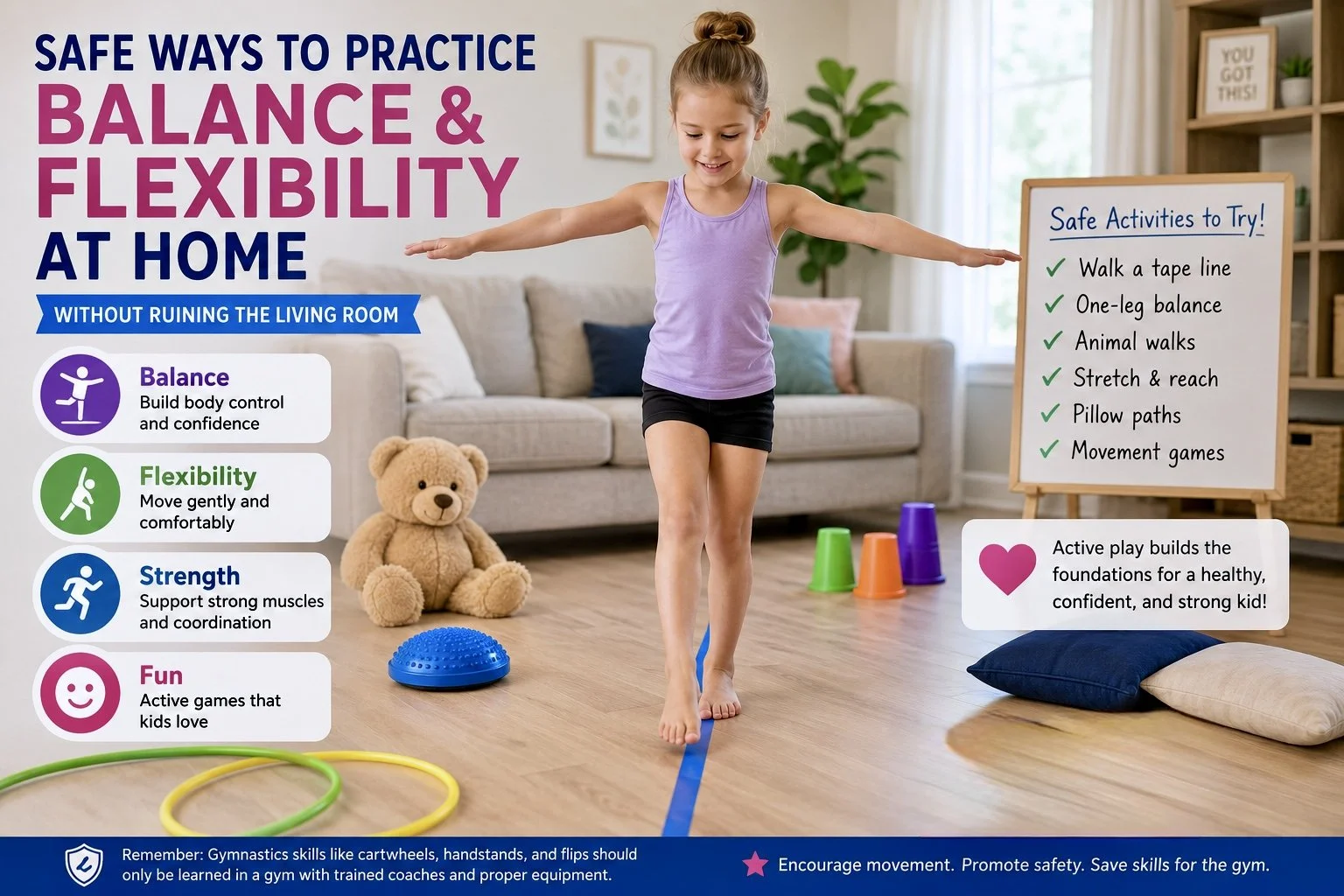
Safe Balance Activities to Try at Home
These activities help children develop body control without encouraging gymnastics skills.
1. Painter's Tape Balance Line
Lay a strip of painter's tape on the floor.
Challenge your child to:
Walk forward
Walk backward
Walk heel-to-toe
Walk sideways
Carry a stuffed animal while balancing
Because the tape is flat on the floor, children practice balance with minimal risk of falls beyond normal walking.
2. One-Leg Balance Challenge
Make balancing into a fun game.
Can they stand on one foot for:
5 seconds?
10 seconds?
20 seconds?
Try both sides.
Then pretend to be:
Flamingos
Trees
Statues
Superheroes
3. Pillow Stepping Stones
Place several pillows flat on the floor.
Have children carefully step from pillow to pillow while pretending they're crossing a river or lava field.
Keep pillows low and remove nearby furniture with sharp edges.
4. Balloon Challenge
Instead of tossing balls around the house, use a balloon.
See how long your child can keep it in the air while:
Walking
Standing on one foot
Moving around obstacles
This develops coordination, basic locomotor skills, and reaction time without high-impact play.
Gentle Flexibility Activities
Children naturally have excellent flexibility.
The goal isn't to stretch farther.
The goal is to move comfortably.
Good options include:
Butterfly stretch
Seated straddle stretch
Reaching toward the ceiling
Gentle side bends
Cat-Cow stretch
Child's Pose
Stretching should never be painful or forced.
Slow, relaxed movement is more beneficial than trying to stretch as far as possible.
Remember to breathe during stretching.
Fun Movement Games
Children don't need gymnastics skills to develop athletic ability.
Simple games build many of the same physical qualities.
Animal Walks
Pretend to move like:
Bears
Crabs
Frogs
Penguins
Ducks
These improve strength, coordination, and body awareness while feeling like play.
Simon Says
Include movements like:
Touch your toes.
Reach for the sky.
Stand on one foot.
Stretch like a cat.
Balance like a statue.
Safe Indoor Obstacle Course
Create an obstacle course using everyday household items.
Ideas include:
Walking around plastic cups
Crawling under a sturdy table with adequate clearance
Following a taped line
Tossing bean bags into a basket
Avoid activities that involve jumping from furniture, climbing onto unstable objects, or attempting gymnastics skills.
Household Items That Encourage Movement
You don't need expensive equipment.
Safe movement games can use:
Painter's tape
Plastic cups
Stuffed animals
Pillows placed on the floor
Bean bags
Balloons
Hula hoops
Lightweight playground balls
Simple tools often create the most creative play.
Setting Healthy Boundaries
Instead of constantly saying:
"Don't flip on the couch."
Try saying:
"The couch is for sitting. Gymnastics happens at gymnastics."
Children respond well to consistent expectations.
Many families also create a designated "movement space" where dancing, stretching, balancing, yoga, and active games are encouraged.
Signs Your Child May Love Gymnastics
If your child constantly enjoys:
Climbing
Hanging
Jumping
Balancing
Rolling
Being upside down
Solving physical challenges
They may be ready for a structured gymnastics program.
Gymnastics allows children to learn these skills safely:
Progressive lesson plans
Certified coaches
Professional equipment
Padded landing surfaces
Proper spotting techniques
Age-appropriate instruction
That's where real gymnastics belongs.
Explore More Resources
If your child enjoys being active, you may also enjoy these helpful resources:
These resources can help you choose the right program while supporting your child's healthy development.
Final Thoughts
Children are designed to move.
Our job isn't to stop that movement.
Our job is to guide them toward safe environments where they can build confidence without unnecessary risk.
Encourage stretching.
Encourage balancing.
Encourage active play.
Encourage imagination.
But save gymnastics skills for the gym, where trained coaches, proper equipment, and carefully designed progressions help children learn safely.
Your furniture will thank you.
More importantly, so will your child.
Frequently Asked Questions
Is it okay for my child to practice cartwheels at home?
We recommend learning and practicing gymnastics skills, such as cartwheels, under the supervision of qualified coaches in a properly equipped gymnastics facility. Most homes are not designed for gymnastics training and lack appropriate equipment and safety surfaces.
Can stretching at home help my child with gymnastics?
Yes. Gentle stretching can help improve flexibility and body awareness when performed comfortably and under adult supervision. Stretching should never be painful or forced.
What activities are safe between gymnastics classes?
Simple balance games, gentle stretching, animal walks, balloon games, taped balance lines, and age-appropriate movement games are excellent ways to stay active without practicing gymnastics skills.
How do I stop my child from flipping on the couch?
Set consistent expectations that furniture is for sitting and relaxing, while gymnastics skills are learned at gymnastics. Redirect your child's energy toward safe movement games or enroll them in a structured gymnastics program.
At what age can children start gymnastics?
Many children begin parent-and-me or preschool gymnastics programs as early as 18 months. Classes are designed to be age-appropriate and focus on fun, movement, confidence, and foundational motor skills.
Does my child need to practice gymnastics at home to improve?
No. Consistent attendance in class, combined with general physical activity like balancing, stretching, running, climbing at the playground, and active play, is typically all that's needed for healthy progress. Gymnastics skills should be practiced in a gymnastics facility under qualified supervision.
References
American Academy of Pediatrics. HealthyChildren.org – Home Safety and Injury Prevention Resources.
U.S. Centers for Disease Control and Prevention (CDC). Physical Activity Guidelines for Children and Adolescents.
USA Gymnastics. Athlete Safety and Progressive Skill Development Resources.
Proudly Serving Families In:
• 4S Ranch
• Poway
• Carlsbad
• La Costa
Quick Links
• Register for a free trial class today→]
• Adaptive gymnastics classes at Gyminny Kids→]
• Learn more about GK's no registration or annual fees pricing model→]
• Competitive gymnastics training→]
• Gymnastics mindset training→]