
Why Hanging Is So Good for Kids: Grip Strength, Shoulder Development, Joint Traction, and Upper-Body Strength
By Daniel Gundert, Owner & CEO of Gyminny Kids and North County Gymnastics, former competitive gymnastics coach, gymnastics judge, and father of six.
Featured Snippet: Hanging is one of the simplest and most beneficial movements kids can practice. It develops grip strength, shoulder stability, upper-body and core strength, while gravity provides natural traction through the shoulders, spine, and upper body. Learn why hanging, swinging, and climbing are such valuable parts of childhood physical development.
Watch a child on a playground, and there is a good chance they will eventually find something to hang from.
Monkey bars. A pull-up bar. Rings. A tree branch. Playground equipment.
Kids seem naturally drawn to hanging, swinging, climbing, and pulling themselves around.
And that instinct is worth encouraging.
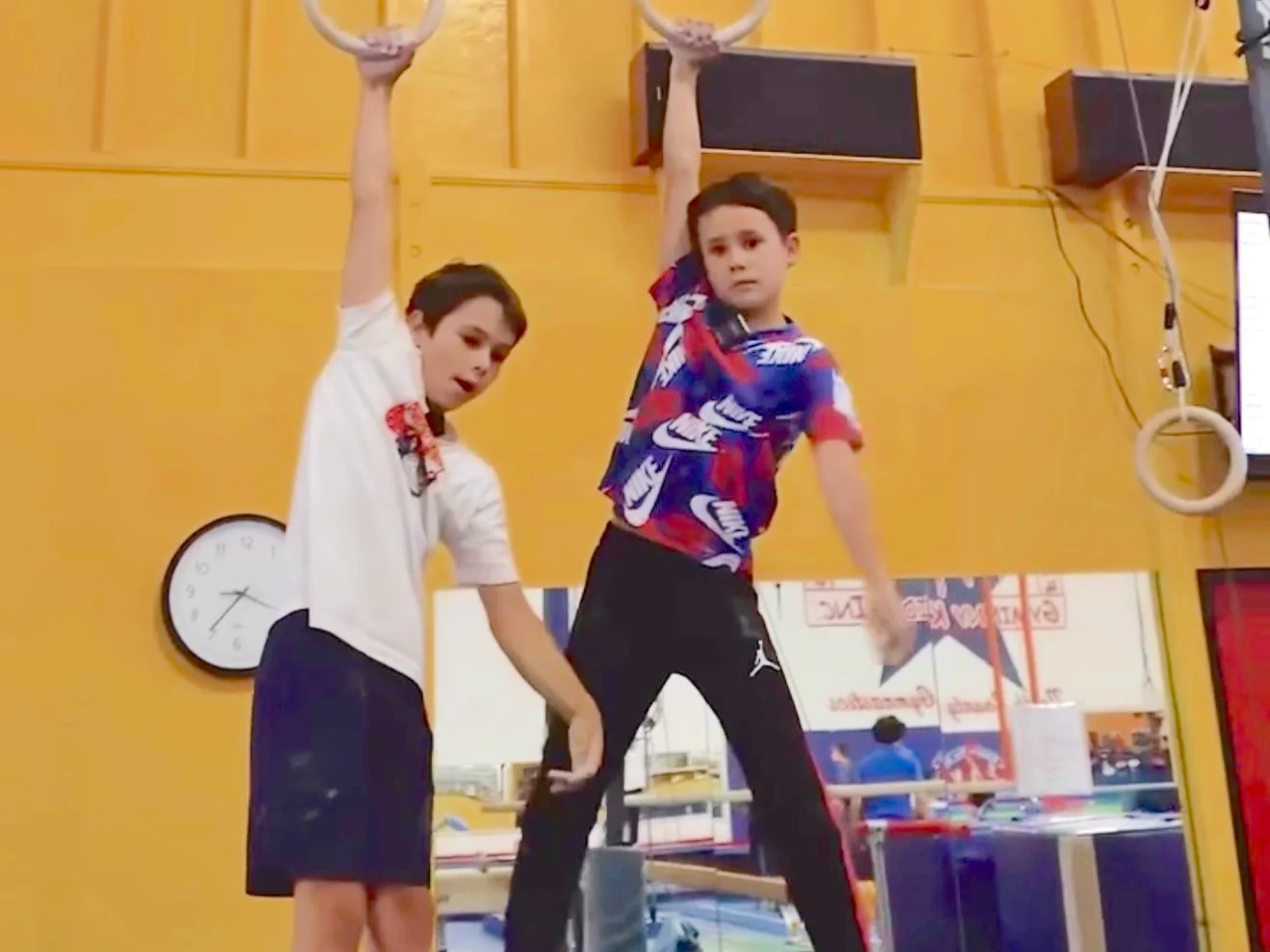
At Gyminny Kids, we incorporate hanging into many of the activities we teach because it develops several physical qualities at once. A child may think they are just swinging across the bars, but their hands, forearms, shoulders, back, core, and nervous system are all working together.
It is one of those wonderfully simple childhood movements that can have benefits far beyond the movement itself.
Hanging Builds Grip Strength
The most obvious benefit of hanging is grip strength.
When children hold onto a bar and support some or all of their body weight, the muscles of the hands and forearms have to work continuously to maintain that grip.
Grip strength matters for much more than gymnastics.
Children use their hands constantly throughout the day. They climb playground equipment, carry backpacks, throw and catch balls, manipulate objects, ride bikes, and participate in countless activities that require hand and forearm strength.
As children become athletes, grip strength becomes even more important in sports such as gymnastics, ninja, climbing, wrestling, baseball, racquet sports, and many other activities.
In gymnastics, grip strength is particularly important.
Our recreational gymnasts begin developing it through activities such as hanging, swinging, climbing, and supporting their body weight. As athletes progress into competitive gymnastics, that foundation becomes increasingly important in events such as uneven bars, high bar, parallel bars, rings, and pommel horse.
You do not suddenly develop a strong grip when you become an advanced gymnast.
It starts with hanging from a bar or the rings as a kid.
Hanging Helps Develop Strong, Stable Shoulders
The shoulder is an incredibly mobile joint.
That mobility allows us to reach overhead, throw, swing, climb, tumble, and perform thousands of different movements. But mobility also means the shoulder depends heavily on the surrounding muscles for control and stability.
Hanging introduces children to supporting their body weight through their hands while their arms are overhead.
This position challenges the muscles around the shoulders and shoulder blades and helps children learn to control their bodies while hanging.
Over time, appropriately coached hanging activities can build stronger, more capable shoulders.
This becomes especially valuable as children progress into movements such as pull-ups, rope climbs, monkey bars, swinging skills, handstands, cartwheels, and gymnastics bar work.
Hanging Creates Natural Traction Through the Shoulders, Spine, and Joints
One of the less obvious benefits of hanging is what gravity does to the body.
Most of the day, gravity is compressing us downward. Children sit at school, stand, walk, run, jump, and land, all while their bodies are continually managing gravitational forces.
Hanging changes that relationship with gravity.
When a child grips a bar and lets some or all of their body weight hang beneath their hands, gravity gently pulls the body downward while the hands stay fixed overhead. This creates traction through the shoulders and upper body and can create a temporary sense of lengthening or spinal decompression.
Instead of the body constantly experiencing compression, a brief hang introduces the opposite force.
There can also be a gentle traction effect around the joints involved in the hanging position, particularly the shoulders. The child's own body weight provides the resistance, which is one reason a relaxed hang can feel very different from most other movements children perform throughout the day.
You will sometimes hear this described as "creating space" between the joints or vertebrae. A more accurate way to think about it is that hanging applies a temporary traction force that can reduce compressive loading while the child is hanging.
This does not mean hanging permanently "realigns" the spine, nor should it be considered a treatment for back, shoulder, or orthopedic conditions. But from a healthy movement perspective, exposing the body to both compression and traction adds movement variety.
And movement variety matters.
Children should experience pushing and pulling, flexing and extending, loading and unloading, compression and traction.
Running and jumping teach the body to absorb force.
Hanging teaches the body to support its own weight while gravity gently pulls in the opposite direction.
That combination is another reason climbing, swinging, monkey bars, gymnastics, and ninja and parkour-inspired activities can be such valuable additions to a child's physical development.
Hanging Develops Upper-Body Strength
Many children can develop tremendous lower-body strength through normal childhood activity.
They run.
They jump.
They climb stairs.
They ride bikes.
Upper-body strength sometimes requires more intentional opportunities.
Hanging provides one of them.
A basic hang is primarily an isometric exercise, meaning the muscles are producing force even though there may not be much visible movement.
Once children begin moving while hanging, the challenge increases.
They might:
Swing from a bar
Travel across monkey bars
Move sideways along a bar
Lift their knees
Perform tuck-ups
Pull their body upward
Climb a rope
Traverse a ninja obstacle
Swing from rings
Transition between different handholds
Suddenly, a basic hanging position becomes a full-body strength exercise.
Hanging Is Also Core Training
Hanging may look like an upper-body activity, but controlling the body underneath the bar requires significant core involvement.
Think about the difference between a child hanging completely loose and a gymnast performing a controlled hollow-body hang.
The gymnast is using the abdominal muscles, hips, shoulders, and entire body to create a deliberate shape.
This ability to create tension throughout the body is fundamental to gymnastics.
We call it body tension.
Strong gymnastics does not come from isolated muscles working independently. The body has to learn to work as one connected unit.
Hanging provides an excellent environment for children to begin developing that awareness.
Hanging Develops Body Awareness
One of the greatest benefits of gymnastics and ninja training is that children learn where their bodies are in space.
Hanging challenges that awareness in a unique way because the child's feet are no longer connected to the ground.
They have to figure out:
Where are my legs?
How do I stop swinging?
How do I create momentum?
How do I move my hand without falling?
How much force do I need?
How do I get from one bar to the next?
These are physical problems the brain and body have to solve together.
That is part of what makes activities such as gymnastics, ninja, climbing, and playground play so valuable.
Children are not just exercising their muscles.
They are learning how to use their bodies.
Hanging Can Build Confidence Too
There is also a psychological component.
For a young child, taking their feet off the ground and trusting their hands to support them can feel intimidating.
Then they hang for two seconds.
Next time they make it five.
Eventually they swing.
Then they reach for another bar.
Then they make it across the monkey bars by themselves.
That progression creates something children need to experience repeatedly:
"I couldn't do this before, but now I can."
That is one reason we believe physical challenges are so valuable for kids.
Confidence is often built through evidence.
Children attempt something difficult, practice it, struggle with it, and eventually accomplish it.
Why Gymnastics and Ninja Are So Good at Developing This Strength
Gymnastics and ninja naturally incorporate hanging into training.
At Gyminny Kids, depending on the child's age and program, athletes may experience bars, rings, climbing obstacles, ropes, monkey-bar-style activities, ninja rigs, and other equipment that requires them to support and manipulate their own body weight.
The goal is not to turn every child into a competitive gymnast.
The goal is to help children become physically capable.
Can they climb?
Can they hang?
Can they support themselves?
Can they balance?
Can they jump and land safely?
Can they control their body?
Those abilities create a physical foundation that can transfer into almost anything a child chooses to do later.
Gymnastics is often called a foundational sport for exactly this reason. Children develop strength, flexibility, coordination, balance, spatial awareness, and body control that can benefit them whether they remain in gymnastics or eventually transition into another sport.
Start With the Basics
Children don't need complicated strength programs to get stronger.
Sometimes the basics are incredibly effective.
Run.
Jump.
Climb.
Crawl.
Push.
Pull.
Swing.
Hang.
For younger children especially, strength development should often look like play.
A child traveling across the monkey bars may not realize they are building grip endurance, shoulder stability, upper-body strength, core control, coordination, and confidence.
They know they made it one bar farther than last time.
And that is exactly how we want it.
Building Strong Kids at Gyminny Kids
At Gyminny Kids, our mission is Fun and Fitness While Teaching Character Through Sport.
We believe gymnastics provides one of the strongest physical foundations a child can develop because it teaches children how to control their own bodies before asking them to control a ball, bat, stick, or other piece of equipment.
Hanging is a perfect example.
It is simple.
It is natural.
It is challenging.
When taught progressively and appropriately, it can build stronger hands, stronger shoulders, stronger upper bodies, better body awareness, and more confident kids, while also exposing their bodies to the natural traction created by hanging under their own weight.
Sometimes one of the best strength-training tools for a child is simply a bar and the opportunity to hang from it.
Frequently Asked Questions
Is hanging from a bar good for kids?
Yes. Age-appropriate hanging activities can help children develop grip strength, upper-body strength, shoulder control, core strength, coordination, and body awareness. Hanging also creates natural upper-body traction while the child is suspended.
How does hanging improve grip strength?
When children hang from a bar, their hands and forearms must continuously produce force to support their body weight. Repeated exposure can gradually improve grip strength and endurance.
Does hanging strengthen children's shoulders?
Hanging challenges the muscles surrounding the shoulder and shoulder blade while the arms are overhead. When introduced progressively and appropriately, it can be one component of developing stronger, more capable shoulders.
Does hanging create traction through the spine and joints?
Yes. When the hands remain fixed overhead and gravity pulls the body downward, hanging creates a traction force through the upper body. This can temporarily reduce compressive loading and create a sense of lengthening through the shoulders and spine. It should not, however, be viewed as a medical treatment or a way to realign the spine permanently.
Why are monkey bars so good for kids?
Monkey bars combine hanging with movement. Children must maintain their grip, support their body weight, stabilize their shoulders, control their core, generate or control momentum, and coordinate their hands as they travel from one bar to another.
Is hanging good preparation for gymnastics?
Absolutely. Grip strength, shoulder strength, body tension, and the ability to support body weight are foundational qualities for gymnastics. Hanging and swinging skills become particularly important as gymnasts progress on bar-related events.
Is hanging useful for ninja training?
Yes. Ninja obstacles frequently require children to hang, swing, traverse, climb, and move between different handholds. Grip endurance and upper-body strength are therefore extremely valuable.
What if my child cannot hang for very long?
That is completely normal, especially for beginners. Like most physical skills, hanging strength develops progressively. Children can begin with short hangs and gradually increase their time or progress to more challenging activities as their strength and confidence improve.
Should children practice hanging at home?
Children can practice age-appropriate hanging activities on properly installed equipment designed to support their weight, with appropriate adult supervision. Children should not hang from furniture, doors, unstable structures, or equipment not designed for climbing or hanging.
Quick Links
• Register for a free trial class today→]
• Adaptive gymnastics classes at Gyminny Kids→]
• Learn more about GK's no registration or annual fees pricing model→]
• Competitive gymnastics training→]
• Gymnastics mindset training→]
• Why Families Choose Gyminny Kids→]
Proudly Serving Families In:
• 4S Ranch
• Poway
• Carlsbad
• La Costa