
Vestibular Development in Children: Why Spinning, Rolling, Swinging, and Going Upside Down Matter
By Daniel Gundert, Owner & CEO of Gyminny Kids and North County Gymnastics, former competitive gymnastics coach, gymnastics judge, and father of six.
Featured Snippet: Spinning, rolling, swinging, and going upside down aren't just fun for kids. These activities stimulate the vestibular system, helping children develop balance, spatial awareness, coordination, posture, and confidence in movement. Gymnastics provides children with frequent opportunities to explore these movements while building whole-body fitness safely.
If you've ever watched a child repeatedly spin in circles, hang upside down from the couch, roll down a hill, or ask to be pushed higher on a swing, you may have wondered:
Why do kids love doing this so much?
There's actually a fascinating developmental reason.
Children are constantly learning where their bodies are in space and how to control them. One of the systems helping them do that is called the vestibular system.
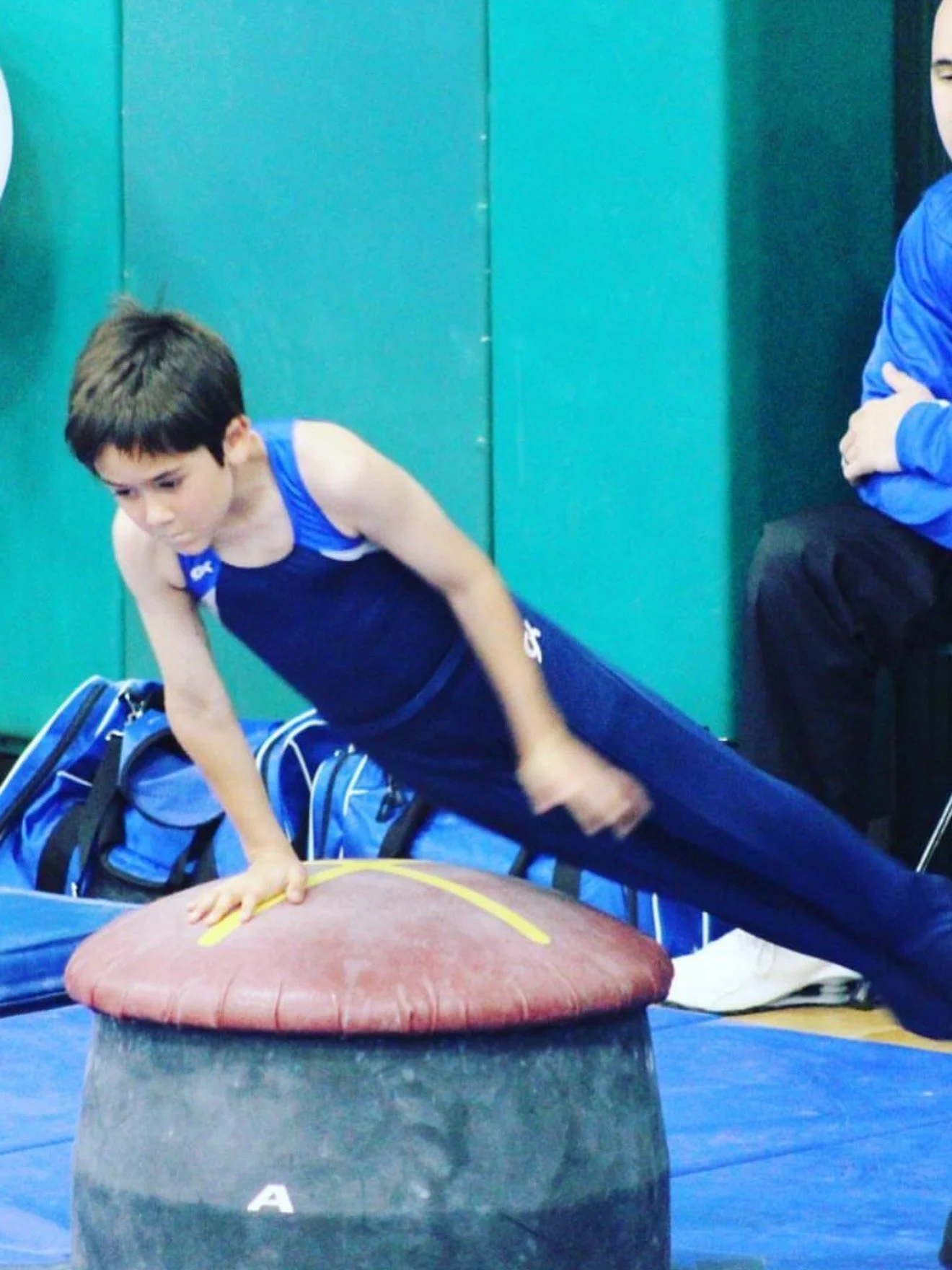
And activities we do every day in gymnastics, including rolling, swinging, jumping, flipping, hanging, and going upside down, give children opportunities to challenge and develop this important sensory system.
What Is the Vestibular System?
The vestibular system is located within the inner ear and helps the brain understand movement, balance, and the position of the head in space.
When a child moves forward, backward, sideways, up, down, or around, structures within the inner ear detect those changes and send information to the brain.
The brain then combines that information with signals from the eyes, muscles, and joints to help the child understand:
Where am I?
Which direction am I moving?
How fast am I moving?
How do I keep my balance?
What does my body need to do next?
For adults, many of these responses happen automatically.
For children, however, these systems are still developing and becoming more refined through experience.
Why Kids Naturally Seek Spinning, Swinging and Rolling
Watch children on a playground, and you'll see vestibular exploration happening everywhere.
They spin on playground equipment.
They swing.
They roll down hills.
They climb.
They jump off things.
They hang upside down.
They turn cartwheels.
Children often seek out different types of movement because movement gives their developing nervous systems information about their bodies and surroundings.
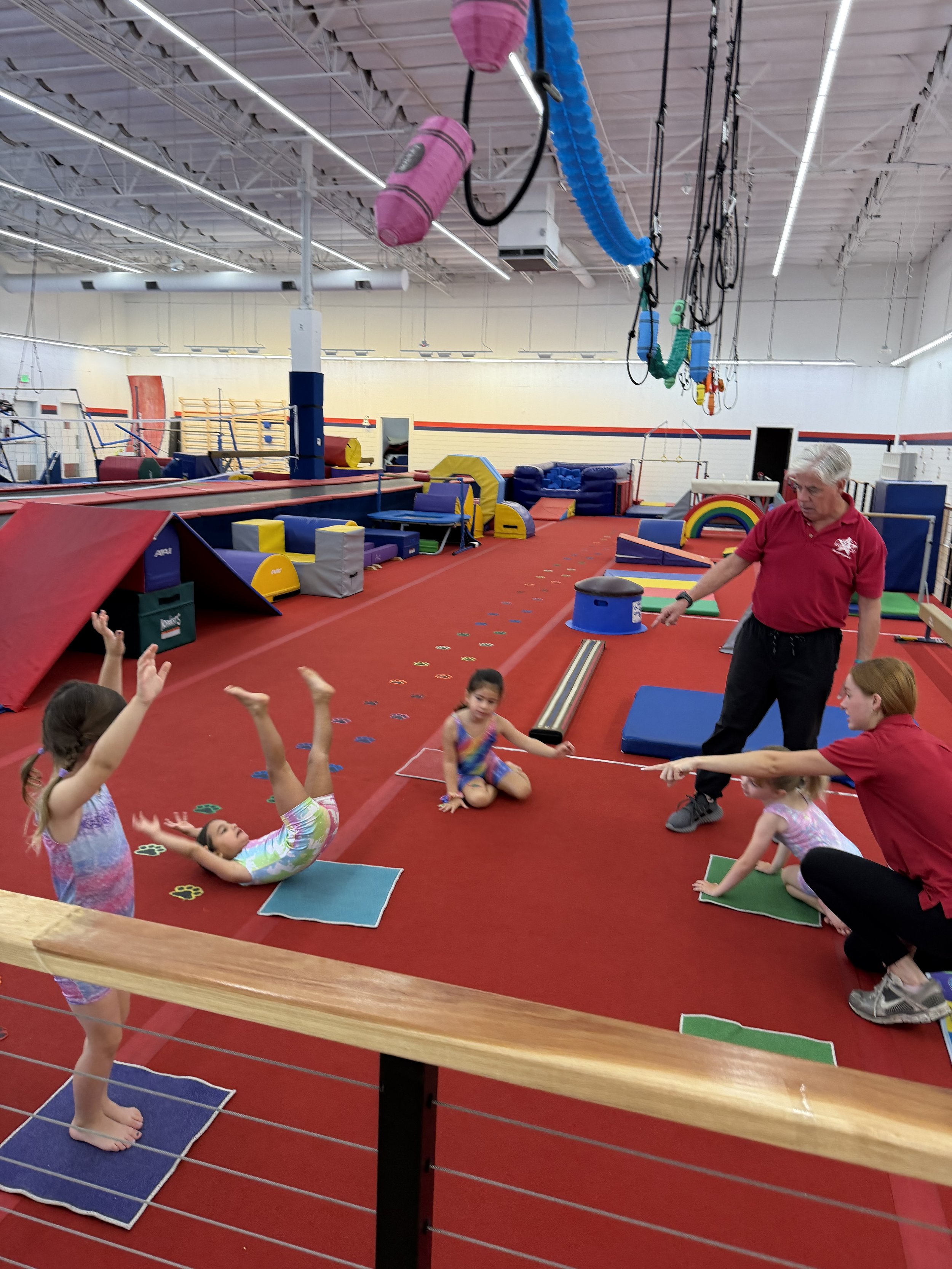
Gymnastics takes many of these movements and introduces them in a structured environment where children can progressively learn how to control their bodies.
Going Upside Down Is a Completely Different Experience for the Brain
One of the things that makes gymnastics unique among children's activities is how frequently athletes change their body's orientation.
Think about a basic forward roll.
A child begins standing upright, lowers toward the floor, becomes inverted, rotates through the movement, and eventually returns upright.
Even a skill as fundamental as a forward roll requires the brain to process a rapidly changing relationship between the head, body, floor, and surrounding environment.
Now consider gymnastics skills such as:
• Backward rolls
• Cartwheels
• Roundoffs
• Pullovers
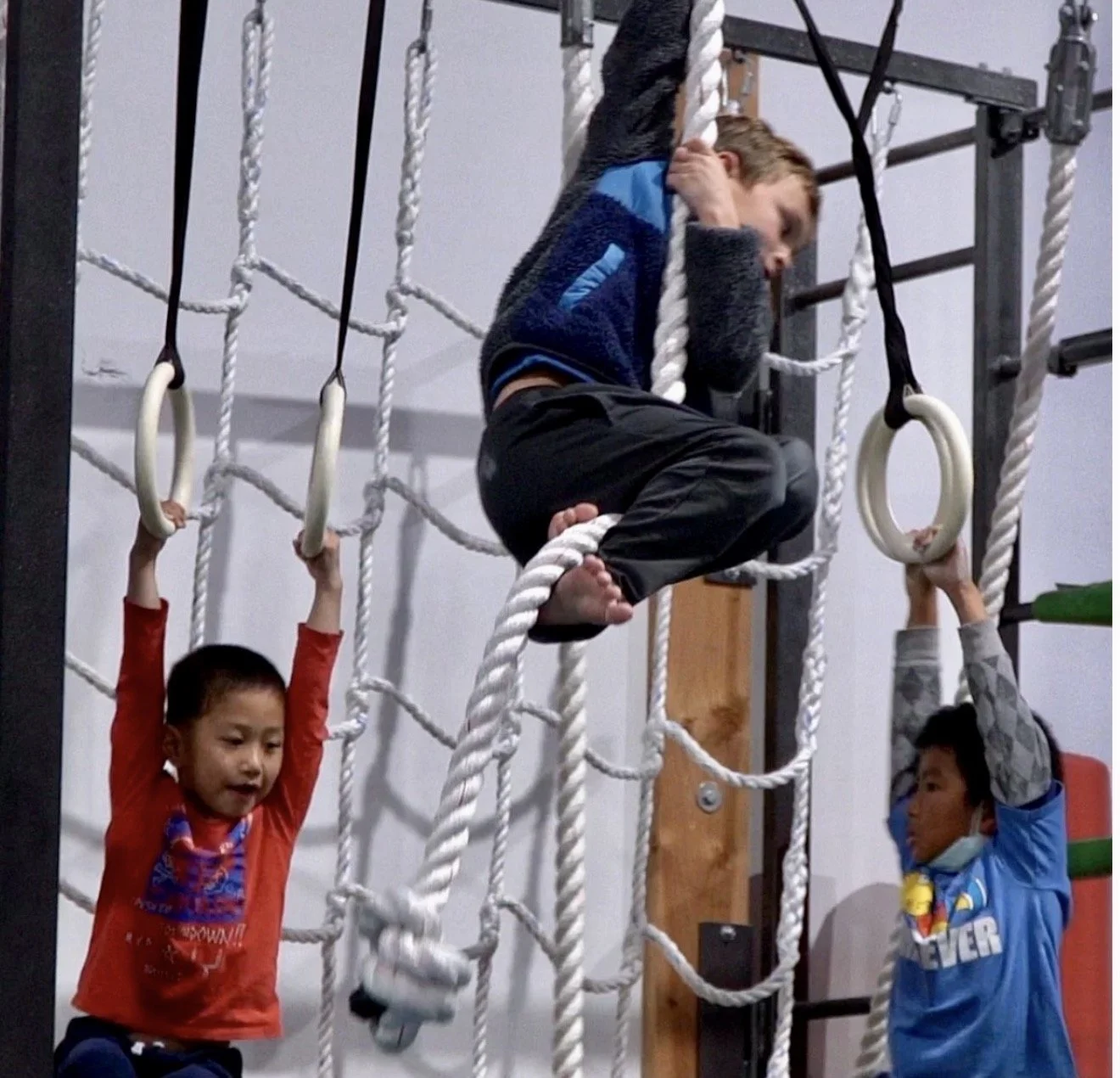
• Swinging on bars
• Hanging
• Rope climbing
• Trampoline jumping
• Flips and more advanced tumbling
Gymnastics continually asks children to understand where their bodies are as their orientation changes.
That is one reason gymnastics can be such a rich movement environment for developing children.
Vestibular Development and Balance
Balance isn't controlled by one system alone.
The brain combines information from several sources, including vision, proprioception, and the vestibular system.
Proprioception is the body's ability to sense where muscles and joints are positioned. The vestibular system contributes information about the position and movement of the head.
Together, these systems help children make constant adjustments to stay balanced.
Consider walking across a balance beam.
A gymnast must determine where their feet are, where their body weight is positioned, and how their head is moving while using visual information about the beam.
With practice, those adjustments can become faster and more automatic.
Gymnastics Builds Spatial Awareness
One of the most important concepts young gymnasts begin learning is body awareness.
Where are my hands?
Where are my feet?
Am I upside down?
How far am I from the ground?
How much rotation have I completed?
Where do I need to land?
Gymnasts eventually develop what coaches often call "air awareness," the ability to understand their body's position while moving through the air.
But air awareness doesn't begin with flips.
It begins with very basic childhood movement:
Rolling.
Jumping.
Swinging.
Hanging.
Balancing.
Turning.
Going upside down.
Over thousands of movement experiences, children gradually build a better internal map of how their bodies move through space.
Why Swinging Is So Valuable
Swinging is another powerful movement experience because the body repeatedly accelerates and decelerates while changing direction.
Gymnastics provides many different opportunities for swinging.
Children may swing from a bar, rings, trapeze, or other equipment. At Gyminny Kids, our world-famous Bungee Bouncers provide another fun environment where children experience vertical movement and changing body positions.
Swinging also requires grip strength, shoulder stability, and core engagement, making it a whole-body activity rather than just a sensory experience.
Rolling Is One of Gymnastics' Foundational Skills
Rolls are introduced so early in gymnastics for a reason.
Forward and backward rolling teach children how to move their bodies through rotation while maintaining control.
Rolling can help develop coordination, body awareness, and comfort with changing head position.
These seemingly basic skills also establish movement patterns that become important as gymnastics advances.
A child learning a forward roll today may eventually learn a handstand, cartwheel, roundoff, back handspring, or flip.
Gymnastics is built progressively.
Movement Challenges Can Build Confidence Too
Learning unfamiliar movement also has an emotional component.
For a young child, going upside down can initially feel strange.
The same can be true of walking across a beam, swinging from a bar, or jumping from a higher surface onto a safe landing area.
With appropriate coaching and gradual progressions, children can learn something powerful:
"I can do something that used to feel scary."
That experience can build confidence in their physical abilities.
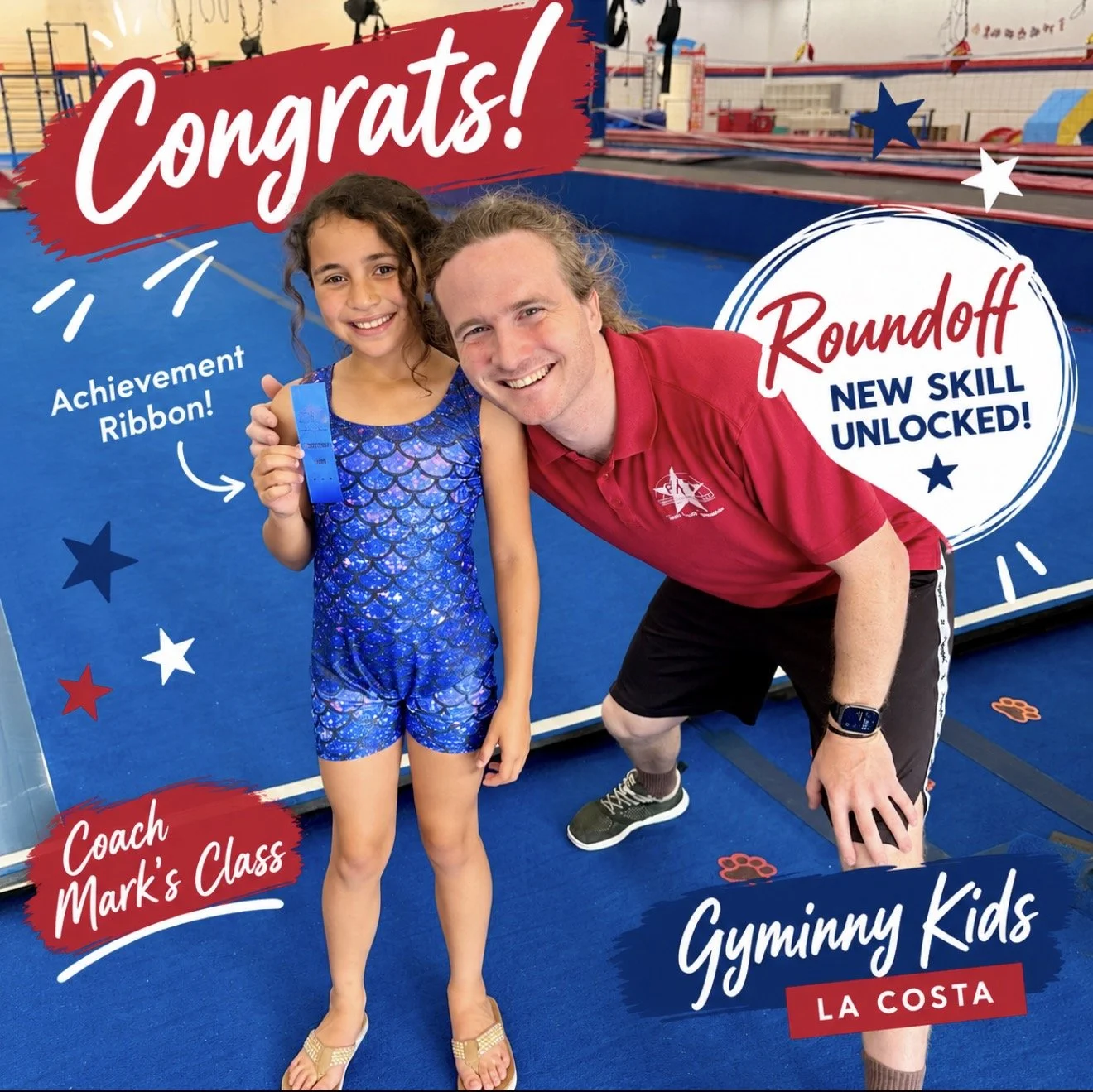
At Gyminny Kids, we believe progress deserves celebration. That's one reason our recreational programs use skill progressions and Achievement Ribbons to recognize milestones as children develop new abilities.
Sometimes the accomplishment is a major gymnastics skill.
Other times, it's a child's first independent forward roll.
Both can feel enormous to the child who worked for them.
Gymnastics Is About Much More Than Learning Gymnastics
Parents sometimes enroll their child because they want them to learn a cartwheel.
That's great.
But gymnastics offers much more than a collection of tricks.
A well-designed gymnastics class challenges many components of physical development:
• Strength
• Balance
• Coordination
• Agility
• Grip strength
• Core strength
• Spatial awareness
• Body control
• Vestibular experiences
Children experience all of these things while doing something they naturally love to do:
Move.
Building a Foundation for Other Sports and Everyday Life
Most children who participate in recreational gymnastics will not become competitive gymnasts, and they don't need to.
The physical foundation they develop can carry over to many other activities.
Running, jumping, climbing, throwing, swimming, dancing, surfing, skateboarding, and countless other sports require children to understand and control their bodies in space.
Gymnastics gives children an unusually broad movement vocabulary at an early age.
That is why we often describe gymnastics as a foundational sport.
Fun and Fitness While Teaching Character Through Sport
At Gyminny Kids, our mission statement is:
"Fun and fitness while teaching character through sport."
Sometimes the "fun" part and the developmental part are actually the same thing.
A child swinging from a bar isn't thinking about their vestibular system.
They're thinking:
"This is fun!"
A child doing forward rolls isn't thinking about spatial orientation.
They're thinking:
"Watch me!"
A child who finally learns a cartwheel isn't thinking about proprioception, balance, and coordination.
They're thinking:
"I did it!"
That's the beauty of gymnastics.
Children can develop strength, coordination, confidence, and a better understanding of their bodies while experiencing movement as something joyful.
And sometimes, spinning, rolling, swinging, and turning upside down is exactly the type of movement a growing child is looking for.
The Science Behind Vestibular Development
Substantial science explains why these different types of movement matter. According to the National Institute on Deafness and Other Communication Disorders (NIDCD), part of the National Institutes of Health, the vestibular system helps maintain balance and posture, orient the body in space, coordinate movement, and keep our vision stable while the body is moving. The sensory organs of the vestibular system are located in the inner ear. The semicircular canals detect rotational movements of the head, while the otolith organs detect linear movement and the head's relationship to gravity. The brain combines this information with signals from vision, muscles, and joints to continually determine where the body is and how it needs to respond.
What is particularly interesting for parents is that this process continues developing throughout childhood. A peer-reviewed review of pediatric vestibular rehabilitation explains that postural control depends on integrating three major sensory systems: visual, vestibular, and somatosensory. These abilities mature progressively through childhood and adolescence, and vestibular information contributes to the development of both static and dynamic postural control. Researchers have also found that children with significant vestibular impairment can experience delays in balance and motor development, which shows how closely the vestibular system and children's physical development are connected.
Another scientific review published in the journal Children notes that although the physical structures of the vestibular portion of the inner ear are essentially developed by birth, the central nervous system connections associated with vestibular processing continue developing into adolescence. The authors describe vestibular experience as relevant to this ongoing development and discuss connections that extend beyond balance to spatial orientation and other aspects of nervous-system function.
That doesn't mean we should claim that doing more cartwheels or spinning more will automatically improve a child's brain development. The science is more nuanced. What we can say is that movement involving rotation, acceleration, deceleration, and changes in head position provides the vestibular system with information it must process. Gymnastics is extraordinarily rich in exactly those kinds of experiences.
What I've Seen After a Lifetime in Gymnastics
I have experienced this from several perspectives. I grew up as a gymnast myself, and I've spent most of my adult life coaching gymnastics, judging the sport at the national level, running North County Gymnastics and Gyminny Kids, and raising competitive gymnasts of my own. Over the years, I've watched thousands of children learn how to roll, swing, balance, jump, turn upside down, and eventually combine those basic movements into increasingly complex skills.
One thing I've learned is that what looks incredibly basic to an adult can be an enormous developmental challenge for a young child. A first forward roll isn't "just a forward roll." The child has to put their hands down, tuck their head, shift their weight, accept the unfamiliar sensation of becoming inverted, rotate, understand where the floor is, and reorganize their body to stand back up. To us, it may happen in two seconds. In those two seconds, a developing child processes an incredible amount of sensory and motor information.
I've also watched that awareness evolve as gymnasts advance. A preschooler may initially be uncomfortable putting their head below their hips. Later, that same child learns a handstand. Then perhaps a cartwheel and roundoff. Some eventually progress to back handsprings, saltos, and twisting skills that require them to know where they are in the air without keeping their eyes fixed on the ground the entire time. Coaches call this "air awareness," but it doesn't suddenly appear when an athlete learns to flip. In my experience, it is built gradually through years of increasingly complex movement experiences.
That's one reason I believe so strongly in gymnastics as a foundational activity for children. The goal doesn't have to be becoming a competitive gymnast. Most kids won't. The value is giving children opportunities to climb, hang, swing, balance, jump, roll, and safely experience their bodies in many different positions. They're having fun, but beneath that fun, their visual, vestibular, and proprioceptive systems constantly work together to solve movement problems.
And after decades in gymnastics, I still think that's one of the most fascinating things about our sport: kids think they're playing, but their bodies are learning the entire time.
For readers who want to explore the science further, the National Institute on Deafness and Other Communication Disorders' explanation of balance and the vestibular system is an excellent parent-friendly resource.
Frequently Asked Questions About Vestibular Development and Gymnastics
What is the vestibular system in children?
The vestibular system is a sensory system located within the inner ear that detects head movement and position. The brain uses this information, along with visual and proprioceptive input, to help a child maintain balance, understand movement, and orient their body in space.
Why do children like spinning and going upside down?
Many children enjoy movement that provides strong sensory input, including spinning, swinging, rolling, and being upside down. These movements stimulate the vestibular system and give the brain information about direction, speed, and body position. Children also enjoy them for a simpler reason: they're fun!
Is spinning good for children?
Age-appropriate spinning can be a normal part of active play and provides vestibular stimulation. However, more is not necessarily better. Children respond differently to vestibular input, and you shouldn't force them to spin. If a child becomes dizzy, nauseated, unusually disoriented, or uncomfortable, stop the activity.
Why is going upside down beneficial for kids?
Inversion changes the head's position relative to gravity and gives the vestibular system a different movement experience. In gymnastics, skills such as rolls, handstands, and cartwheels also challenge strength, coordination, balance, and spatial awareness. Teachers should teach these skills through appropriate progressions and supervision.
Does gymnastics help children develop balance?
Gymnastics provides many opportunities to practice balance. Walking on beams, landing jumps, holding body positions, swinging and performing skills all require the brain to integrate information from vision, the vestibular system and proprioception.
What is proprioception, and how is it different from the vestibular system?
Proprioception is the sense of where the body and joints are positioned without needing to look at them. The vestibular system primarily provides information about head movement, orientation, and balance. The brain combines both systems, along with vision, to help coordinate movement.
What gymnastics activities stimulate the vestibular system?
Gymnastics provides a wide variety of movement experiences, including forward and backward rolls, cartwheels, handstands, swinging, hanging, jumping, turning, trampoline activities, and more advanced rotational skills. The type and difficulty of the activity should always match the child's age and ability.
Can gymnastics help with spatial awareness?
Gymnastics repeatedly challenges children to determine where their bodies are relative to the floor, equipment, and surrounding space. As skills advance, gymnasts also learn to recognize body position while rotating or moving through the air.
At what age can children start gymnastics?
Children can begin age-appropriate gymnastics experiences at a very young age. Parent-and-tot programs typically focus on playful exploration, climbing, rolling, balancing, hanging, and other fundamental movements rather than formal gymnastics skills. Activities become progressively more structured as children develop.
Do children need to become competitive gymnasts to benefit from gymnastics?
Not at all. Most children can benefit from recreational gymnastics without ever entering competition. Strength, flexibility, coordination, balance, confidence, and body awareness can support participation in many other sports and everyday physical activity.
What if my child doesn't like spinning or going upside down?
That's okay. Children have different comfort levels with movement and sensory experiences. A good coach should never force a child into an activity that causes significant discomfort or fear. Skills can be introduced gradually with progressions that build confidence over time.
About Gyminny Kids
North County Gymnastics and the Gyminny Kids have been serving San Diego families since 1987, offering gymnastics and children's fitness programs from the earliest stages of childhood through advanced competitive gymnastics.
Programs include parent-and-tot and preschool gymnastics, recreational gymnastics, ninja, tumbling, Bungee Bouncers, camps, open gyms, birthday parties, homeschool opportunities, pre-team, Xcel and Development Program competitive gymnastics, and boys gymnastics pathways through Level 10.
Our goal is to provide children with a fun, positive environment where they can become stronger, more confident, and more capable movers while developing character through sport.