
How Gymnastics Helps Children Manage Big Emotions: Building Resilience Through Physical Activity
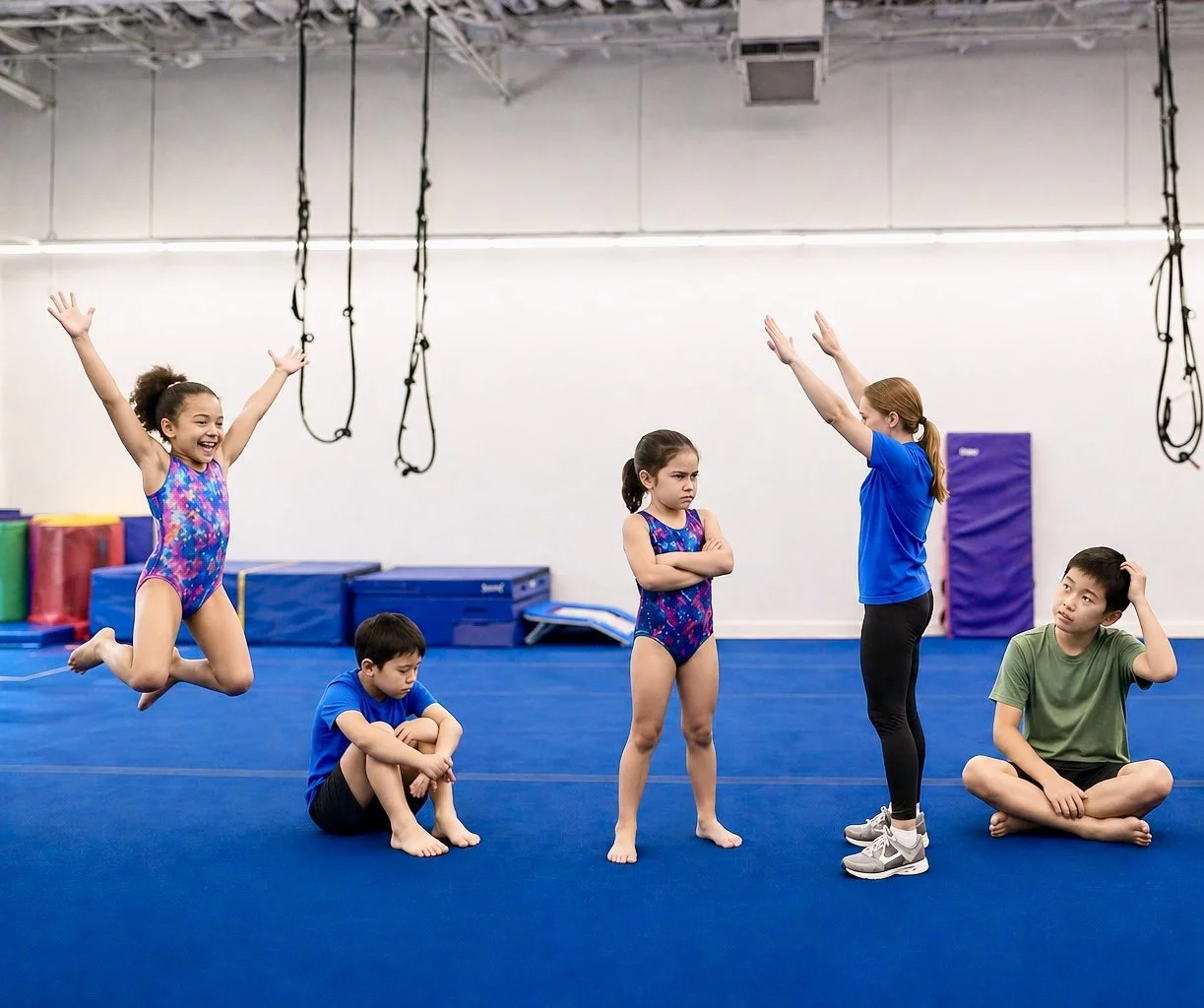
Every parent has seen it.
The meltdown when something does not go their way.The frustration when a task feels too hard. The tears after a small setback.
These moments are not just "kids being kids." They are opportunities. There are moments where emotional regulation is either learned or missed.
And one of the most powerful, overlooked tools to help children manage emotions is gymnastics.
Parents often ask: Can gymnastics help kids manage their emotions?
The answer is yes, and not in a surface-level way. Gymnastics builds emotional regulation from the inside out through structure, challenge, repetition, and coaching.
At North County Gymnastics & The Gyminny Kids, we see this transformation every day. Kids come in with big feelings, high energy, and sometimes limited coping skills. Over time, they learn how to stay calm under pressure, bounce back from mistakes, and regulate themselves in ways that carry into school, friendships, and life.
What Is Emotional Regulation in Children?
Emotional regulation is a child's ability to:
Stay calm when things do not go their way
Manage frustration without shutting down or acting out
Recover from disappointment
Focus even when emotions are high
Research shows that emotional regulation is one of the most important predictors of long-term success, influencing academic performance, relationships, and mental health.
This is not something kids are born with fully developed. It must be taught, practiced, and reinforced.
And that is where gymnastics comes in.
Why Gymnastics Is Uniquely Powerful for Emotional Regulation
Not all activities are created equal.
Gymnastics stands out because it combines:
Physical challenge
Mental focus
Immediate feedback
Repetition under pressure
Unlike passive activities, gymnastics forces children to feel emotions in real time and work through them.
Balancing on a beam, attempting a new skill, or waiting their turn requires children to manage nerves, excitement, frustration, and focus simultaneously.
This creates what psychologists call a "live training environment" for emotional control.
1. Gymnastics Teaches Kids How to Handle Frustration
Frustration is one of the biggest emotional challenges for children.
In a kids' gymnastics class, frustration shows up constantly:
Falling off the beam
Missing a skill
Watching another child succeed first
Having to try again and again
Instead of avoiding frustration, gymnastics teaches kids to work through it.
Research shows that gymnastics training improves inhibitory control, which is the ability to pause, reset, and try again instead of reacting emotionally.
That is emotional regulation in action.
At Gyminny Kids, we coach kids through these moments, not around them. That is where the growth happens.
2. Structured Classes Build Emotional Control
Children thrive on structure.
Every gymnastics class for kids follows a predictable format:
Warm-up
Skill stations
Rotations
Practice and repetition
This structure helps children feel safe, and safety is what allows emotional regulation to develop.
In structured environments, kids learn:
When to listen
When to act
When to wait
How to transition between activities
These are the same skills required in school and at home.
3. Gymnastics Strengthens Focus and Reduces Emotional Reactivity
Emotional outbursts often come from a lack of focus and overstimulation.
Gymnastics directly trains focus.
Balancing, flipping, and coordinating movements require intense concentration. Kids learn to block out distractions and stay locked in on the task at hand.
This has a powerful side effect:
When focus increases, emotional reactivity decreases.
Kids who can focus are less likely to:
Overreact
Get overwhelmed
Lose control
They learn to stay present rather than spiral emotionally.
4. Repetition Builds Emotional Resilience
Gymnastics is built on repetition.
Not once. Not twice. Sometimes hundreds of attempts.
This repetition teaches one of the most important emotional skills:
Failure is part of the process
Instead of seeing mistakes as something to avoid, kids learn:
Mistakes are normal
Progress takes time
Effort matters more than perfection
This builds resilience.
Studies show that gymnastics helps children develop emotional resilience and coping skills that transfer into school and social settings.
That is the difference between a child who gives up and a child who keeps going.
5. Gymnastics Builds Brain Skills That Support Emotional Regulation
Emotional regulation is not just behavioral. It is neurological.
Gymnastics improves:
Working memory
Cognitive flexibility
Inhibitory control
These are all part of what researchers call executive function.
Studies show that gymnastics training improves these core brain functions, including memory and cognitive control.
Another study found that gymnastics significantly improved inhibitory control, working memory, and cognitive flexibility in children.
These are the exact skills kids use to:
Pause before reacting
Think before acting
Manage emotions effectively
6. Special Needs Gymnastics and Emotional Regulation
For children with additional needs, emotional regulation can be even more challenging.
This is where special needs gymnastics becomes incredibly valuable.
Research shows that structured gymnastics programs can improve executive function in children with autism, including better emotional and behavioral control.
Why?
Because gymnastics provides:
Clear structure
Predictable routines
Sensory input
Repetition
At Gyminny Kids, our adaptive programs are designed to meet children where they are and help them build regulation step by step.
7. Gymnastics Teaches Kids to Stay Calm Under Pressure
Even at the recreational level, gymnastics introduces pressure:
Performing in front of others
Trying new skills
These moments are opportunities to practice staying calm.
Over time, kids learn:
How to breathe and reset
How to focus despite nerves
How to perform even when uncomfortable
This carries directly into:
School tests
Life challenges
8. Emotional Regulation Through Physical Activity
Physical activity plays a major role in emotional health.
Research shows that physical activity is associated with improvements in cognitive function and self-regulation in children.
Gymnastics takes this a step further because it combines:
Physical effort
Mental focus
Skill progression
It is not just movement. It is intentional skill-building under pressure.
9. Confidence and Emotional Stability Go Hand in Hand
Confidence reduces emotional volatility.
When kids feel capable, they are less likely to:
Shut down
Overreact
Avoid challenges
Gymnastics builds confidence through:
Skill progression
Clear wins
Consistent feedback
Research shows gymnastics improves self-esteem and mental well-being, helping children manage stress and emotions more effectively.
10. The Transfer to School and Life
Here is what matters most to parents:
Does this actually carry over outside the gym?
Yes.
Kids who develop emotional regulation through gymnastics often show:
Better listening skills in class
Fewer emotional outbursts
Stronger friendships
Greater independence
These are not gymnastics skills. These are life skills.
Why Families Choose Gymnastics Classes for Emotional Growth
At North County Gymnastics & The Gyminny Kids, our approach is built around more than just skills.
We focus on:
Structured classes that build discipline
A positive environment where kids can struggle and succeed
Emotional regulation is not taught through lectures. It is built through experience, challenge, and repetition.
Category: Child Development
Proudly Serving Families In:
• 4S Ranch
• Poway
• Carlsbad
• La Costa
Quick Links
• Register for a free trial class today→]
• Adaptive gymnastics classes at Gyminny Kids→]
• Learn more about GK's no registration or annual fees pricing model→]
• Competitive gymnastics training→]
• Gymnastics mindset training→]
• Why Families Choose Gyminny Kids→]
FAQs
Can gymnastics help kids manage their emotions?
Yes. Gymnastics helps children develop emotional regulation by teaching focus, patience, resilience, and self-control through structured challenges and repetition.
What age should kids start gymnastics for emotional development?
Children can start as early as 9 months in parent-child classes. Early exposure helps build foundational emotional and social skills.
Is gymnastics good for kids with anxiety or big emotions?
Yes. The structured environment and physical activity help reduce stress, improve confidence, and teach coping strategies.
How does gymnastics help with meltdowns?
Gymnastics builds inhibitory control, helping kids pause, reset, and respond rather than react impulsively.
Is special needs gymnastics helpful for emotional regulation?
Absolutely. Adaptive gymnastics programs provide structure, sensory input, and repetition, which are key for developing emotional control.
By Daniel Gundert
Owner of North County Gymnastics & The Gyminny Kids, former gymnast, lifelong coach, national gymnastics judge, best-selling Author, and father of five competitive gymnasts.