
How Gymnastics Teaches Self-Discipline: Why This Skill Transfers to School and Life
Gymnastics classes for kids do a lot more than teach cartwheels and handstands. They build something deeper, something that shows up in the classroom, at home, and later in life: self-discipline.
Parents often ask, "Will a kids' gymnastics class actually help my child listen better, stay focused, and follow through?" The answer is yes, and not by accident. The structure, coaching, and progression inside quality gymnastics classes are designed to build discipline from the ground up.
At North County Gymnastics & The Gyminny Kids, we see it every day. Kids come in with energy, curiosity, and sometimes a short attention span. Over time, they leave with stronger habits, better focus, and the ability to do hard things even when they do not feel like it.
What is Self-Discipline for Young Children?
Self-discipline is the ability to:
Follow instructions, even when it is not exciting
Stay focused on a task from start to finish
Push through challenges instead of quitting
These are not traits kids are born with fully developed. They are built through repetition, structure, and consistent expectations.
That is exactly what gymnastics classes provide.
1. Structure Builds Discipline From Day One
A quality gymnastics class follows a clear format:
Warm up
Stretch
Skill stations
Rotations
Cool down
Every class has a similar structure, even as skills progress. This consistency teaches kids what to expect and how to behave within that structure.
Over time, children begin to anticipate the flow of class. They line up when it is time. They move when instructed. They transition between activities without chaos.
2. Listening Skills Are Constantly Reinforced
In a kids' gymnastics class, listening is not optional. It is required for safety and success.
Coaches give clear, direct instructions:
"Hands here"
"Eyes forward"
"Wait until I say go."
Kids who do not listen cannot safely perform the skill. That immediate feedback loop helps them understand why listening matters.
Parents often tell us:
"My child is paying attention better at school after starting gymnastics. We noticed it within a few weeks."
3. Waiting Your Turn Teaches Impulse Control
One of the most underrated parts of recreational gymnastics classes is learning to wait.
Kids line up. They watch others. They wait for their turn.
For young children, this is hard. But it is also essential.
Impulse control, the ability to pause instead of acting immediately, is one of the strongest predictors of success in school and life. Gymnastics gives kids dozens of opportunities every class to practice this skill.
4. Repetition Builds Work Ethic
In gymnastics, there is no shortcut to improvement.
A child might repeat the same movement:
10 times
20 times
50 times
before they get it right.
That repetition teaches:
Patience
Persistence
Effort over outcome
This is where discipline really starts to take root. Kids begin to understand that improvement comes from consistent effort, not instant success.
5. Progressions Teach Kids to Trust the Process
Gymnastics is built on progressions. A child does not jump straight to advanced skills. They build a strong foundation first.
For example:
Forward roll → handstand → cartwheel → roundoff
Each step prepares them for the next.
This teaches kids a powerful life lesson:
You do not skip steps. You earn them.
That mindset carries directly into academics, sports, and future goals.
6. Coaches Set Clear Expectations and Accountability
At Gyminny Kids, our coaches are trained to lead with structure, consistency, and encouragement.
Kids learn:
There are expectations
There are consequences for not following directions
Effort matters more than talent
This creates an environment where discipline is not forced; it is developed.
That is what families should be looking for.
7. Physical Challenge Builds Mental Toughness
Gymnastics is physically demanding.
Kids fall. They get back up. They try again.
This cycle builds resilience and mental toughness.
Over time, children become more comfortable being uncomfortable. They learn that struggle is part of growth.
That lesson alone transfers into every area of life.
8. Confidence and Discipline Grow Together
As kids build discipline, they also build confidence.
They start to think:
"I can do hard things."
"If I keep trying, I will get better."
When kids believe in themselves, they are more likely to stay disciplined in school, in sports, and with their responsibilities at home.
9. Gymnastics Helps Kids Focus in School
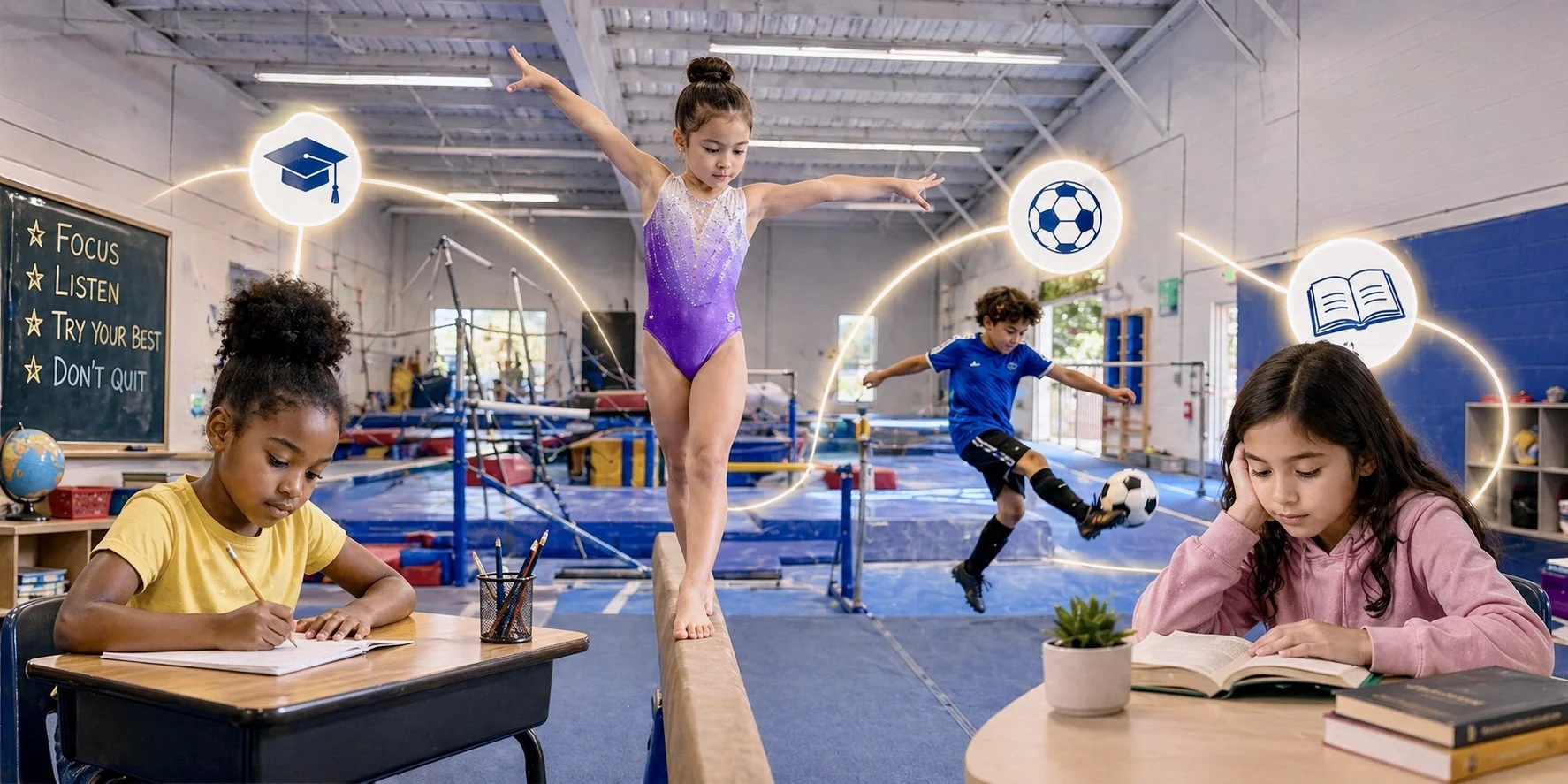
The same skills developed in gymnastics classes for kids show up in the classroom:
Sitting and listening
Following multi-step directions
Completing tasks
Staying engaged
Research consistently shows that physical activity improves cognitive function, attention, and behavior in children. Gymnastics takes it a step further by combining physical activity with structured learning.
10. Discipline That Lasts a Lifetime
The goal is not just better behavior in class.
The goal is long-term character development.
Gymnastics helps kids become:
More responsible
More focused
More resilient
More disciplined
These are life skills, not just sports skills.
What Research Says About Discipline, Focus, and Physical Activity in Kids
Research supports what many parents already see firsthand. Studies published by organizations like the Centers for Disease Control and Prevention and the American Academy of Pediatrics show that regular physical activity is directly linked to improved attention, better classroom behavior, and stronger executive functioning in children. Executive functioning includes skills like self-control, working memory, and the ability to follow multi-step directions. When physical activity is paired with structured environments, like in gymnastics classes where kids must listen, wait, repeat, and progress through skills, the impact becomes even stronger. In other words, it is not just that kids are moving; it is how they are learning to move within a structured framework that builds discipline and focus that carry into school and everyday life.
Gymnastics is the foundation for all sports. Start with gymnastics, go anywhere!
Why Families Choose North County Gymnastics & The Gyminny Kids
At North County Gymnastics & The Gyminny Kids, discipline is built into everything we do.
Structured classes with clear progressions
Career coaches trained through Gyminny Kids Academy & USA Gymnastics
Unlimited makeups for busy families
We have helped over 100,000 families build confident, disciplined kids, all while promoting fun and fitness!
Quick Links
• Register for a free trial class today→]
• Adaptive gymnastics classes at Gyminny Kids→]
• Learn more about GK's no registration or annual fees pricing model→]
• Competitive gymnastics training→]
• Gymnastics mindset training→]
• Why Families Choose Gyminny Kids→]
Proudly Serving Families In:
• 4S Ranch
• Poway
• Carlsbad
• La Costa
By Daniel Gundert
Owner of North County Gymnastics & The Gyminny Kids, former gymnast, lifelong coach, national gymnastics judge, best-selling Author, and father of five competitive gymnasts.
Category:
Parent Resources
FAQs
Does gymnastics teach discipline to young children?
Yes. Gymnastics teaches discipline through structured classes, repetition, listening, and clear expectations. Kids learn to follow directions, wait their turn, and stay focused.
At what age can kids start learning discipline through gymnastics?
Children can start as early as 9 months old in parent-and-me classes. Even at a young age, they begin learning structure, routines, and listening skills.
How do gymnastics classes help with behavior at school?
Gymnastics improves listening, focus, and impulse control. These skills directly translate to better classroom behavior and academic performance.
Are recreational gymnastics classes effective for discipline?
Yes. Recreational gymnastics classes are one of the best environments for building discipline because they combine fun with structure and consistent expectations.
Is gymnastics good for boys and girls?
Absolutely. Both boys and girls benefit from the discipline, strength, and confidence that gymnastics builds.