
How Gymnastics Class Builds Lasting Friendships, The Social Side Parents Don't Expect
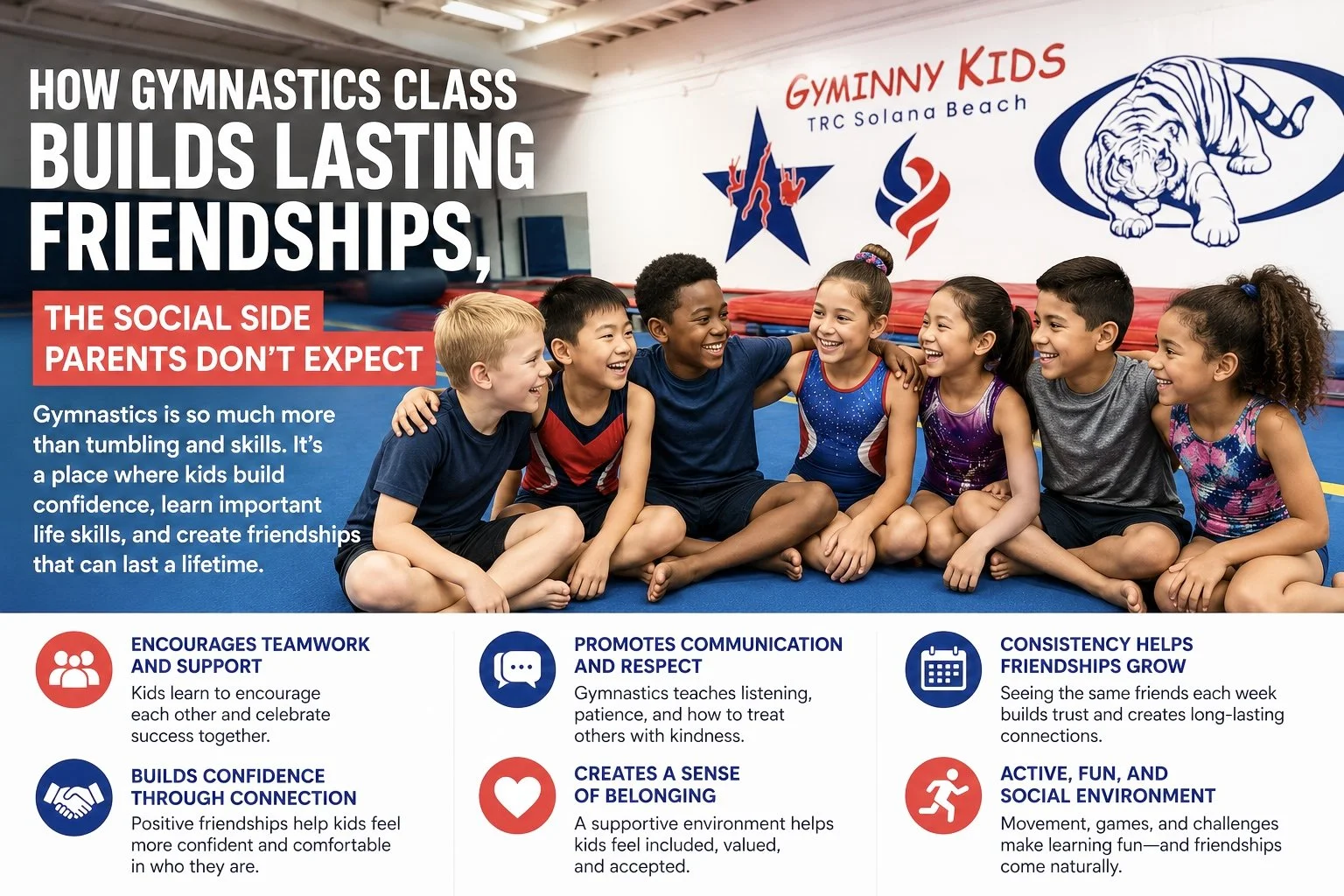
Parents usually enroll their child in a kids' gymnastics class because they want them to become stronger, more coordinated, more confident, or simply more active. Those benefits are real. But one of the most overlooked advantages of gymnastics is something many families do not expect at first:
The friendships.
At North County Gymnastics & The Gyminny Kids, we have watched countless friendships begin in the gym and continue for years beyond it. Some of our athletes who started together as toddlers are now teenagers competing side by side on team. Others became best friends during recreational gymnastics classes and still meet up outside the gym years later.
Many kids attend gymnastics together that start at school. School friends share thier love of gymnastics and make it a group activity. What's better than doing gymnastics alone? Doing it with your best friends and schoolmates!
As a parent of five competitive gymnasts, I have personally seen how gymnastics builds social confidence, teaches kids to interact with peers, and provides a healthy environment for building meaningful relationships.
And honestly, many parents are surprised by how important that social side becomes.
Do Kids Make Friends In Gymnastics Class?
Absolutely.
Gymnastics naturally encourages interaction, teamwork, encouragement, and shared experiences. Even though gymnastics is technically considered an individual sport during competition, training is incredibly social and adds the team component.
Children rotate stations together, stretch together, cheer each other on, wait in line together, laugh together, and overcome challenges together. Eventually, if they join the competitive teams, they will compete together.
That repeated interaction creates a connection.
Research published through the University of Minnesota Experts Database found that friendship quality in youth sports is strongly associated with motivation, enjoyment, and positive athletic experiences among children and adolescents. Children who develop strong peer relationships in sports are more likely to continue participating and develop confidence through athletics.
For younger children, especially, gymnastics classes for kids often become one of their first opportunities to build friendships outside of school or daycare.
According to the Harvard Center on the Developing Child, positive peer relationships during childhood play a major role in emotional development, resilience, communication skills, and long-term confidence. Activities that combine physical movement with social interaction help children feel more emotionally connected and secure.
Gymnastics naturally supports all of those areas.
Why Gymnastics Creates Strong Friendships
Kids Experience Challenges Together
One reason gymnastics friendships become so strong is that children experience growth and challenges together.
Maybe one child is nervous about doing a cartwheel independently for the first time.
Another is working on a forward roll.
Another is scared to jump into the foam pit.
When kids encourage each other through those moments, trust forms naturally.
There is something powerful about learning difficult skills alongside peers who understand the same fears and excitement.
We see this constantly inside our kids gymnastics classes.
Children celebrate each other's successes. They clap when a teammate gets a new skill. They comfort friends after a rough day. They build empathy without even realizing it.
Research published through Frontiers for Young Minds found that friendships and peer acceptance strongly influence how children experience youth sports. Researchers noted that positive peer relationships significantly improve motivation, enjoyment, confidence, and long-term participation in athletics.
Gymnastics Helps Shy Kids Come Out Of Their Shell
Some children walk into the gym naturally social and outgoing.
Others take time.
One of the beautiful things about gymnastics is that it provides structured interaction, which often feels safer and easier for shy children than completely unstructured environments.
Instead of awkwardly trying to figure out how to socialize, children are participating together in activities with a shared focus.
That structure lowers pressure.
Over time, many quiet children begin to open up.
As coaches, we often watch this transformation happen right in front of us. A child who barely spoke during their first month eventually starts laughing with classmates, helping newer students, and confidently participating in group activities.
Parents frequently tell us:
"My child has become so much more social since starting gymnastics."
And it makes sense.
The gym becomes a place where children feel successful, accepted, and connected.
Recreational Gymnastics Classes Often Create The Most Natural Friendships
Competitive team gymnastics absolutely creates strong bonds. Some teammates become like family.
But many parents are surprised to learn that recreational gymnastics classes often create incredibly strong friendships, too.
Why?
Recreational programs tend to feel relaxed, fun, and socially engaging.
Children interact with different classmates each week. They participate in games, obstacle courses, relay races, warmups, and partner activities.
The environment encourages communication naturally.
At Gyminny Kids, our classes are intentionally designed to combine skill development with fun and interaction because children learn best when they feel emotionally comfortable and socially connected.
That positive environment helps friendships grow organically.
Shared Physical Activity Helps Kids Bond Faster
Research from the American Academy of Pediatrics notes that organized sports help children develop not only physical skills, but also emotional health, social skills, self-regulation, and long-term life skills.
Movement-based activities often help children connect more quickly than in purely academic settings.
Why?
Because active play reduces stress and creates shared excitement.
Kids laugh together.
They move together.
They solve problems together.
They encourage each other.
In gymnastics, children are constantly interacting in ways that strengthen social connections without forcing it.
That is one reason many children begin looking forward to gymnastics, not only because of the sport itself, but also because they get to see their friends.
Friendship Through Consistency
Another reason gymnastics friendships often last is consistency.
Most children attend weekly classes with the same group of peers for long periods.
That repeated exposure matters.
According to developmental psychology research, consistent interaction is one of the strongest predictors of friendship formation in children.
Gymnastics provides exactly that.
In many activities, children rotate frequently or interact only briefly. But in kids gymnastics classes, children often see the same classmates every week for months or years.
Those repeated positive experiences build familiarity and trust.
Over time, the gym starts to feel like a second home.
Gymnastics Teaches Important Social Skills
Friendship building is not only about making friends. It is also about learning how to be a good friend.
Gymnastics helps teach important social skills like:
Taking turns
Patience
Encouraging others
Respecting boundaries
Handling wins and losses
Communicating appropriately
Supporting teammates
Working through frustration positively
A study published in the Journal of Sport for Development found that youth sports programs can improve teamwork, social competence, self-control, effort, and emotional regulation through positive peer interaction.
These lessons happen constantly inside gymnastics classes.
As coaches, we spend a tremendous amount of time helping children navigate social situations in healthy ways.
That is especially important today when many children spend more time on screens and less time engaging in face-to-face social interaction.
Gymnastics creates real-world social learning.
Parent Review Spotlight
One parent recently wrote on Google:
"My daughter started gymnastics for exercise, but what surprised us most was how many friendships she built. She now talks about her gymnastics friends nonstop and looks forward to class every week."
Another parent shared on Yelp:
"The coaches create such a positive atmosphere. My son was nervous and shy at first, but now he has friends at the gym and feels so much more confident socially."
A Facebook parent review shared:
"The community aspect has been incredible. My child feels like she belongs here, and she has made friendships that extend far beyond class."
Gymnastics Friendships Often Extend Beyond The Gym
One thing we have noticed over the years is that gymnastics friendships often extend far beyond class itself.
Playdates.
School friendships.
Travel meets.
Team bonding events.
The gym becomes a social hub for many families.
For parents, this often creates friendships too.
Some of our closest family friendships today began when our children trained in gymnastics together, which led to a sense of belonging and community. Not only did our children meet friends at gymnastics, but we also met other parents on the team, and they became our friends. There's something special about the bond that gymnastics families have, especially considering gymnastics is often considered one of the hardest sports in the world. As parents, we get to support each other and watch our kids fly on the gym floor from our seats in the bleachers. That is something extra special that words can not fully capture.
Why The Coaching Environment Matters
Not every gym environment creates strong social development.
The coaching culture matters tremendously.
Programs that create fear, excessive pressure, negativity, or unhealthy comparison can hurt confidence and social interaction.
A quality gymnastics program should create an environment where children feel:
Encouraged
Included
Supported
Challenged appropriately
Respected
That atmosphere allows friendships to develop naturally.
At Gyminny Kids, we place a huge emphasis on positivity, encouragement, teamwork, and emotional safety alongside skill progression.
Children thrive socially when they feel emotionally secure.
Gymnastics Gives Kids A Sense Of Belonging
This may be the most important part of all.
Many children today struggle with confidence, anxiety, loneliness, or feeling disconnected.
Gymnastics gives children a place to belong.
A place where they are recognized.
A place where they are encouraged.
A place where they can improve, laugh, interact, and grow together.
The Harvard Center on the Developing Child emphasizes that supportive relationship environments are one of the strongest contributors to emotional resilience, confidence, and healthy childhood development.
For many kids, gymnastics becomes much more than a sport.
It becomes part of their identity and community.
And often, the friendships they build along the way become one of the most meaningful parts of the experience.
Why Families Choose Gyminny Kids
At North County Gymnastics & The Gyminny Kids, we have spent decades building programs designed to help children grow physically, emotionally, and socially.
Families appreciate that we offer:
Positive and encouraging environments
Recreational through elite-level programs
Unlimited makeup classes
Age-appropriate class structures
Open gyms, camps, and special events that encourage social interaction
Programs for toddlers through competitive athletes
Most importantly, we work hard to create an environment where children genuinely enjoy being at the gym.
Because when kids feel connected, supported, and excited to attend class, everything else improves, too.
Gymnastics is the foundation for all sports. Start with gymnastics, go anywhere!
Proudly Serving Families In:
• 4S Ranch
• Poway
• Carlsbad
• La Costa
Quick Links
• Register for a free trial class today→]
• Adaptive gymnastics classes at Gyminny Kids→]
• Learn more about GK's no registration or annual fees pricing model→]
• Competitive gymnastics training→]
• Gymnastics mindset training→]
• Why Families Choose Gyminny Kids→]
By Daniel Gundert: Owner of North County Gymnastics & The Gyminny Kids, former gymnast, lifelong coach, national gymnastics judge, best-selling author, and father of five competitive gymnasts.
Frequently Asked Questions
Do kids make friends in gymnastics classes?
Yes. Gymnastics classes naturally encourage interaction, teamwork, and shared experiences, helping children build friendships over time.
Is gymnastics good for shy children?
Gymnastics can be excellent for shy children because it provides structured social interaction in a supportive environment. Many children become more confident socially after participating consistently.
Are recreational gymnastics classes social?
Very much so. Recreational gymnastics classes often include games, partner activities, obstacle courses, and group stations that encourage communication and friendship building.
At what age do children begin making friends in gymnastics?
Even toddlers and preschoolers begin developing early social skills and familiarity with peers in gymnastics classes. As children get older, those relationships often become stronger and more meaningful.
Can gymnastics help improve social confidence?
Yes. Gymnastics helps children practice communication, teamwork, patience, listening skills, emotional regulation, and peer encouragement, all of which support stronger social confidence.