
How Gymnastics Improves Posture in Children: Why It Matters More Than Parents Realize
How Gymnastics Improves Posture in Children: Why It Matters More Than Parents Realize
If you've ever watched a gymnast walk across a room, you may notice something different about the way they carry themselves. Their shoulders are often back, their head is upright, and they move with confidence and control.
Parents frequently ask us:
"Does gymnastics improve posture?"
The short answer is yes.
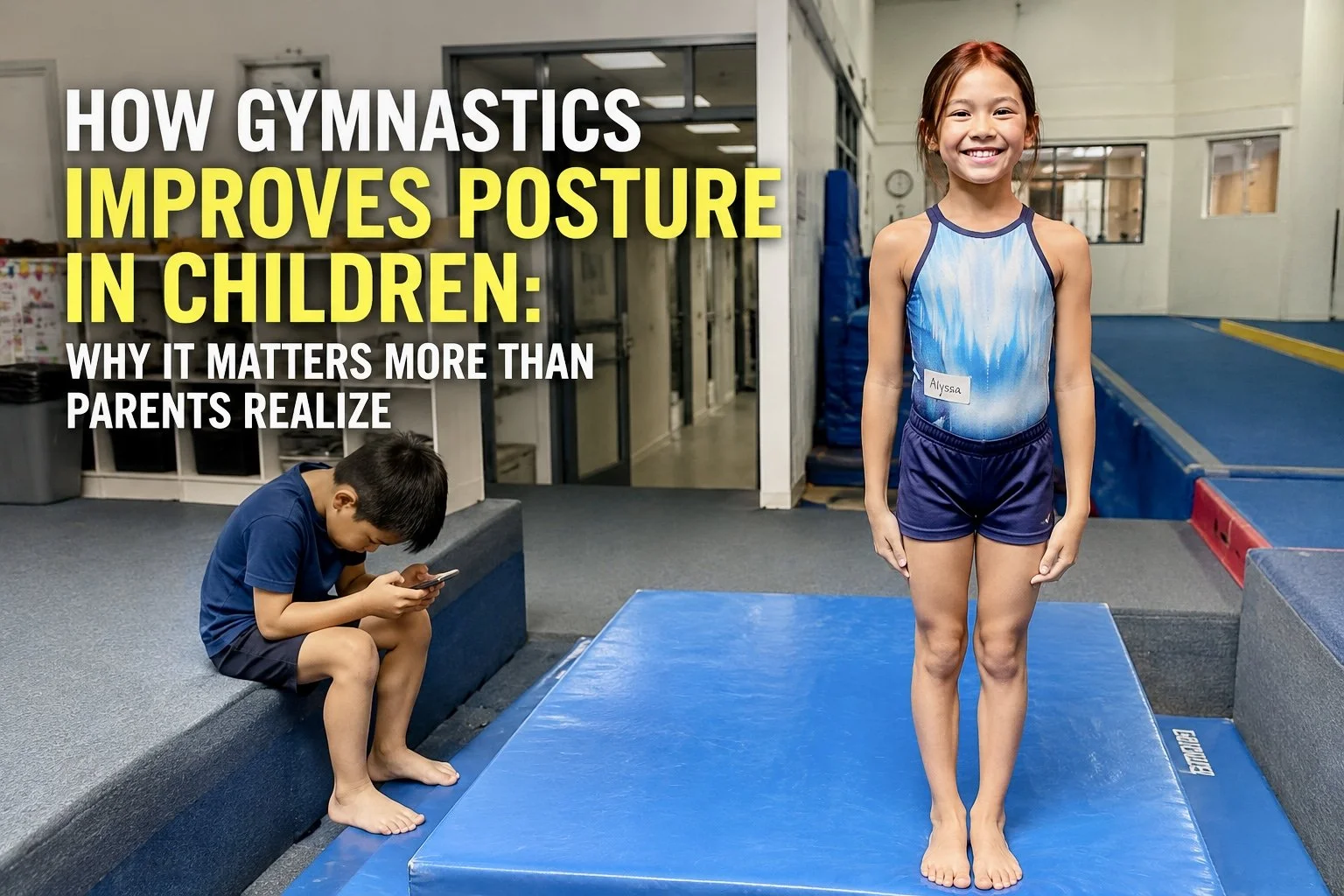
While gymnastics is known for developing strength, flexibility, coordination, and confidence, one of its lesser-known benefits is its ability to influence a child's posture positively. In a world where children spend increasing amounts of time sitting in classrooms, looking down at tablets, and using smartphones, posture has become more important than ever.
At The Gyminny Kids, we've worked with more than 100,000 children since 1987. One thing we've consistently observed is that children who participate in gymnastics classes often develop greater body awareness, stronger core muscles, and better overall posture than their peers.
Let's take a closer look at why.
Why Good Posture Matters for Children
Posture is simply the way the body holds itself while standing, sitting, walking, or moving.
Good posture allows the muscles, joints, and spine to work efficiently. Poor posture places unnecessary stress on the body and can lead to discomfort, fatigue, injury, and movement limitations over time.
For children, proper posture can influence:
Balance and coordination
Athletic performance
Confidence and self-image
Breathing efficiency
Muscular development
Injury prevention
Many parents are surprised to learn that posture habits begin developing at a very young age. The movement patterns children practice every day often become the foundation for how they carry themselves later in life.
Modern Childhood Is Working Against Posture
Today's children face challenges that previous generations did not.
Research shows that children spend significant time sitting. School, homework, television, video games, tablets, and smartphones all contribute to prolonged periods of inactivity.
Common posture issues seen in children include:
Rounded shoulders
Forward head position
Slouched sitting
Weak core muscles
Poor body awareness
Tight shoulder and neck muscles
These habits can become ingrained if children are not regularly participating in activities that encourage proper movement patterns.
This is one reason many parents seek out gymnastics classes for their kids to promote healthy physical development.
How Gymnastics Naturally Improves Posture
Unlike many sports that emphasize only specific movements, gymnastics develops the entire body.
Nearly every gymnastics skill requires children to maintain proper body alignment as they move through space.
Whether a child is learning a forward roll, balancing on a beam, swinging on bars, or jumping on a trampoline, they are constantly being taught body positions that reinforce good posture.
Here are several ways gymnastics helps.
1. Gymnastics Strengthens the Core
The core serves as the body's foundation.
When people hear "core," they often think only about abdominal muscles. In reality, the core includes muscles throughout the abdomen, lower back, hips, and pelvis.
Strong core muscles help support the spine and maintain proper alignment.
Gymnastics activities regularly challenge these muscles through:
Hollow body holds
Planks
Handstands
Hanging exercises help spinal alignment through traction, using gravity to elongate, allowing increased blood flow and nutrient exchange in the vertebral column
Tumbling drills
Over time, stronger core muscles help children maintain better posture naturally throughout the day.
2. Gymnastics Develops Body Awareness
One of the greatest benefits of gymnastics is improved proprioception, also known as body awareness.
Gymnasts learn exactly where their bodies are in space.
They learn to recognize:
Shoulder position
Head position
Hip alignment
Foot placement
Spinal alignment
Many children with poor posture aren't aware they're slouching.
Gymnastics helps develop the awareness needed to self-correct posture without constant reminders from parents or teachers.
3. Gymnastics Strengthens Postural Muscles
Good posture requires more than strong abs.
The muscles of the upper back, shoulders, neck, and lower back all play important roles.
Gymnastics exercises frequently strengthen:
Rhomboids
Trapezius muscles
Erector spinae
Glutes
Shoulder stabilizers
These muscles help counteract the forward-rounded positions commonly seen from excessive screen time.
As these muscles become stronger, maintaining proper posture becomes easier.
4. Gymnastics Improves Flexibility
Tight muscles often contribute to poor posture.
For example:
Tight chest muscles may pull the shoulders forward.
Tight hip flexors may contribute to lower back issues.
Tight hamstrings may affect pelvic positioning.
Tight shoulders may pull the chest and head forward.
Flexibility training is a regular part of most kids' gymnastics and ninja classes.
Consistent stretching helps maintain healthy movement patterns, improves alignment, and increases range of motion, which also helps with injury prevention.
5. Coaches Reinforce Proper Alignment
One advantage of structured gymnastics and ninja classes is the constant coaching feedback.
Gymnastics coaches routinely provide cues such as:
Stand tall
Lift your chest
Tighten your core
Keep your head neutral
Squeeze your glutes
Over time, these corrections become habits.
Children begin applying the same body positions outside the gym at school, during sports, and throughout daily life.
Posture and Confidence Are Connected
Posture isn't only physical.
Research has shown that posture can influence confidence, mood, and self-perception.
Children who stand taller and move confidently often project greater self-assurance.
One reason gymnastics is so effective is that it combines physical development with confidence-building experiences.
When a child masters a cartwheel, learns a back walkover, or conquers a challenging obstacle, they begin to believe in themselves.
That confidence often shows up in how they carry themselves both physically and emotionally.
What Age Is Best to Start?
Parents often ask whether there is an ideal age to begin.
The good news is that children can benefit from gymnastics at virtually any age.
Preschool gymnastics classes help develop foundational movement patterns early.
School-age children can build strength, coordination, and body awareness.
Teenagers can still improve their posture, flexibility, and physical conditioning.
The earlier healthy movement habits are established, the easier they are to maintain throughout life.
Recreational Gymnastics Classes Are Enough
Parents sometimes assume children must become competitive gymnasts to see these benefits.
That's simply not true.
Most posture-related benefits come from participation in recreational gymnastics classes.
Even one class per week can help children:
Develop stronger muscles
Improve flexibility
Increase body awareness
Learn proper movement mechanics
Build confidence
The goal isn't creating elite athletes.
The goal is to help children build healthy bodies that will serve them for years to come.
What Parents May Notice at Home
After several months in gymnastics classes, parents frequently report seeing improvements such as:
Standing taller
Less slouching
Better balance
Improved coordination
Increased confidence
Greater overall athleticism
While every child develops differently, these changes are common outcomes of consistent participation.
The Long-Term Benefits Extend Beyond Childhood
Perhaps the greatest benefit of gymnastics is that it teaches movement skills children can carry into adulthood.
Strong posture, body awareness, flexibility, and core strength remain valuable throughout life.
The habits children develop today may influence how they move, exercise, and care for their bodies decades from now.
That's one reason gymnastics remains one of the most comprehensive youth activities available.
Final Thoughts
So, does gymnastics improve posture?
In most cases, absolutely.
Through core strengthening, flexibility training, body awareness development, and consistent reinforcement of proper movement patterns, gymnastics creates an environment where healthy posture can thrive.
While posture is only one of many benefits, it's often one that parents notice quickly and appreciate for years to come.
Whether your child is a preschool beginner or an experienced athlete, gymnastics provides valuable opportunities to develop strength, confidence, coordination, and lifelong healthy movement habits.
By Daniel Gundert: Owner of North County Gymnastics & The Gyminny Kids, former gymnast, lifelong coach, national gymnastics judge, best-selling author, and father of five competitive gymnasts.
Quick Links
Proudly Serving Families In:
• 4S Ranch
• Poway
• Carlsbad
• La Costa
Frequently Asked Questions
Can gymnastics correct poor posture?
Gymnastics is not a medical treatment, but it can help improve posture by strengthening muscles, improving flexibility, and increasing body awareness.
How long does it take to see posture improvements?
Many parents report noticing improvements within a few months of consistent participation, although results vary by child.
Are recreational gymnastics classes enough to improve posture?
Yes. Recreational gymnastics classes provide many of the same foundational benefits that support better posture.
Does gymnastics strengthen the core?
Absolutely. Core development is a major component of gymnastics training and plays a significant role in posture improvement.
At what age should my child start gymnastics?
Children can begin gymnastics as young as walking age through parent participation programs, with structured preschool classes commonly starting around age 3.
Sources
American Academy of Pediatrics (AAP)
National Institutes of Health (NIH)
Centers for Disease Control and Prevention (CDC)
International Journal of Environmental Research and Public Health
Journal of Physical Activity and Health