
How to Do a Proper Handstand: A Step-by-Step Guide for all ages and abilities
How to Do a Proper Handstand: A Step by Step Guide for Kids
The handstand is one of the most important skills in gymnastics.
It serves as the foundation for cartwheels, roundoffs, walkovers, handsprings, vaulting, bars, rings, beam, and countless advanced gymnastics skills. A great handstand teaches balance, body control, strength, flexibility, coordination, and spatial awareness.
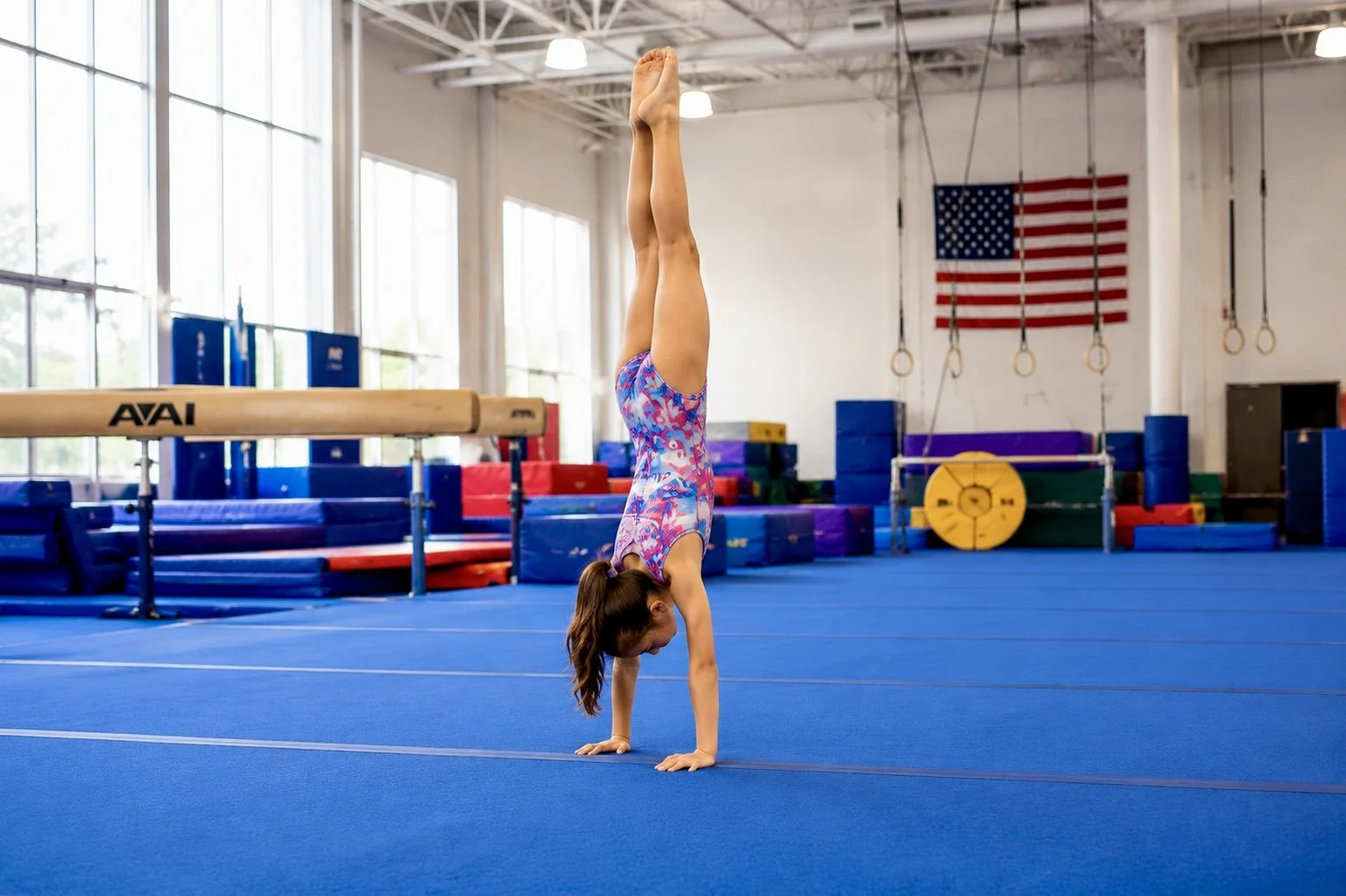
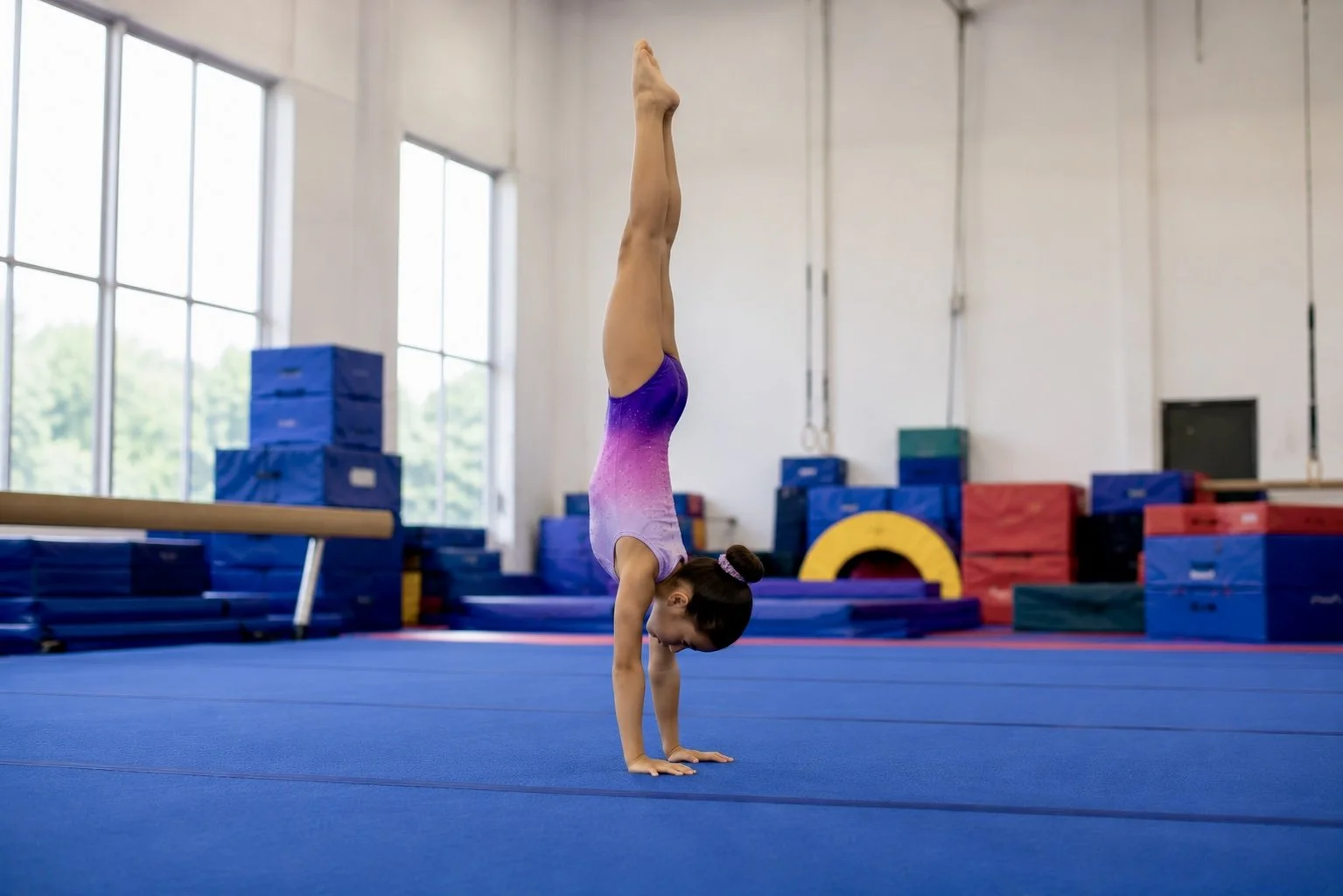
Many people think a handstand is all about strength. In reality, a handstand is mostly about alignment.
When every body part is stacked correctly, holding a handstand becomes surprisingly easy. When there are angles throughout the body, balance becomes much harder. Confidence-building gym camps for kids provide guided gymnastics training that helps children improve alignment, balance, and body control as they master skills like handstands.
Let's break down a proper gymnastics handstand from the ground up.
WHY THE HANDSTAND IS THE MOST IMPORTANT SKILL IN GYMNASTICS
If there is one skill that serves as the foundation for nearly every gymnastics event, it is the handstand.
In fact, the handstand is the only fundamental position that appears across every Olympic gymnastics apparatus.
For women, handstands are used on all four events:
Vault
Uneven Bars
Balance Beam
Floor Exercise
For men, handstands are used on all six events:
Floor Exercise
Pommel Horse
Still Rings
Vault
Parallel Bars
High Bar
Many parents immediately understand how handstands apply to floor exercise, bars, beam, and rings. They are often surprised to learn that handstands play a major role on pommel horse as well.
While pommel horse routines are famous for circles and scissor work, optional level gymnasts are required to perform dismounts that pass through a handstand position. At the highest levels of gymnastics, handstands become an essential part of nearly every apparatus.
That is why gymnastics coaches spend so much time teaching proper handstand technique. Learning a handstand is like pouring the foundation of a house. If the foundation is strong, everything built on top of it becomes easier.
Roundoffs, walkovers, cartwheels, handsprings, giant swings, casts, pirouettes, presses, and countless advanced gymnastics skills all depend on a gymnast's ability to understand and control a handstand position.
Every Olympic champion in artistic gymnastics, regardless of event specialty, has spent thousands of hours perfecting handstands. Whether they compete primarily on rings, beam, bars, pommel horse, or floor, a world-class handstand is one of the clearest indicators of strong gymnastics fundamentals.
The value of a handstand extends far beyond gymnastics.
Handstands are commonly used in:
CrossFit
Yoga
Cheerleading
Acrobatics
Parkour
Breakdancing
Diving
Martial arts
Calisthenics training
Ninja and parkour
Breakdancing
Even people who never plan to compete in gymnastics benefit from learning handstands because they develop shoulder strength, core control, balance, body awareness, flexibility, coordination, and confidence.
For young athletes, learning a handstand is one of the best investments they can make, as the skill carries over to so many sports and activities.
At North County Gymnastics & The Gyminny Kids, we often tell athletes that if they can master a handstand, they are building a foundation that will support almost every skill they learn in the future.
START WITH THE HANDS
Your hands create the foundation of the entire skill.
Place your hands approximately shoulder-width apart.
Turn the hands slightly outward rather than keeping them perfectly straight.
Spread your fingers wide apart, roughly 1 inch between each fingertip.
This wider base provides greater stability and creates more contact with the floor.
One of the biggest secrets of balancing a handstand is learning to use your fingers.
Think of your fingers as the brakes and steering wheel of the handstand.
If you begin tipping forward, press harder through your fingertips.
If you begin tipping backward, shift pressure toward the heel of your hand.
The more surface area your hands create on the floor, the easier balancing becomes.
LOCK YOUR ELBOWS
Once your hands are set, focus on your elbows.
Push through the floor and fully straighten your arms.
Gymnastics coaches often say, "lock your elbows" or "push through your arms."
Bent elbows create weakness and force your muscles to work harder.
Straight elbows allow your skeleton to support your body weight much more efficiently.
Imagine pushing the floor away from you.
Strong, straight arms create a solid pillar from your hands all the way through your shoulders.
OPEN YOUR SHOULDERS COMPLETELY
Shoulder flexibility is one of the most overlooked parts of a handstand.
Ideally, your arms should be fully extended overhead with your biceps next to your ears.
Many children and adults lack the flexibility to achieve this position.
When the shoulders cannot fully open, several compensations occur:
The head sticks forward
The lower back arches
The ribs flare outward
The hips pike
Instead of a straight line, the body starts to resemble a question mark.
A simple test is standing tall with your arms overhead.
Can you lift your arms completely overhead without arching your back or allowing your rib cage to stick out?
If not, shoulder flexibility should become a priority before spending hours practicing handstands.
SHOULDER FLEXIBILITY EXERCISES
Some of our favorite drills include:
Seal stretches
Cat stretch
Bridge rocks
Wall shoulder stretches
Elevated shoulder openers
Foam roller shoulder extensions
During bridge rocks, focus on gently pushing your shoulders forward while maintaining control.
Over time, increased shoulder flexibility allows the entire handstand line to improve dramatically.
THE PROPER HEAD POSITION
Head position influences the entire body.
The human head weighs approximately eight pounds.
That may not sound like much, but moving those eight pounds even a few inches changes your entire balance.
Try this experiment.
Stand naturally with your arms by your sides.
Now drop your chin completely toward your chest.
Notice how your hips shift backward.
Next, lift your head all the way up and look toward the ceiling.
Notice how your hips move forward.
The same principle applies in a handstand.
WHERE SHOULD YOU LOOK?
The ideal head position for a handstand is neutral, with a very slight upward angle so you can see your hands and the floor.
You should be looking at your hands just barely through your eyebrows.
If you can clearly see your entire hands, your head is probably too far out.
This often creates an arch in the lower back.
If your chin is tucked excessively, your hips may pike.
A neutral head position allows the spine to remain stacked and balanced.
PULL YOUR BELLY BUTTON TO YOUR SPINE
Core engagement is critical.
One simple cue we use with athletes is:
"Pull your belly button toward your spine."
This activates the deep abdominal muscles and helps eliminate excessive arching.
Rather than letting your ribs flare outward, think about keeping your rib cage connected and your stomach tight.
Your body should feel long, strong, and controlled.
PUSH TALL THROUGH YOUR SHOULDERS
One of the biggest differences between a beginner handstand and an advanced handstand is shoulder engagement.
Many athletes support themselves on straight arms.
Advanced gymnasts actively push through their shoulders.
Think about shrugging your shoulders toward your ears while simultaneously pushing the floor away.
Coaches often call this "pushing tall."
This creates a longer line, improves balance, protects the shoulder joints, and helps transfer force efficiently through the body.
When watching elite gymnasts, you will notice they never hang in their shoulders. They actively press tall throughout the entire handstand.
SQUEEZE EVERYTHING BELOW THE WAIST
Many gymnasts focus so much on their upper body that they forget about their legs.
A proper handstand requires total body tension.
Think about:
Squeezing your thighs
Tightening the muscles above your knees
Pressing your knees straight
Bringing your ankle bones together
Keeping your big toes touching
Pointing your toes as hard as possible
Every body part should contribute to the straight line.
Loose legs create instability.
Tight legs create control.
STRETCH UP LIKE A SPAGHETTI NOODLE
One of my favorite handstand cues is imagining a spaghetti noodle.
When a boiled spaghetti noodle lies on a table, it naturally curves and bends.
But if you lifted the noodle from the top like a string, it would become perfectly straight.
That is exactly how a handstand should feel.
Imagine a string attached to your toes pulling you upward toward the ceiling.
Stretch through your shoulders.
Stretch through your hips.
Stretch through your knees.
Stretch through your toes.
The sensation should almost feel like traction running through your entire body.
The more you stretch upward, the straighter and more balanced the handstand becomes.
WHY STRAIGHT HANDSTANDS BALANCE BETTER
Many beginners believe balancing comes from constantly moving.
The reality is the opposite.
The straighter your body becomes, the less correction is required.
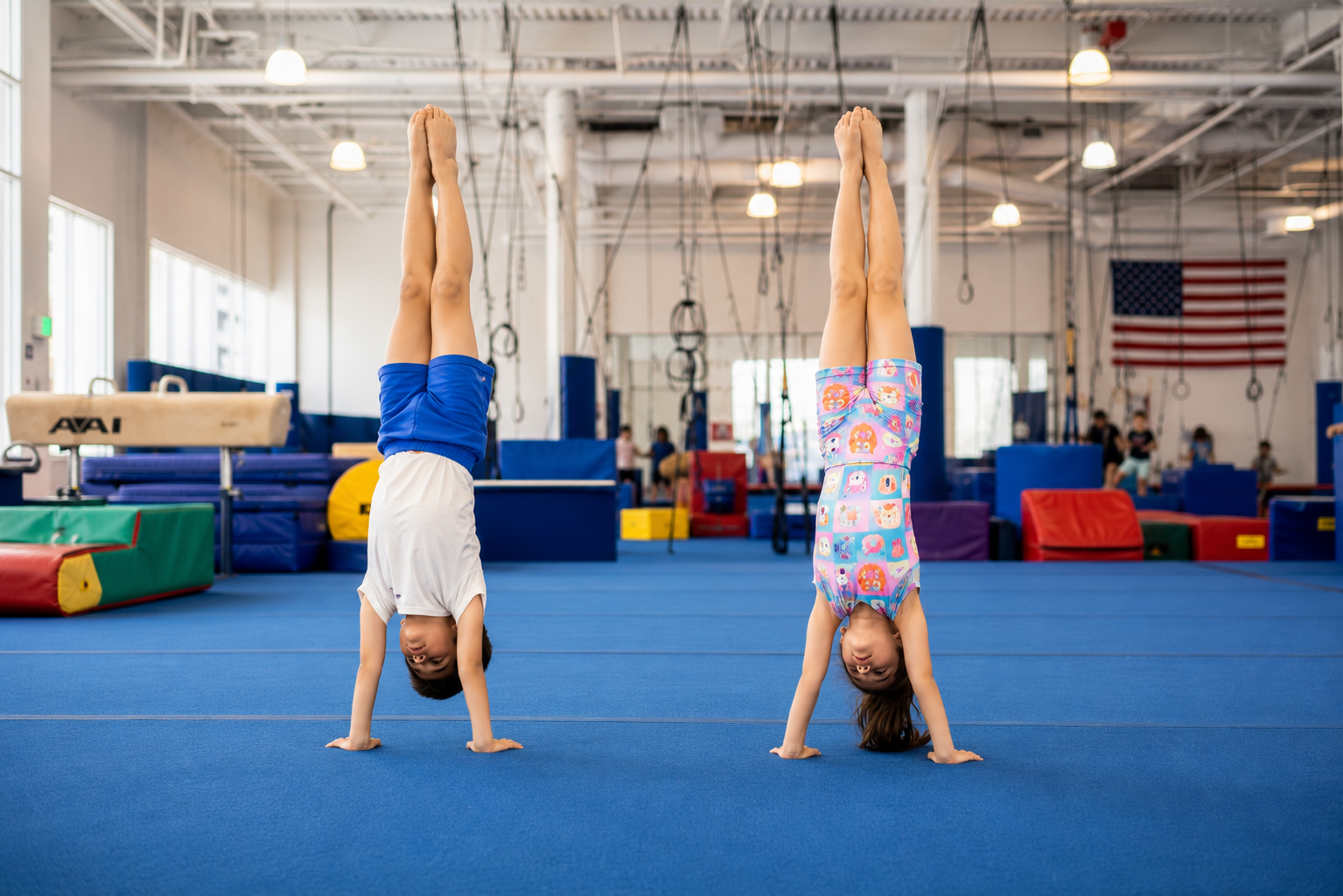
A straight handstand allows your hands, wrists, elbows, shoulders, hips, knees, ankles, and toes to stack directly on top of each other.
When these body parts align vertically, balance becomes significantly easier.
This is why elite gymnasts can hold handstands seemingly motionless.
WRIST PREPARATION MATTERS
Because your wrists support your entire body weight during a handstand, they must be prepared gradually.
Before handstand training, spend a few minutes warming up your wrists with:
Wrist circles
Palm rocks
Finger pulses
Gentle stretching
Young athletes should build handstand volume progressively rather than spending long periods upside down immediately.
Healthy wrists make handstand training more enjoyable and more sustainable.
HANDSTAND PROGRESSIONS FOR BEGINNERS
At Gyminny Kids, we teach handstands through a series of progressions.
Children do not simply kick upside down and hope for the best.
We build strength, flexibility, and body awareness first.
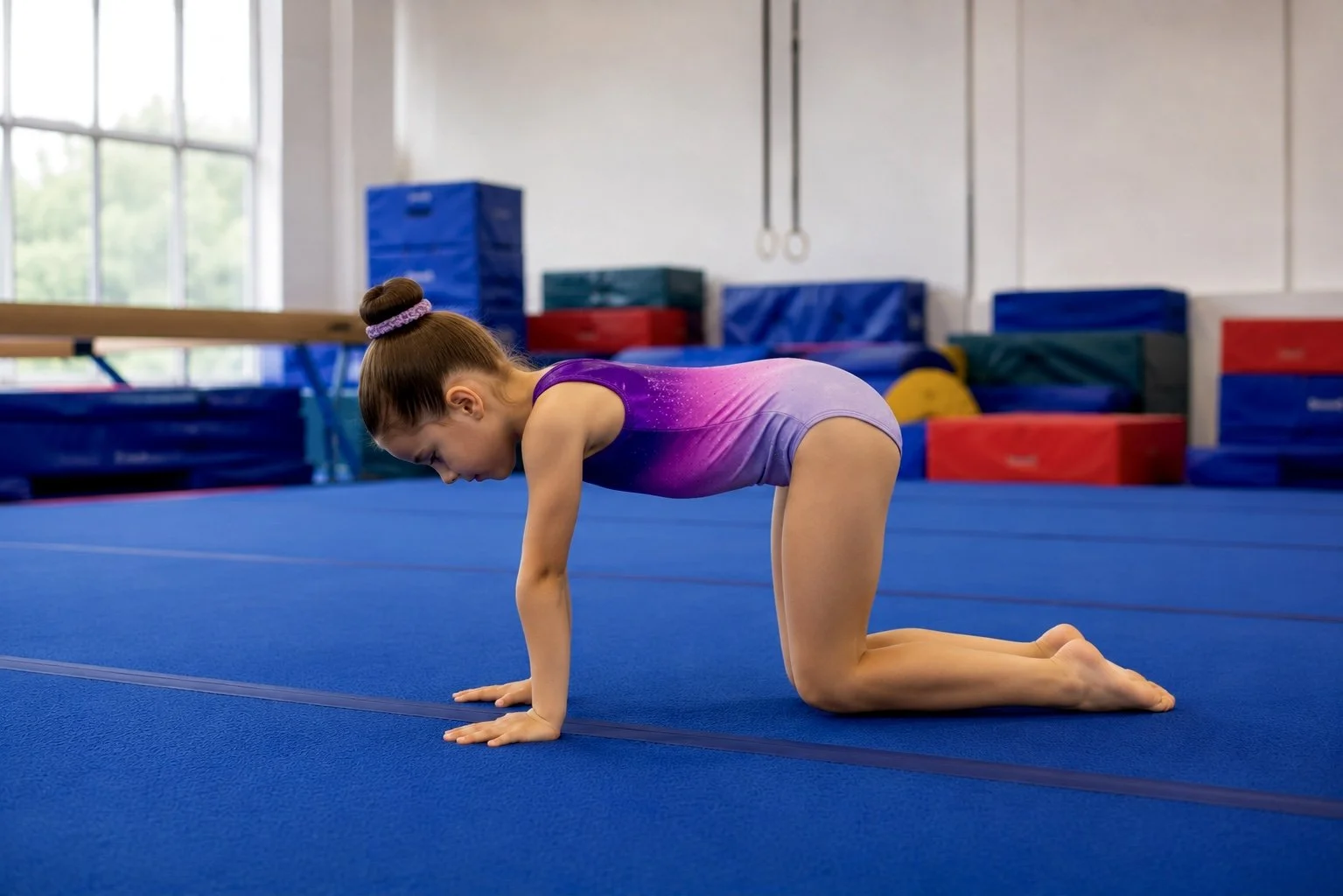
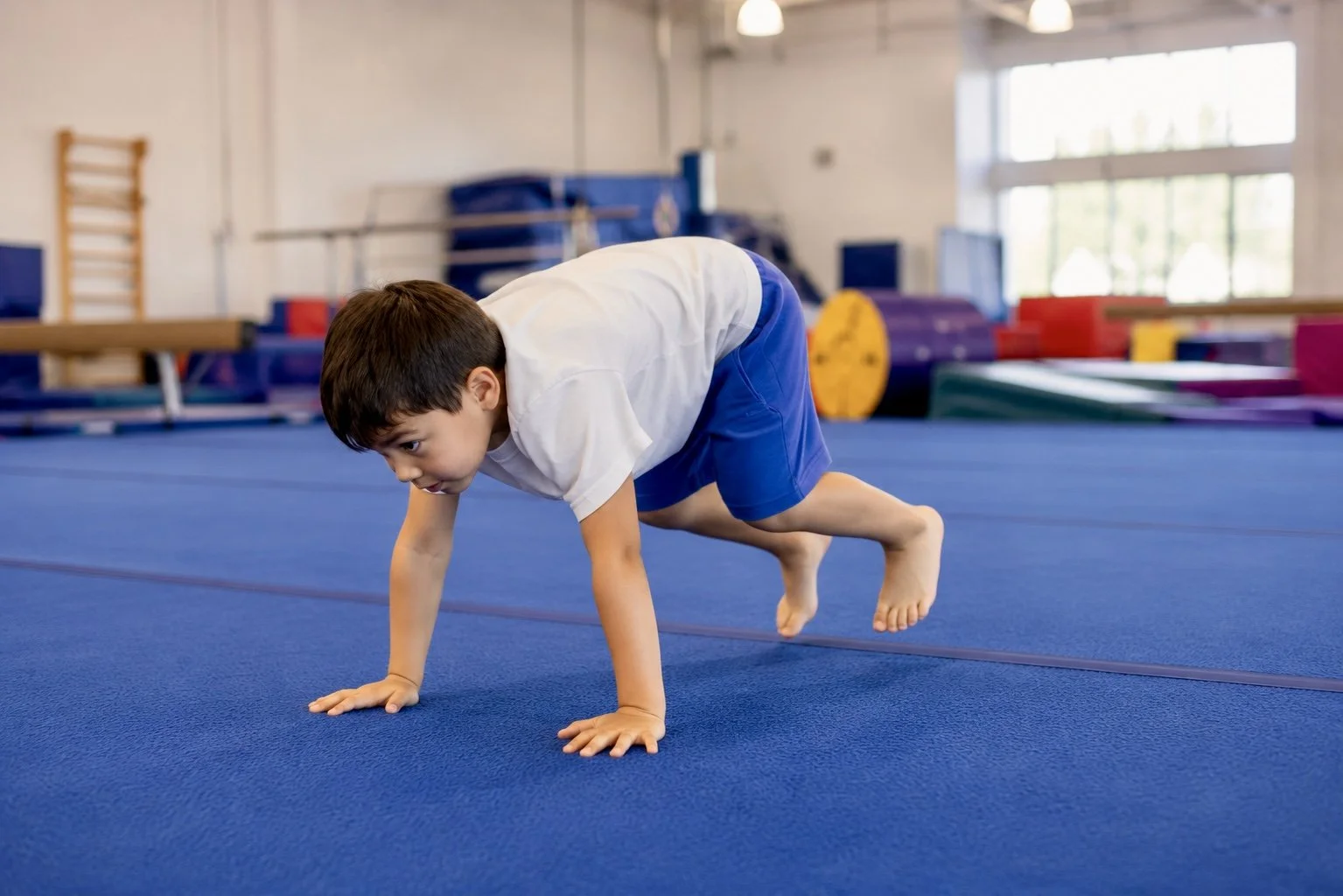
BEAR WALKS
Bear walks teach weight shifting through the shoulders.
They also strengthen the wrists and core.
CRAB WALKS
Crab walks improve shoulder stability and coordination.
DONKEY KICKS
Donkey kicks introduce explosive weight transfer onto the hands.
They are one of the best beginner handstand drills.
HEADSTANDS
Headstands teach inversion and body awareness while building confidence upside down.
LUNGE HANDSTAND KICKS
Start in a lunge.
Kick only a few inches off the ground.
Return to the same lunge.
Repeat while gradually increasing height and control.
This teaches proper entry mechanics without fear.
THE SPIDER WALK DRILL
One of the most effective handstand drills is the spider walk.
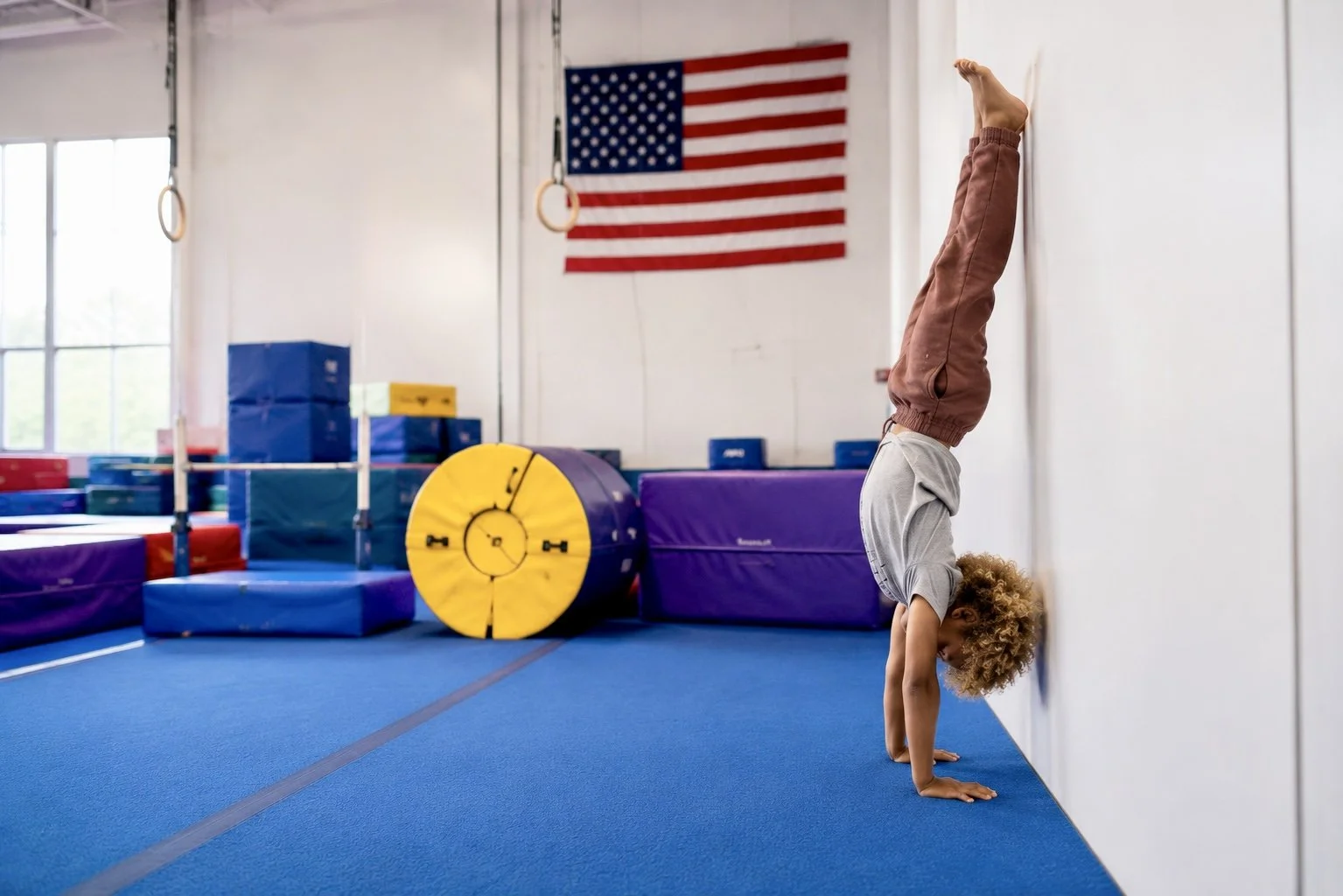
Face the wall.
Walk your feet up the wall while your hands stay on the floor.
Continue until your nose is close to the wall.
In this position:
Hands are shoulder-width apart
Head looks at the hands
Chest touches the wall
Hips touch the wall
Toes touch the wall
Then focus on stretching upward through your toes.
This drill teaches the exact body position needed for a straight handstand.
Many gymnastics coaches consider this one of the best handstand drills available.
COMMON HANDSTAND MISTAKES
LOOKING TOO FAR FORWARD
This causes the lower back to arch.
BENT ARMS
Bent elbows reduce stability and strength.
LOOSE LEGS
Leg separation creates balance problems.
CLOSED SHOULDERS
Poor shoulder flexibility causes multiple alignment issues.
LACK OF CORE ENGAGEMENT
An arched lower back often starts with a relaxed core.
NOT PUSHING TALL
Athletes who relax into their shoulders often struggle to find a strong, balanced position.
WHY HANDSTANDS MATTER BEYOND GYMNASTICS
Handstands teach much more than a gymnastics skill.
They improve:
Shoulder strength
Core strength
Balance
Body awareness
Coordination
Confidence
Focus
Discipline
Many of the physical literacy skills developed through handstands transfer directly to other sports and activities.
That is one reason handstands remain a cornerstone of quality gymnastics instruction.
FINAL THOUGHTS
Learning a handstand is not about muscling your way upside down.
It is about creating one long, straight line from your fingertips to your toes.
Start with proper hand placement.
Lock your elbows.
Open your shoulders.
Keep a neutral head position with the chin slightly tilted up.
Engage your core.
Push tall through your shoulders.
Squeeze your legs.
Stretch tall.
Master those fundamentals and your handstand will become stronger, straighter, and easier to balance.
Like most gymnastics skills, consistency beats intensity.
A few minutes of quality handstand practice each day often produces better results than long sessions with poor technique.
At Gyminny Kids, handstands are one of the first building blocks we teach because they create the foundation for nearly every skill that follows.
One final note. If you cannot do at least 10 push-ups with proper form, you are not strong enough to hold your body up in a handstand, so please start with some foundational strength to prevent injury. Progressive ninja classes for kids can help children build the strength, coordination, and body control needed to develop new movement skills safely.
Start with gymnastics. Go anywhere!
By Daniel Gundert, Owner of North County Gymnastics & The Gyminny Kids, former gymnast, lifelong coach, national gymnastics judge, best-selling author, and father of five competitive gymnasts.
QUICK LINKS
• Register for a free trial class today→]
• Adaptive gymnastics classes at Gyminny Kids→]
• Learn more about GK's no registration or annual fees pricing model→]
• Competitive gymnastics training→]
• Gymnastics mindset training→]
• Why Families Choose Gyminny Kids→]
PROUDLY SERVING FAMILIES IN:
• 4S Ranch
• Poway
• Carlsbad
• La Costa
FREQUENTLY ASKED QUESTIONS
HOW LONG DOES IT TAKE A CHILD TO LEARN A HANDSTAND?
Most children can learn the basics of a handstand within a few weeks of consistent practice. Achieving a straight, balanced handstand often takes several months.
WHAT AGE SHOULD KIDS START LEARNING HANDSTANDS?
Many children begin learning handstand progressions as early as preschool age in structured gymnastics classes.
ARE HANDSTANDS SAFE FOR KIDS?
When taught with proper progressions and qualified coaching, handstands are considered a fundamental and safe gymnastics skill.
WHY CAN'T MY CHILD HOLD A HANDSTAND?
The most common reasons are insufficient shoulder flexibility, lack of core strength, poor body alignment, or simply needing more practice upside down.
ARE WALL HANDSTANDS HELPFUL?
Yes. Wall handstands help athletes learn correct body alignment and build the strength needed for freestanding handstands.
WHAT'S MORE IMPORTANT, STRENGTH OR BALANCE?
Both matter, but body alignment is often the biggest factor in achieving a successful handstand.