
When Is My Child Ready to Move Up to the Next Recreational Gymnastics, Tumbling, or Ninja Level?
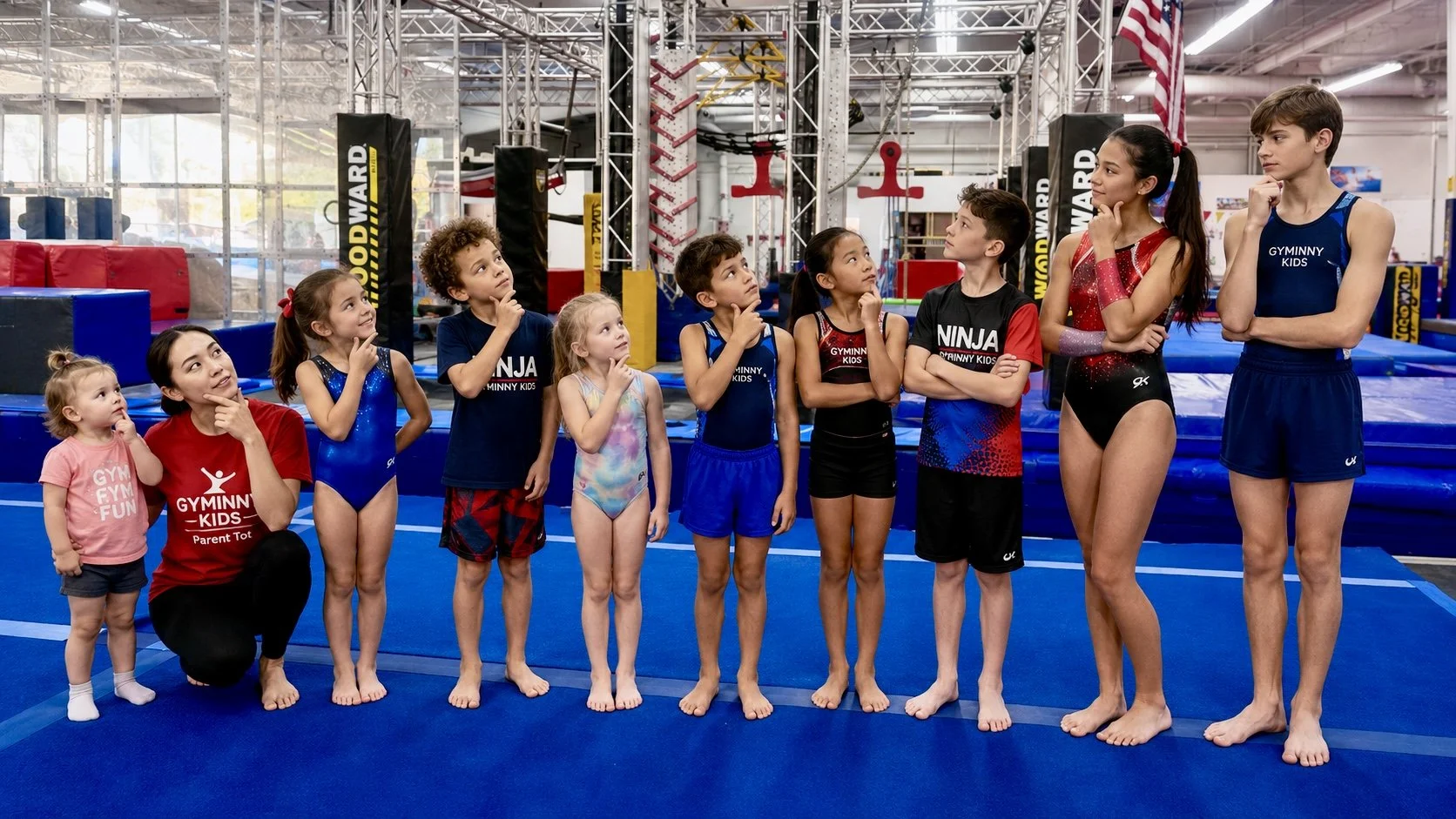
By Daniel Gundert, Owner & CEO of Gyminny Kids and North County Gymnastics, former competitive gymnastics coach, gymnastics judge, and father of six.
Category: Gymnastics Education & Parent Resources
Featured Snippet
A child is generally ready to move up in recreational gymnastics when they demonstrate proficiency in most skills at their current level, and their coach determines they can participate safely, confidently, and successfully at the next level. Gyminny Kids generally uses approximately 75% skill proficiency as a guideline, while also considering attendance, emotional readiness, strength, and overall development. Kids who are close to that mark sometimes get the extra practice they need at our full-day gym camps for kids, where several hours on the mat can help a stubborn skill finally click.
One of the most common questions we hear from parents is:
"When will my child move up to the next level?"
It's a great question, and after more than two decades of coaching gymnastics, I've learned that the best answer isn't always based on how long a child has been enrolled.
At Gyminny Kids, moving up isn't about racing through levels. It's about putting children in the environment where they have the best opportunity to be safe, successful, challenged, and confident.
For some children, that means moving up relatively quickly. Others need additional time to develop a particular skill, strength, flexibility, coordination, confidence, or emotional maturity.
Both are perfectly normal.
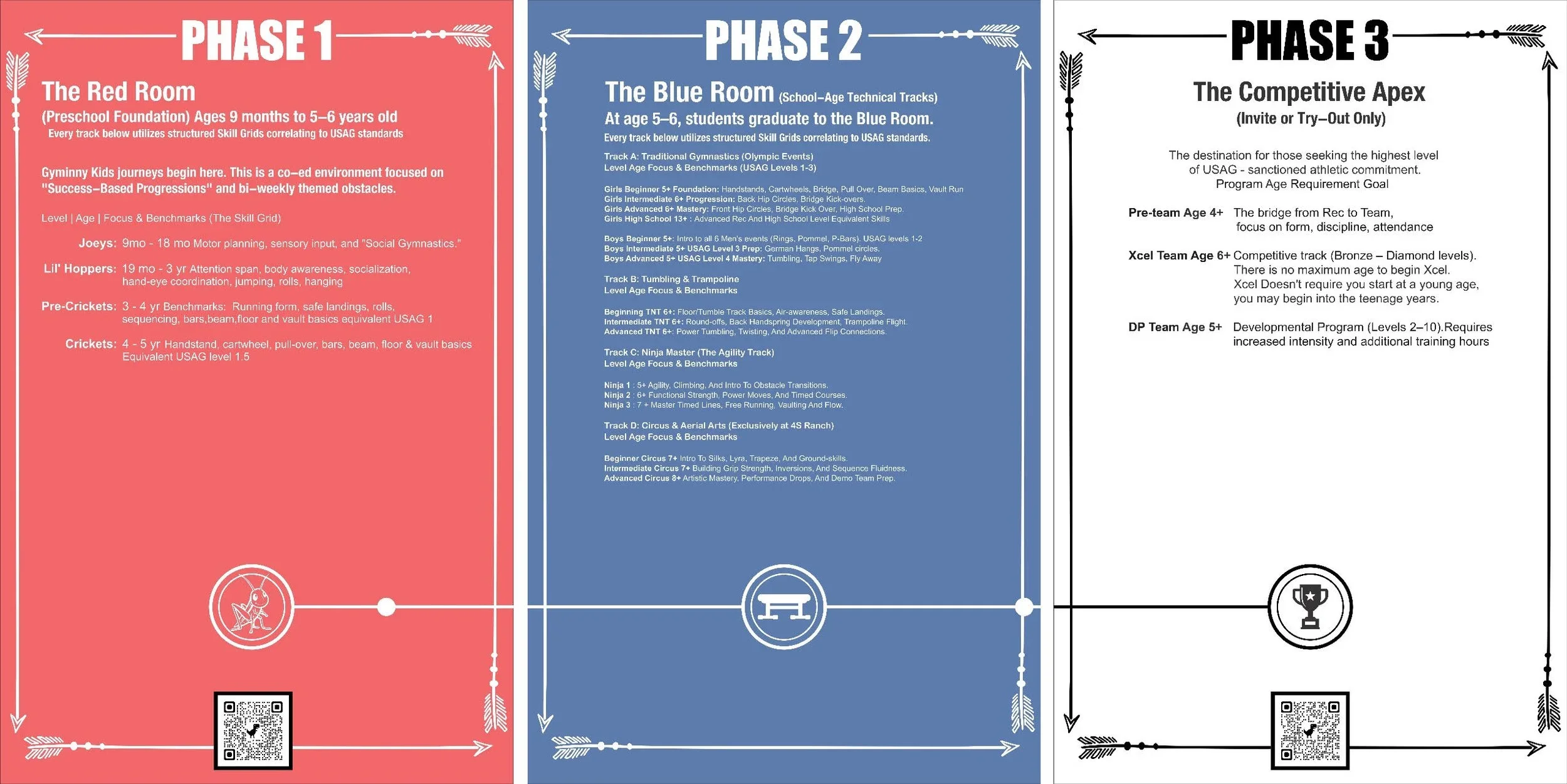
Our recreational program is designed as a progression, from our youngest Parent-Tot students through preschool gymnastics, school-age recreational gymnastics, advanced classes, Ninja and Tumbling.
For children who eventually want more, we also offer pathways into pre-team and competitive gymnastics.
The goal isn't to move through the levels as fast as possible.
The goal is to build a lasting foundation.
What Do We Look for Before Moving a Child Up?
No single skill or test determines whether a gymnast is ready.
Our coaches look at the whole child.
1. Will They Be Safe at the Next Level?
Safety comes first.
Gymnastics skills build on one another. Before introducing more difficult skills, we want children to demonstrate the strength, body awareness, shapes, technique, and foundational skills necessary to attempt those progressions safely.
Sometimes a child can physically "do" a skill but isn't yet consistent enough to perform it independently or safely.
That's an important distinction.
We would rather give a gymnast a little more time to build a strong foundation than rush them into skills their body isn't ready for.
2. Will They Be Confident at the Next Level?
This is something parents sometimes overlook.
Imagine being one of the strongest students in your current class and then suddenly entering a class where nearly everyone appears significantly more advanced than you.
For some children, that's motivating.
For others, it can crush their confidence.
That's why we don't want to move children up merely because they can technically complete a certain number of skills. We also want them prepared to belong in the next group.
Research supports the importance of this relationship between skill and confidence. Studies of youth motor development have found connections between actual motor competence, perceived competence, and children's continued participation in physical activity.
In other words, children aren't just developing skills. They're developing a perception of themselves as athletes.
That's something worth protecting.
3. Are They Emotionally Ready?
Physical ability isn't the only consideration.
As classes progress, expectations generally increase.
Children may need to:
Listen for longer periods
Follow more complex instructions
Work more independently
Handle corrections
Wait appropriately between turns
Manage frustration when skills become difficult
Stay engaged through more challenging stations
A child can occasionally have the physical ability for the next level before having the emotional readiness for it.
That's okay.
Gymnastics should challenge children without overwhelming them.
4. How Consistent Is Their Attendance?
Consistency matters tremendously in skill development.
Gymnastics requires strength, flexibility, coordination, spatial awareness, and motor learning. Those abilities are developed through repetition over time.
If a child misses several weeks or months, progress can naturally slow.
That's not a punishment. It's simply part of learning a physical skill.
Think about learning an instrument. Practicing a little every week is usually more effective than practicing occasionally with long gaps in between.
Gymnastics works similarly.
How Long Should My Child Stay in Each Gymnastics Level?
There is no universal timeline, but as a broad guideline, many recreational students may spend approximately three to six months in a level.
Some progress faster.
Some may spend closer to a year at a particular level, especially if attendance is inconsistent, they're developing strength or flexibility, or they're working through personally challenging skills.
There is nothing wrong with that.
Children don't develop on identical schedules.
I've coached long enough to see children who progressed quickly when they were young eventually get passed by athletes who took longer initially. I've also seen children struggle with one particular stage and then suddenly take off.
Development isn't always a straight line. Just like the stock market, there will be peaks and valleys, but the overall trajectory will be up, given the right consistency.
The Approximately 75% Guideline
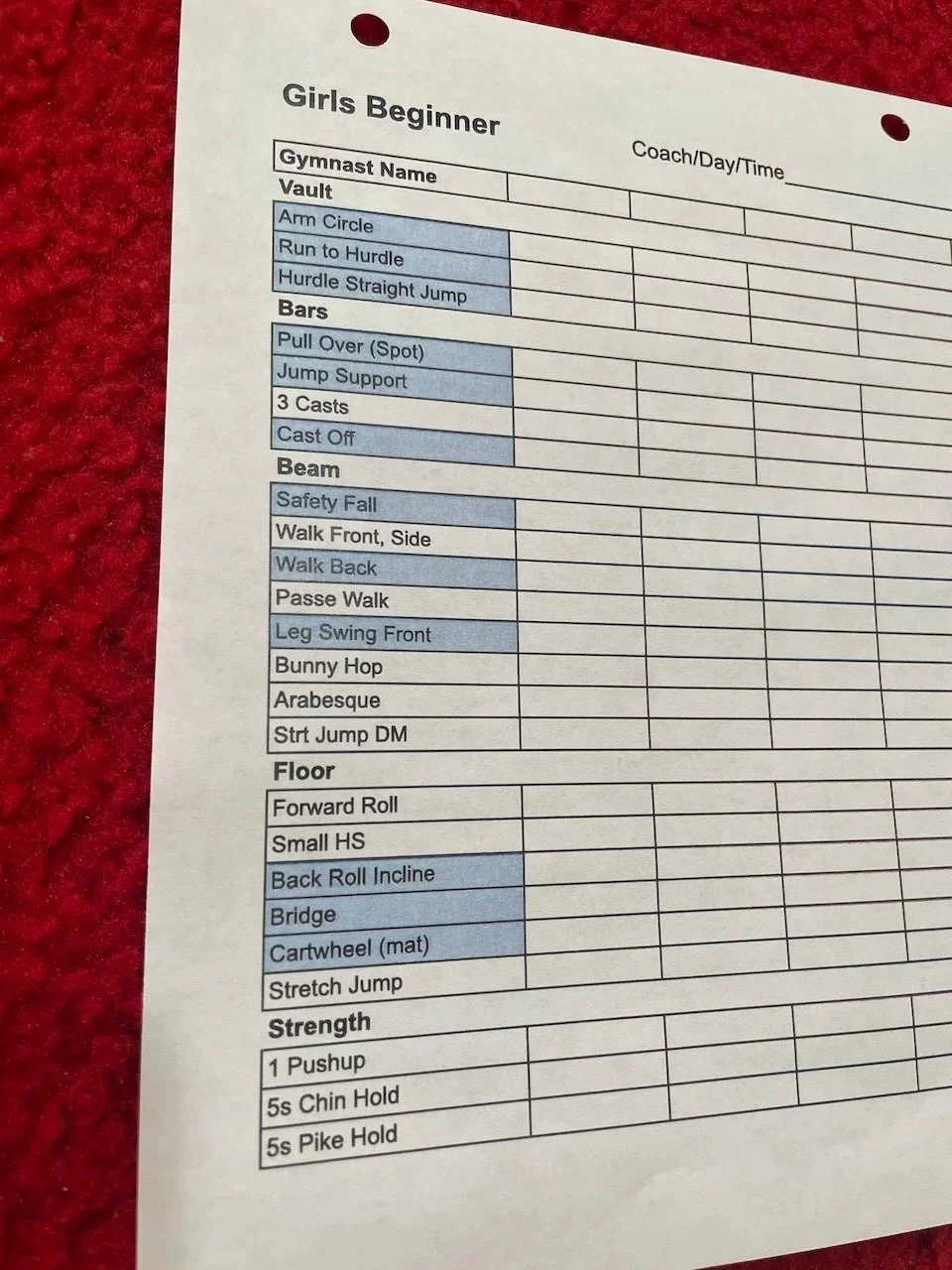
At Gyminny Kids, a good general benchmark for recreational move-ups is when a child is proficient in approximately 75% of the major skills within their current level.
That doesn't mean every skill must be perfect.
We evaluate whether the athlete has enough proficiency across the different events and skill categories to safely and confidently succeed in the next class.
When the coach determines that the student is ready, the child receives a move-up sheet and congratulatory ribbon.
That's a big accomplishment!
Families can then bring the move-up sheet to the front desk and ask about available classes at the next level.
What If the Next Level Is Full?
Sometimes a gymnast earns a move-up but the preferred day or time at the next level has a waitlist, or the new class may not work with your schedule.
Don't worry.
Your child can remain in their existing class until an appropriate opening becomes available.
One advantage of having experienced career coaches is their ability to individualize instruction within a class. A good gymnastics coach can make a station easier or harder, introduce a progression, or provide an advanced variation depending on the athlete standing in front of them.
Your child won't suddenly stop progressing just because they earned their move-up.
We'll continue challenging them while you wait for the right opening.
Will My Child Keep the Same Coach?
Maybe, but not always.
Many of our coaches teach multiple levels, so sometimes a child can move up and remain with the same instructor.
Other times, the next step means meeting a new coach.
That can actually be beneficial.
Different coaches communicate differently, notice different details, and bring different strengths to the learning process.
One thing we've worked hard to build at Gyminny Kids is a coaching system, not a program dependent on one individual instructor. Our career coaches work within the same curriculum, safety expectations, and progression philosophy.
The relationship with the coach matters tremendously, but children can also benefit from learning how to work successfully with different great coaches throughout their gymnastics journey.
Want to Progress Faster? Consider Twice-a-Week Gymnastics
If your family's priority is recreational gymnastics once a week, that's great.
There is absolutely nothing wrong with enjoying gymnastics once a week and progressing gradually.
But if your child is constantly asking:
"When can I move up?"
there is one change that can make a major difference:
Come twice a week.
Our classes run for about 48 weeks each year. The gym closes classes around major holidays, approximately four weeks a year.
That means:
Once per week = approximately 48 practices per year.
Twice per week = approximately 96 practices per year.
That's approximately 48 additional practices every year.
And the benefit isn't necessarily limited to having twice as much gym time.
The shorter gap between practices means children have more frequent opportunities to reinforce motor patterns, strength, flexibility, coordination and body awareness.
Instead of spending part of each class remembering what they worked on a week ago, they get another opportunity to practice only a few days later.
Research into motor learning generally supports repeated, appropriately distributed practice for developing and retaining physical skills.
We can't guarantee every child will progress exactly twice as fast, but decades of coaching show that children who attend twice per week often progress substantially faster than those who attend once per week.
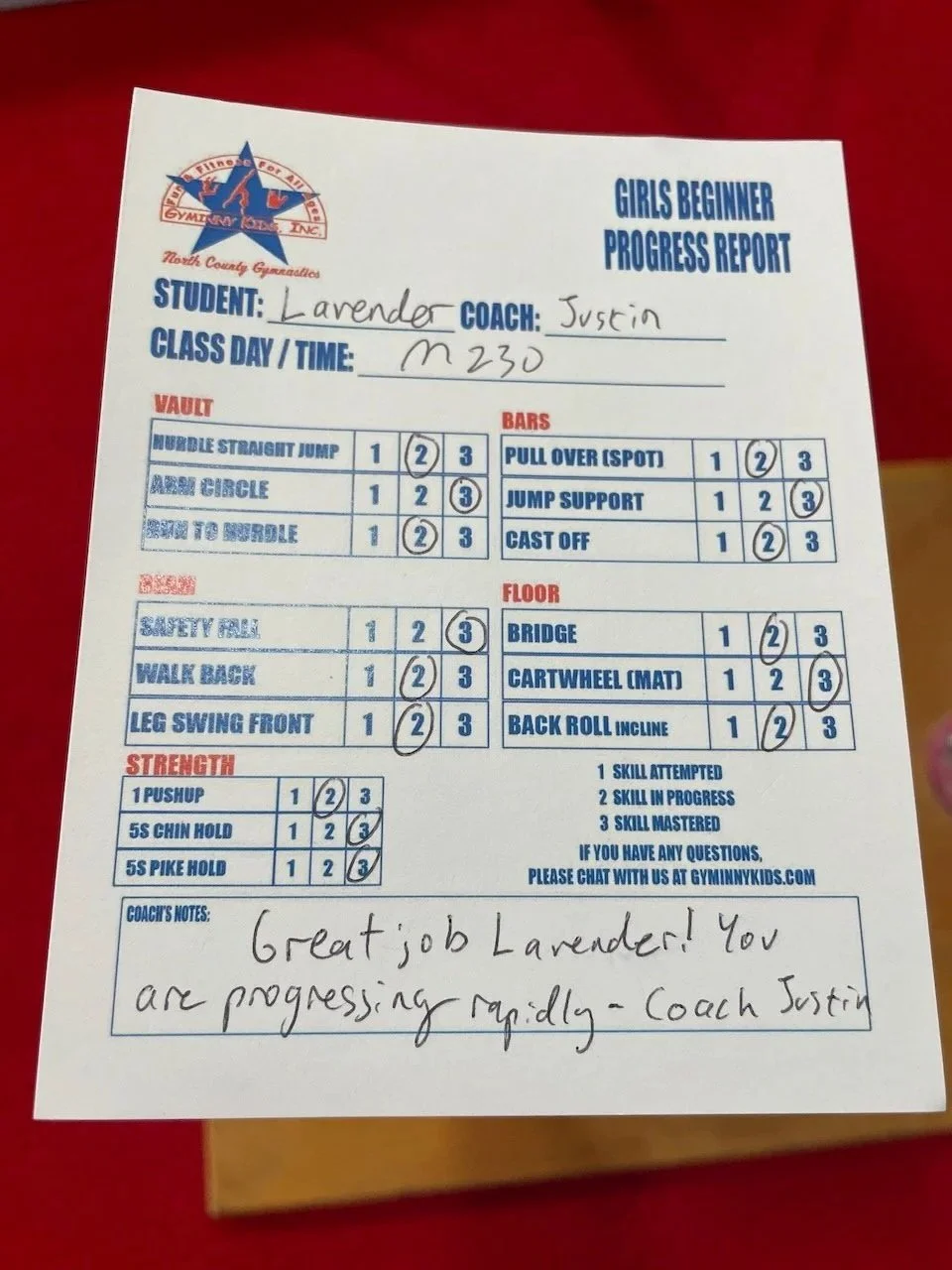
Your Quarterly Report Card Is a Great Progress Check
Gyminny Kids recreational students receive a quarterly report card approximately every three months.
The report card covers major skills on the different events and includes feedback from the coach.
Parents should use this as a progress checkpoint.
Look at what your child has accomplished. Look at what's still developing. Most importantly, don't hesitate to ask questions.
We encourage our coaches to be available after class at dismissal.
That's a great time to ask:
"How is he or she progressing?"
"What is he working toward?"
"What skills are keeping her from the next level?"
"Would twice a week make sense for him?"
A short conversation with your child's coach can often provide more context than a skill checklist alone.
The Gyminny Kids Pathway: From First Steps to Advanced Gymnastics
One thing that makes Gyminny Kids unique is that a child doesn't have to outgrow us.
Our programs begin with Parent-Tot gymnastics for babies and toddlers. Our current class offerings begin as young as 9 months, with age-appropriate programs designed around movement, balance, coordination, body awareness, and eventually more structured gymnastics skills.
From there, children can progress through our preschool and recreational programs.
The Red Room: Preschool Gymnastics
Our Red Room is designed around younger children's developmental needs.
Students begin with Parent-Tot classes and gradually progress toward independent preschool gymnastics, which begins at three years old.
At this age, success isn't about producing miniature competitive gymnasts.
We're developing:
Balance
Coordination
Strength
Flexibility
Body awareness
Listening skills
Social skills
Confidence
Fundamental movement patterns
These are building blocks not only for gymnastics, but for virtually every sport a child may eventually choose.
The Blue Room: School-Age Gymnastics
Around school age, children transition into our Blue Room recreational pathway and progress through beginner, intermediate, and advanced gymnastics.
This is where foundational skills gradually become more recognizable gymnastics.
But the same philosophy applies:
Master the foundation before building the next floor.
Ninja and Tumbling Have Levels Too
Not every child wants traditional gymnastics.
That's why Gyminny Kids offers multiple recreational pathways.
Our Ninja program lets children progress through beginner, intermediate, and advanced training while building agility, strength, coordination, obstacle skills, and confidence.
Our Tumbling program also provides progressive levels for athletes interested in floor skills, whether they're participating for fun or developing Tumbling for cheer, dance, or another sport.
The same move-up philosophy applies.
We want athletes challenged enough to grow, but prepared enough to succeed.
What If My Child Wants Competitive Gymnastics?
That's a different conversation.
Our competitive pathway can begin early through developmental pre-team programs such as Jets for girls and Rockets for boys, which introduce children to a more committed training environment.
From there, athletes may eventually pursue competitive gymnastics through different pathways.
For girls looking for competition with a more moderate time commitment, Xcel can be an excellent option.
Development Program gymnastics provides another pathway for athletes interested in progressively higher levels of competitive training.
Boys can also enter competition through introductory levels before progressing through the men's Development Program.
Our competitive program competes as North County Gymnastics, and we've developed athletes from introductory competition through Level 10 and beyond.
But competitive move-ups involve additional considerations and deserve their own discussion.
Read our guide: "When Is My Competitive Gymnast Ready to Move Up?"
Competitive move-up blog
Why We Don't Rush Children Through Gymnastics Levels
As a coach, I've always looked at gymnastics development more like a marathon than a sprint.
I don't particularly care whether a child reaches the next recreational level two months earlier if rushing that move makes them afraid, frustrated, or unsafe.
I'd rather have a child build strong basics, develop confidence, and still love gymnastics years from now.
A move-up ribbon is exciting.
But the ribbon isn't the goal.
The goal is the child who walks into the gym excited to learn, develops confidence through accomplishing difficult things, becomes stronger and more coordinated, and discovers that consistent effort eventually produces results.
Those lessons extend far beyond gymnastics.
There Is a Place for Every Child at Gyminny Kids
You don't need previous gymnastics experience to start.
You don't need dreams of becoming an elite gymnast or tumbler.
And you certainly don't have to progress at someone else's pace.
Some children want one recreational class every week.
Some want two.
Some discover Ninja.
Some fall in love with Tumbling.
Some eventually decide they want competitive gymnastics.
And a small percentage may pursue gymnastics through Level 10, college, or elite-level training.
That's why we've built a program with a place for every stage.
Gyminny Kids has served San Diego families since 1987, with programs ranging from Parent-Tot and preschool gymnastics through recreational, Ninja, Tumbling, and competitive training. Our current programs serve multiple San Diego communities through locations in 4S Ranch, Poway, Carlsbad, La Costa, La Jolla UTC, and Solana Beach.
Every child's destination is different.
Our responsibility is to help them take the right next step, not necessarily the fastest one.
Click here to read more about evaluating the differences between recreational and competitive gymnastics.
Ready to Find the Right Gymnastics Class?
Explore our Gymnastics Classes for Kids in San Diego, including Parent-Tot, preschool gymnastics, recreational gymnastics, competitive teams, Ninja and Tumbling:
New families can also start with a free trial class to find the right program and level.
Visit Gyminny Kids
By Daniel Gundert
About Gyminny Kids
Since 1987, Gyminny Kids has helped children throughout San Diego County discover gymnastics through recreational classes for kids, preschool gymnastics, competitive teams, tumbling, ninja programs, camps, and more.
Our mission goes far beyond teaching skills:
Fun and fitness while teaching character through sport.
Because whether a child becomes a champion gymnast or eventually chooses another path, the strength, confidence, perseverance, and character developed in the gym can last a lifetime.
Quick Links
• Register for a free trial class today→]
• Adaptive gymnastics classes at Gyminny Kids→]
• Learn more about GK's no registration or annual fees pricing model→]
• Competitive gymnastics training→]
• Gymnastics mindset training→]
• Why Families Choose Gyminny Kids→]
Proudly Serving Families In:
• 4S Ranch
• Poway
• Carlsbad
• La Costa
Frequently Asked Questions
How do I know when my child is ready to move up in gymnastics?
Gyminny Kids coaches consider overall skill proficiency, safety, confidence, emotional readiness, attendance, and whether the child is prepared to succeed in the next class. Recreational students are generally considered for a move-up when they're proficient in approximately 75% of the major skills within their current level.
How long does it take to move up a gymnastics level?
There is no exact timeline. A broad guideline for many recreational students is approximately three to six months, although some children progress faster and others may remain at a level for closer to a year. Attendance, age, strength, flexibility, coordination, confidence, and individual skill development all affect progression.
Will taking gymnastics twice a week help my child progress faster?
Generally, yes. A child attending about 48 weeks per year gets about 48 practices when attending once weekly versus about 96 when attending twice weekly. The additional practice and shorter intervals between classes can make a substantial difference in skill development, strength, flexibility, coordination, and confidence.
Does my child need to master every gymnastics skill before moving up?
No. Our general recreational guideline is approximately 75% proficiency across the major skills, combined with the coach's assessment that the child can participate safely and confidently at the next level.
What happens when my child moves up?
When a coach determines that a student is ready, the child receives a move-up sheet and congratulatory ribbon. Families can bring the move-up information to the front desk to explore available classes at the next level.
What if there isn't space in the next gymnastics level?
Your child can remain in their current class until an appropriate opening becomes available. Their coach can continue individualizing stations and progressions to keep them challenged in the meantime.
Can my child keep the same gymnastics coach after moving up?
Sometimes. Many coaches teach several levels, but scheduling and class availability may mean your child works with another Gyminny Kids coach. Learning from different qualified coaches can also support an athlete's development.
How often will I receive an update about my child's gymnastics progress?
Gyminny Kids provides quarterly recreational report cards. Parents are also encouraged to speak briefly with their child's coach after class during dismissal if they have questions about skills, progress, or move-up readiness.
What age can children start gymnastics?
Gyminny Kids currently offers classes beginning at approximately 9 months old through Parent-Tot programming, with progressive preschool, school-age, recreational, and advanced opportunities as children grow.
Does my child need experience before starting gymnastics?
No. Beginners are welcome. Children can enter at an age- and ability-appropriate level and progress from there.
Does Gyminny Kids offer more than recreational gymnastics?
Yes. In addition to recreational gymnastics, Gyminny Kids offers Parent-Tot and preschool programs, Ninja, Tumbling, and competitive pathways through North County Gymnastics. Families can choose a pathway based on their child's interests, ability, and desired commitment level.