
Is Gymnastics the Hardest Sport in the World? The Case for Why It Might Be
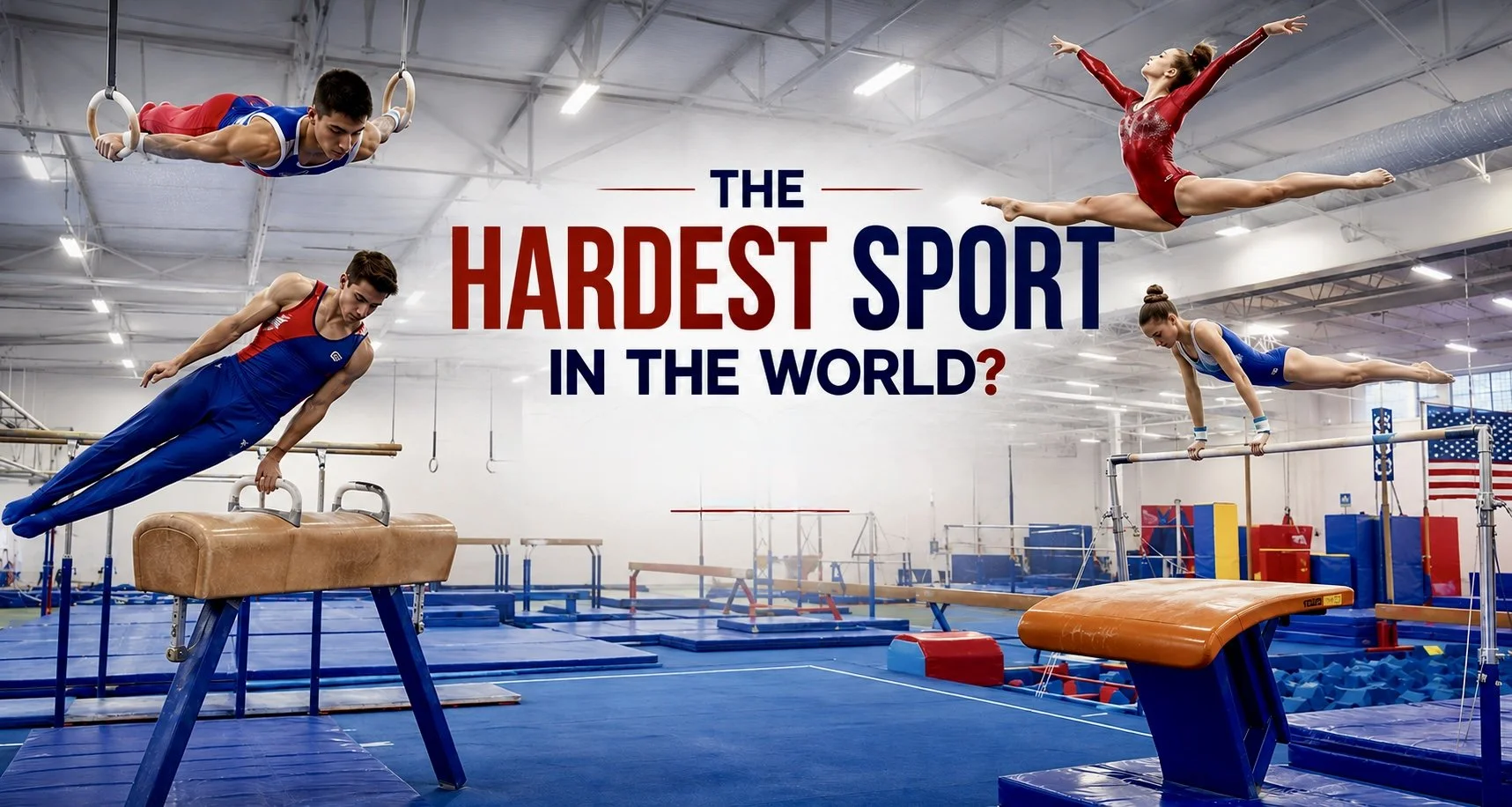
People love debating which sport is the hardest in the world.
Is it boxing? Wrestling? Hockey? Football? Water polo? Gymnastics?
There probably isn't a scientifically perfect answer because "hard" can mean different things. Are we measuring endurance? Strength? Pain tolerance? Coordination? Flexibility? Mental toughness? Technical difficulty? Injury risk?
But after spending most of my life around gymnastics, first as a gymnast, then as a coach, judge, gym owner, and now the father of competitive gymnasts, I believe gymnastics has one of the strongest arguments of any sport on Earth.
And the biggest reason is something that I think gets overlooked:
Gymnastics isn't really one sport. It is multiple extraordinarily difficult disciplines combined into one sport.
One Athlete. Six Completely Different Events.
Consider men's artistic gymnastics.
An all-around male gymnast competes:
Floor Exercise
Pommel Horse
Still Rings
Vault
Parallel Bars
Horizontal Bar
The International Gymnastics Federation (FIG) recognizes these six apparatus. Women's artistic gymnastics consists of four: Vault, Uneven Bars, Balance Beam, and Floor Exercise.
Now think about how different those events actually are.
Pommel Horse requires rhythm, endurance, coordination, impeccable balance, and the ability to support your entire body on your hands while continuously circling an apparatus.
Still Rings demand extraordinary upper-body and straight-arm strength and require swinging skills, handstands, and dismounts.
Vault requires speed, explosive power, spatial awareness, and the ability to generate enormous rotation in seconds.
Horizontal Bar requires giant swings, release moves, catches, and the willingness to let go of a steel bar while several feet in the air and trust that you can find it again.
Floor Exercise combines tumbling, strength, flexibility, landing control, and quick-twitch muscle, huge power, and endurance.
Parallel Bars require yet another combination of support strength, swinging technique, balance, and aerial awareness.
Any one of those could practically be its own sport.
Yet an elite men's all-around gymnast has to be good at all six.
The FIG itself points out how different the physical demands are across the apparatus. Rings emphasize strength, Pommel Horse requires balance and stamina, and Horizontal Bar requires sophisticated swinging ability.
That diversity is one reason I believe men's gymnastics has perhaps the strongest argument for being the most technically difficult all-around sport in the world.
You can be phenomenal on five events.
But if you're significantly behind on the sixth, it can take you right out of contention in the all-around.
Women's Gymnastics Has the Same Challenge, Times Four
Women's artistic gymnastics has four events:
Vault. Uneven Bars. Balance Beam. Floor Exercise.
Again, these aren't variations of the same basic activity.
They are completely different physical problems.
The FIG describes Vault as emphasizing speed and explosiveness, Uneven Bars as demanding upper-body strength, Balance Beam as requiring balance and mental toughness, and Floor Exercise as combining endurance with expression.
Think about Balance Beam alone.
A gymnast performs acrobatic skills, turns, leaps, and combinations on a surface only 10 centimeters, or roughly four inches, wide.
Then she may walk across the gym and swing between two uneven bars.
Then sprint full speed toward a stationary vault table.
Then perform tumbling passes on floor.
Four events. Four skill sets. One all-around athlete.
There are absolutely event specialists in gymnastics, just as there are specialists in other sports. But when we're discussing the difficulty of gymnastics as a whole, I think the all-around deserves special consideration.
The 10 Hardest Sports Overall
No universally accepted scientific ranking of the world's hardest sports exists, so treat any list as an informed comparison rather than an absolute fact.
One of the most famous attempts came from ESPN, which assembled a panel to evaluate sports across multiple categories, including endurance, strength, power, speed, agility, flexibility, nerve, durability, hand-eye coordination, and analytical aptitude.
Their ranking placed boxing first overall and gymnastics eighth.
If I combine that type of multidimensional analysis with technical complexity, number of disciplines, consequences of mistakes, years required for mastery, and my own experience in gymnastics, my top 10 would look like this:
1. Gymnastics
Why: Extraordinary strength-to-weight ratio, flexibility, power, balance, coordination, spatial awareness, precision, mental toughness, and multiple distinct apparatus.
The defining difference for me is breadth.
Men's all-around requires six disciplines and women's requires four. Few sports ask athletes to master that many fundamentally different movement systems at once.
2. Boxing
Why: Elite endurance, speed, reaction time, strength, strategy, courage, and the obvious physical consequences of being hit.
There is a very legitimate argument for boxing being number one.
3. Wrestling
Why: Tremendous strength, conditioning, leverage, explosiveness, technique, and mental toughness, all while another athlete is actively trying to defeat you.
4. Ice Hockey
Why: Athletes combine skating, speed, balance, endurance, hand-eye coordination, tactical awareness, and physical contact while moving at high speed on ice.
5. Water Polo
Why: Swimming endurance, explosive movement, throwing, wrestling for position, and tactical awareness while competing in the water.
6. Football
Why: Explosive power, speed, strength, tactical complexity, contact, and tremendous positional specialization.
7. Basketball
Why: Endurance, agility, speed, jumping ability, hand-eye coordination, decision-making, and repeated explosive movements.
8. Tennis
Why: Speed, endurance, reaction time, precision, strategy, and the ability to execute technically difficult strokes under fatigue.
9. Soccer
Why: Exceptional cardiovascular endurance combined with speed, agility, foot-eye coordination, tactical awareness, and continuous decision-making.
10. Figure Skating
Why: Balance, flexibility, artistry, rotational awareness, jumping ability, and the mental challenge of executing extremely difficult skills on a thin blade over ice.
Reasonable people could rearrange this list dramatically.
That's part of what makes the debate fun.
But gymnastics has several characteristics that are difficult to find together anywhere else.
Gymnastics Requires Strength AND Flexibility
Many sports reward strength.
Others reward flexibility.
Gymnastics requires both.
And sometimes it requires them simultaneously.
A gymnast may need enough shoulder flexibility to reach extreme positions while also possessing enough strength to control those positions.
Male gymnasts perform straight-arm strength elements on rings that require tremendous strength and body control.
Female gymnasts need tremendous lower-body power for tumbling and Vault while maintaining the flexibility necessary for leaps, dance elements, and body positions.
Being strong isn't enough.
Being flexible isn't enough.
Being fast isn't enough.
Being coordinated isn't enough.
Gymnastics asks you to put them all together.
Gymnastics Requires Extraordinary Spatial Awareness
Gymnasts routinely rotate around multiple axes without being able to see where they're going continuously.
A gymnast may flip backward, twist, lose sight of the ground (blind landing), locate it again, and make landing adjustments in fractions of a second.
That spatial awareness takes years to develop.
As a coach, I've always found this to be one of the most fascinating parts of gymnastics. Eventually, experienced gymnasts don't just see where they are.
They feel where they are.
Their brains develop an incredible understanding of body position in space.
That's also why I've long believed gymnastics creates such a powerful foundation for other sports.
You Have to Overcome Fear
There is another component that statistics don't always capture:
At some point, nearly every competitive gymnast encounters a skill that scares them.
Going backward on beam.
Releasing the high Bar.
Learning a giant.
Flipping a vault.
Adding another twist.
Performing a new tumbling pass.
You can't eliminate fear.
You learn how to prepare yourself well enough to move through it.
As coaches, one of our jobs is to help athletes develop the preparation, progressions, confidence, and mental tools necessary to approach those challenges safely.
That lesson extends far beyond gymnastics.
The Margin for Error Can Be Inches
In many sports, an imperfect movement can still produce a successful outcome.
A basketball shot can bounce around the rim and fall in.
A quarterback can throw an ugly pass that still gets caught.
A soccer player can mishit a ball that still finds the net.
Gymnastics is different.
Hand placement a few inches off can completely change a skill.
A slight under-rotation can turn a stuck landing into a fall.
A tiny balance correction on beam can become a major deduction or take the athlete off the apparatus.
At high levels, athletes aren't merely being asked to complete incredibly difficult skills.
They're being asked to make them look controlled.
Then We Judge How Pretty You Made the Impossible Look
This may be my favorite contradiction in gymnastics.
A gymnast can do something that 99.9% of human beings couldn't physically attempt.
And then a judge says:
"Your toes weren't pointed enough."
I can say that because I've been on both sides.
As a former gymnast and coach, I understand how incredibly difficult the skills are.
As a gymnastics judge, I also understand why execution matters.
Gymnastics isn't just about completing a skill.
Body position matters.
Amplitude matters.
Landings matter.
Form matters.
Connections matter.
Rhythm matters.
Artistry matters on the events where it applies.
Difficulty and execution have to coexist.
The athlete has to make the extraordinary look ordinary.
The Physical Demands Are Enormous
Gymnastics combines repeated impact, explosive movements, strength work, flexibility, twisting, flipping, swinging, and landings.
That doesn't mean gymnastics should be viewed as inherently unsafe.
It means that progression matters.
Appropriate equipment matters.
Conditioning matters.
Spotting matters.
Athlete readiness matters.
There is a huge difference between recreational gymnastics taught through safe progressions and elite athletes performing world-class skills.
One of the beautiful things about gymnastics is that the sport can meet children where they are.
A beginner might be learning a forward roll.
An Olympian might be performing multiple flips and twists.
Both are participating in gymnastics.
My Perspective After a Lifetime in Gymnastics
I've experienced gymnastics from almost every angle.
I've been the athlete.
I've been the coach standing next to an athlete as they learn something scary.
I've been the judge evaluating routines.
I've owned gyms and watched thousands of children progress through the sport.
And I've been the parent sitting in the stands watching my own children compete.
The longer I'm around gymnastics, the more respect I have for how difficult it is.
Sometimes the greatest accomplishment isn't winning.
It's finally making the skill you've worked on for months.
It's getting back on the beam after falling.
It's overcoming a mental block.
It's showing up to practice after a bad meet.
It's learning that progress doesn't happen on your schedule.
Those lessons are part of what makes gymnastics so valuable.
The Hardest Sport Can Also Be One of the Best First Sports
Here's the interesting part.
Everything that makes gymnastics very difficult at its highest levels is exactly what makes introductory gymnastics so valuable for children.
We're not asking a four-year-old to become an Olympian.
We're teaching that child how to:
Run
Jump
Swing
Hang
Roll
Balance
Climb
Support their body weight
Understand where their body is in space
Take turns
Work through challenges
Get back up after falling
Those abilities transfer everywhere.
That's why I have always believed:
Gymnastics is the foundation for all sports.
Start with gymnastics. Go anywhere!
Whether a child eventually becomes a gymnast, football player, baseball player, dancer, wrestler, soccer player, diver, or simply an active adult, the physical literacy developed in gymnastics can follow them for life.
So, Is Gymnastics Really the Hardest Sport in the World?
We can't scientifically crown a definitive winner.
Other athletes can make compelling cases for boxing, wrestling, motocross, hockey, water polo, football, and countless other sports.
But if we're measuring the combination of strength, flexibility, power, coordination, balance, spatial awareness, precision, courage, technical complexity, and the number of distinct disciplines an athlete must master, I believe gymnastics ranks number one.
Especially when you remember this:
A men's all-around gymnast isn't mastering one event. He's mastering six.
A women's all-around gymnast isn't mastering one event. She's mastering four.
And each apparatus can truly take a lifetime to master.
That, more than anything else, is why I believe gymnastics may be the hardest sport in the world.
And it's also why I have so much respect for every athlete who chooses to pursue it.
By Daniel Gundert
Owner & CEO of Gyminny Kids and North County Gymnastics, former competitive gymnastics coach, gymnastics judge, and father of six.
About Gyminny Kids
Since 1987, Gyminny Kids has helped children throughout San Diego County discover gymnastics through recreational classes for kids, preschool gymnastics, competitive teams, tumbling, ninja programs, camps, and more.
Our mission goes far beyond teaching skills:
Fun and fitness while teaching character through sport.
Because whether a child becomes a champion gymnast or eventually chooses another path, the strength, confidence, perseverance, and character developed in the gym can last a lifetime.
Quick Links
• Register for a free trial class today→]
• Adaptive gymnastics classes at Gyminny Kids→]
• Learn more about GK's no registration or annual fees pricing model→]
• Competitive gymnastics training→]
• Gymnastics mindset training→]
• Why Families Choose Gyminny Kids→]
Proudly Serving Families In:
• 4S Ranch
• Poway
• Carlsbad
• La Costa
Frequently Asked Questions
Is gymnastics officially the hardest sport in the world?
No organization or scientific study can definitively crown one sport the hardest, because difficulty can be measured in many ways. However, gymnastics has an unusually strong case because it combines strength, flexibility, power, coordination, balance, spatial awareness, technical precision, and multiple distinct events.
Why do people say gymnastics is one of the hardest sports?
Gymnastics requires an unusual combination of physical and mental abilities. Artistic gymnasts must also learn several distinctly different apparatus rather than specializing in only one movement pattern.
How many events do male gymnasts compete in?
Men's artistic gymnastics includes six apparatus: Floor Exercise, Pommel Horse, Still Rings, Vault, Parallel Bars, and Horizontal Bar.
How many events do female gymnasts compete in?
Women's artistic gymnastics includes four apparatus: Vault, Uneven Bars, Balance Beam, and Floor Exercise.
What is the hardest gymnastics event?
There isn't one universal answer. Different athletes struggle with different events. Pommel Horse is notoriously technical, Rings requires tremendous strength, Horizontal Bar involves difficult release skills, and Balance Beam combines acrobatics with an extremely small margin for error.
Does a gymnast have to compete every event?
No. Gymnastics includes event specialists who focus on particular apparatus. All-around gymnasts, however, compete across all six men's events or all four women's events.
Is gymnastics a good first sport for children?
Gymnastics develops fundamental movement abilities including balance, coordination, strength, flexibility, running, jumping, landing, climbing, and spatial awareness. These abilities can transfer to many other sports and physical activities.
What age should children start gymnastics?
Children can benefit from age-appropriate gymnastics from a very young age. Early classes focus on fundamental movement, listening, coordination, confidence, and fun rather than advanced competitive skills.