
Swimming for Kids: Why Gymnastics Builds a Strong Foundation for Every Sport
Swimming for Kids: Why Gymnastics Builds a Strong Foundation for Every Sport
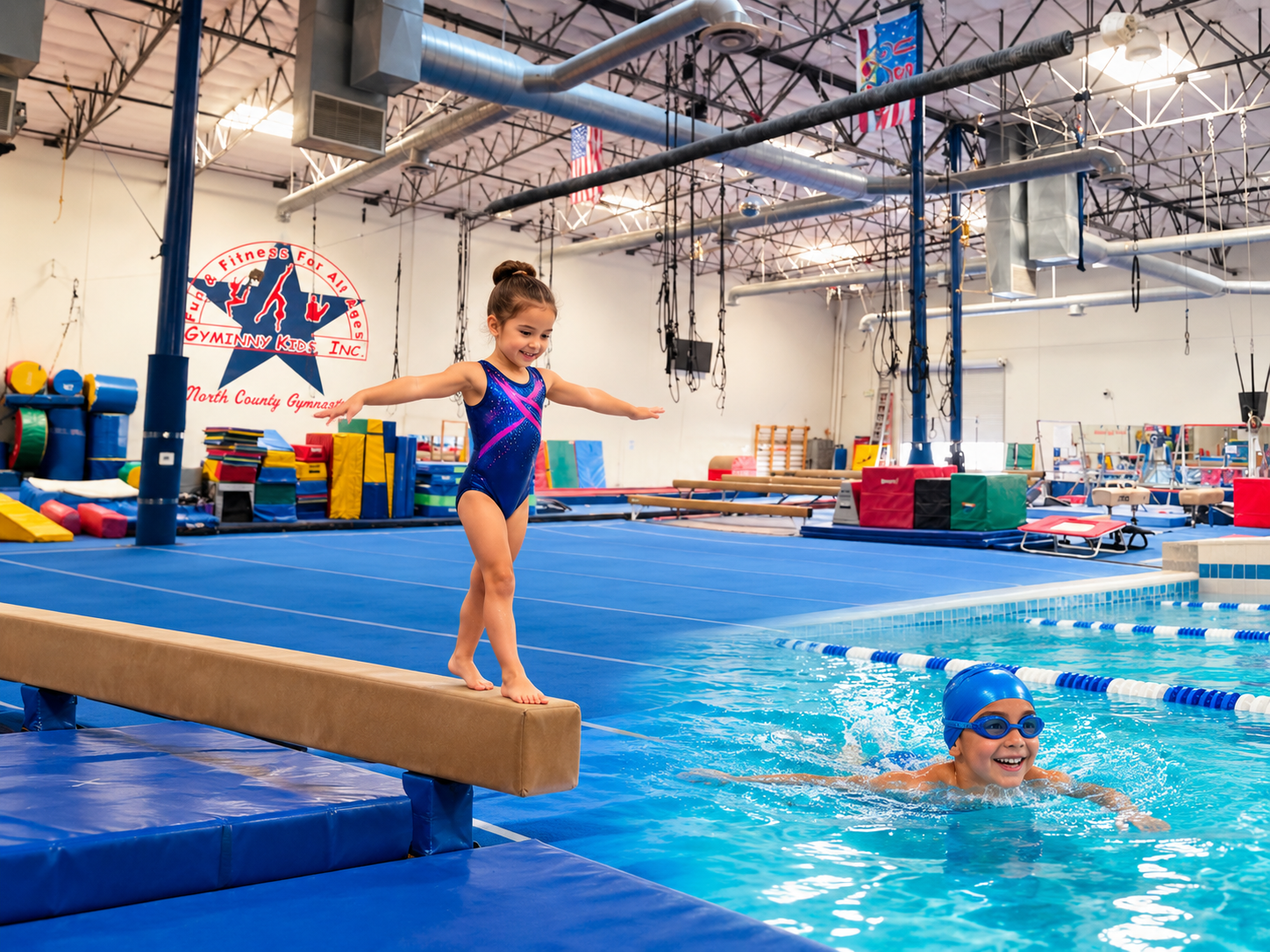
Swimming helps children develop important water skills. Gymnastics builds strength, balance, coordination, and body awareness that can support movement in and out of the pool.
By Daniel Gundert: Owner of North County Gymnastics & The Gyminny Kids; gymnastics coach and judge; former gymnast; and father of six.
If you're searching for swimming lessons for your child, you're looking at an important life skill. The American Academy of Pediatrics recommends that children learn to swim, with lessons beginning after a child's first birthday. The AAP also emphasizes that swimming lessons are only one part of water safety. Close adult supervision, barriers that prevent unsupervised access to water, and other safety measures remain essential. Drowning is the leading cause of death for children ages 1 to 4 in the United States. AAP, "Prevention of Drowning". (publications.aap.org)
Families may also consider activities that help their children develop strength, coordination, and confidence. From my perspective as a coach and a dad, gymnastics is one of the broadest foundations for movement because it asks children to control their bodies in many different positions and directions.
Swimming and gymnastics teach different skills. Many children can enjoy both.
What Swimming Teaches Kids
Swimming gives children opportunities to learn how to move through water, practice breathing and strokes, build endurance, and become more comfortable in the pool. Learning water competency is valuable. The AAP explains that this involves more than swimming a particular stroke. It includes skills such as floating, treading water, turning around, moving toward an exit, and learning safe behaviors around water. AAP, "Swim Lessons for Children." (healthychildren.org)
A 2009 case-control study found that formal swim lessons were associated with an estimated 88% lower risk of drowning among children ages 1 to 4. The researchers cautioned that the estimate was imprecise, so it should not be treated as a guarantee. This is one reason swim instruction matters, alongside supervision and other layers of water safety. Brenner et al., Archives of Pediatrics & Adolescent Medicine. (pubmed.ncbi.nlm.nih.gov)
Swimming is valuable on its own. It also gives children an enjoyable way to stay active and set goals as they learn new skills.
Why Gymnastics Is the Foundation for All Sports
In gymnastics, children practice a wide range of movements. They may balance, jump, land, roll, climb, hang, swing, and move through an obstacle course. These challenges ask them to understand where their bodies are and how to move with control.
Gymnastics classes give children practice with:
Balance and coordination
Strength and flexibility
Body control and spatial awareness
Jumping, landing, rolling, and climbing
Focus, confidence, and persistence
The American Academy of Pediatrics identifies strength, flexibility, balance, and coordination among the physical skills children can develop through gymnastics. AAP, "Gymnastics: Keeping the Sport Safe & Fun for Kids". (healthychildren.org)
Research supports the value of structured movement practice. In a study of 333 primary-school children with an average age of 8.1, students took part in either a 16-week gymnastics curriculum or regular physical education. The gymnastics group improved more in stability and object-control skills.
That distinction matters. The study supports gymnastics as a way to practice certain foundational movement skills. It does not show that gymnastics teaches children to swim faster or replaces swim instruction.
The U.S. Olympic & Paralympic Committee's American Development Model also encourages children to develop fundamental skills that transfer between sports and to experience varied physical activities as they grow. USOPC, American Development Model. (usopc.org)
What I've Seen as a Coach and a Dad
I've been involved in gymnastics since 1993. Over the years, I've watched children arrive unsure of a movement and gradually become more comfortable trying it, adjusting their bodies, and working through a new challenge. Those small steps are part of how children build physical confidence.
I've also seen that process at home with my own children. Remi, Rocket, and Finley had been doing gymnastics since they were toddlers. When they started swimming lessons at about four, five, and six, they also continued gymnastics. They each learned to swim quickly, and their swim instructors noticed their athleticism and ability to move in the water and often asked, "Is your kid in gymnastics?" I would reply, "Well, yes. How did you know?" The swim instructors told me they can tell when a child does gymnastics because they tend to pick up movements in the water faster and more confidently.
I can't say gymnastics alone caused that, and every child learns at their own pace. But as their dad, I could see how being familiar with coordination and body control seemed to help them take on new physical challenges. That experience is one reason I believe gymnastics can provide a strong foundation for children who may explore swimming and other sports.
How Gymnastics and Swimming Can Complement Each Other
Swimming develops skills for moving through water. Gymnastics gives children a place to practice a broader range of movements on the ground and equipment. The physical skills aren't identical, but children can benefit from having varied movement experiences.
For example, gymnastics gives children opportunities to practice:
Holding and changing body positions
Coordinating their arms and legs
Building strength and flexibility
Balancing and moving with control
Trying a new skill one step at a time
These experiences may help a child feel more confident taking on physical challenges in other activities. Gymnastics does not teach swim strokes or water safety, so families should pursue swim lessons for those skills.
A Foundation That Grows With Your Child
At Gyminny Kids, classes are structured around children's ages, abilities, and progress. Parent-and-tot classes begin as early as 9 months, and programs continue through recreational gymnastics, competitive training, adaptive gymnastics, and adult classes. Explore Gyminny Kids classes. (gyminnykids.com)
Young children can explore movement with a parent nearby. As they grow, they can work through age-appropriate classes that introduce new skills step by step. The goal is steady progress, not rushing a child into advanced skills before they are ready.
Whether your child is just beginning to explore movement or already enjoys the pool, gymnastics can offer new physical challenges and opportunities to build confidence.
To read more about our foundations blog series, check out the links below:
Gymnastics in the foundation of all other sports →]
Gymnastics for Baseball: Why the Best Baseball Players Start in the Gym→]
Gymnastics and Football: Why Gymnastics May Be the Best Foundation for Future Football Players →]
Why Gymnastics Is the Best Foundation for Current & Future Soccer Players →]
How Gymnastics Creates Better Athletes: The Cross-Training Benefits for Every Sport →]
Life After Gymnastics: Why Great Gymnasts Don't Leave the Sport Behind. They Take It Everywhere →]
Why Families Choose Gyminny Kids
Gyminny Kids has served San Diego families since 1987, offering programs for children of all ages and ability levels. Our coaches guide children through structured progressions in a welcoming environment, helping them try new movements and build confidence at their own pace.
Families can find Gyminny Kids in:
Proudly Serving Families In:
• 4S Ranch
• Poway
• Carlsbad
• La Costa
If your child is interested in gymnastics, explore classes and schedule a free trial.
Quick Links
• Register for a free trial class today→]
• Adaptive gymnastics classes at Gyminny Kids→]
• Learn more about GK's no registration or annual fees pricing model→]
• Competitive gymnastics training→]
• Gymnastics mindset training→]
• Why Families Choose Gyminny Kids→]
Frequently Asked Questions
Is swimming or gymnastics better for my child?
They serve different purposes. Swimming develops water skills and confidence in the pool. Gymnastics gives children opportunities to practice a broad range of movement skills, including balance, coordination, strength, and body control. Many children enjoy both, and we've found they complement each other.
Does gymnastics help with swimming?
Gymnastics does not teach swimming technique. It gives children opportunities to practice general movement skills such as coordination, strength, flexibility, and body awareness. In my family, swim instructors noticed my children's athleticism and ease of movement, and they had been doing gymnastics since they were toddlers. Every child is different, so that experience doesn't guarantee a particular outcome.
When should my child start swimming lessons?
The American Academy of Pediatrics recommends that swim lessons begin after a child's first birthday, while recognizing that readiness and development vary. Swim lessons are one layer of water safety. They do not make a child "drown-proof" and do not replace close supervision or barriers to prevent unsupervised access to water. Read the AAP's swim lesson guidance. (healthychildren.org)
What age can my child start gymnastics at Gyminny Kids?
Gyminny Kids parent-and-tot classes begin as early as 9 months. View current class options to find a program that fits your child's age and experience.
Can my child do gymnastics and swimming at the same time?
Yes. Families can choose activities based on their child's interests, schedule, and readiness. Swimming and gymnastics offer different experiences, and some children enjoy both.
Start With a Strong Foundation
Swimming is an important skill for children to learn. Gymnastics offers another valuable opportunity: a place to build strength, balance, coordination, and body awareness through movement.
Gymnastics is the foundation for all sports. Start with gymnastics, go anywhere.
Schedule a free trial class at Gyminny Kids.
References
American Academy of Pediatrics: Prevention of Drowning
American Academy of Pediatrics: Gymnastics: Keeping the Sport Safe & Fun for Kids
Brenner et al.: Association Between Swimming Lessons and Drowning in Childhood
U.S. Olympic & Paralympic Committee: American Development Model
About the Author
Daniel Gundert owns North County Gymnastics & The Gyminny Kids, coaches and judges gymnastics, wrote Baby Gorilla, and is a father of six. He joined Gyminny Kids in 2003 and has spent his career helping children and families discover the benefits of gymnastics.