

How to Be a Good Cyber Teammate: Building Stronger Kids, Stronger Youth Sports Teams, and a Better Digital World
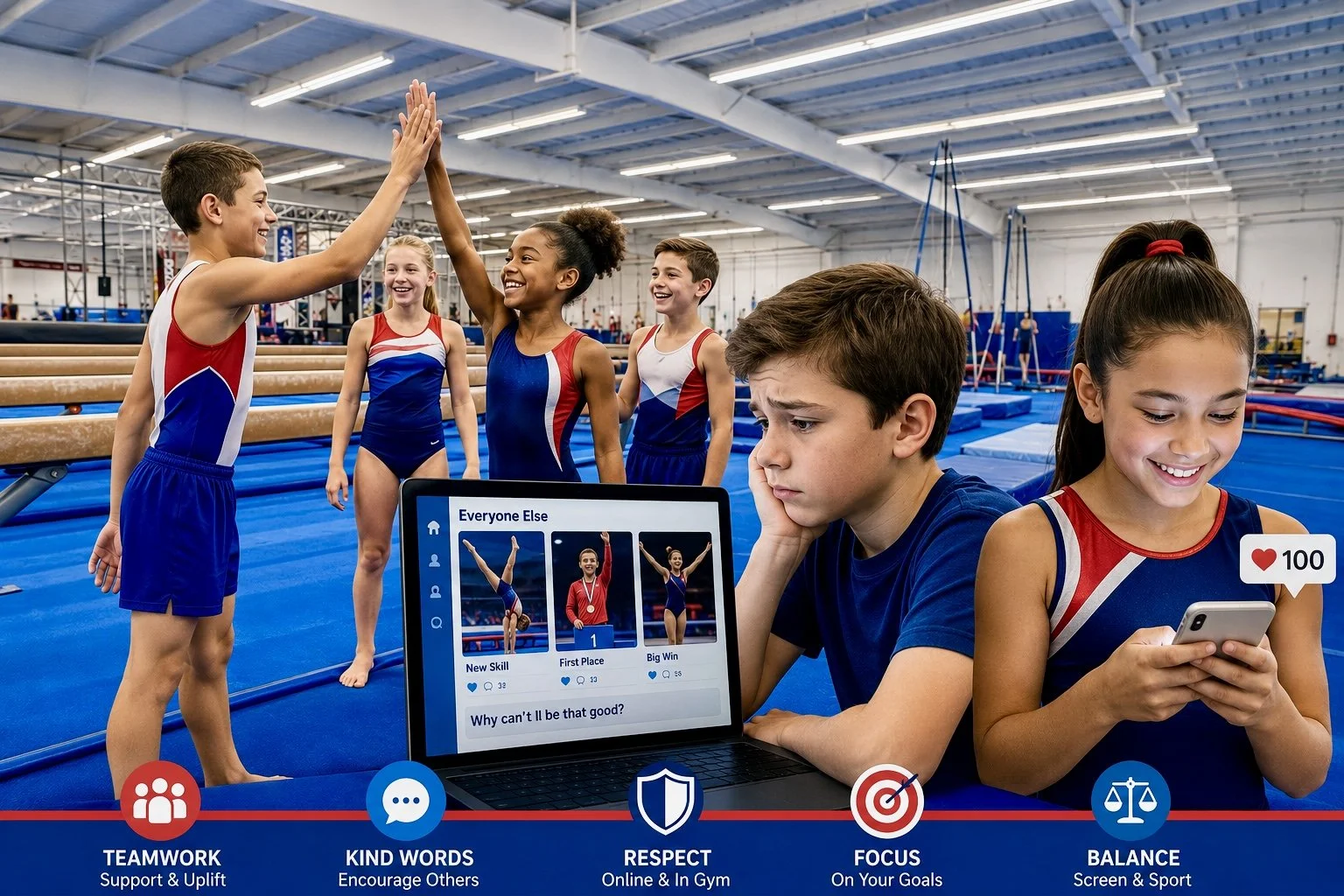
By Daniel Gundert, Owner & CEO, Gyminny Kids | Former Competitive Gymnastics Coach | Father of Six
Being a Good Teammate Doesn't End When Practice Ends
For generations, coaches have taught athletes what it means to be a good teammate.
Cheer for your teammates. Pick them up when they're struggling.
Celebrate their successes. Don't gossip about them. Don't tear someone down to build yourself up. Work hard, stay humble, and remember that your actions affect the entire team.
But today, being a good teammate doesn't end when an athlete walks out of the gym.
It follows them home.
It follows them into group texts, social media, gaming platforms, messaging apps, and whatever digital platform comes next.
That's why I believe we need to start teaching young athletes another skill:
How to be a good cyber teammate.
At North County Gymnastics & The Gyminny Kids, our mission is Fun and fitness while teaching character through sport. In today's world, some of those character lessons have to extend beyond the gym and into the digital lives our kids are increasingly navigating.
This isn't about telling families how to parent. It's not about telling parents how much screen time their children should have, when they should get a phone, or which platforms they should use.
Every family is different.
Instead, this is about something much more universal:
If you're going to be online, bring the same character you expect to bring into the gym.
It's Better to Light a Candle Than to Curse the Darkness
One philosophy I try to live by is:
It's better to light a candle than to curse the darkness.
There are plenty of things we can complain about in today's digital world.
Cyberbullying.
Social comparison.
Too much screen time.
Online negativity.
Anonymous comments.
Kids chasing likes and followers.
Adults behaving poorly online.
Algorithms designed to keep us scrolling.
We could spend all day talking about what's wrong with the internet.
But what does that accomplish?
I'd rather light a candle.
Instead of asking, "How do we fix everybody else online?" maybe the better question is:
"How can I behave better online?"
That's where change starts.
And that's a lesson sports can teach exceptionally well.
You can't control the judges.
You can't control your opponent.
You can't control what your teammate posts.
You can't control what someone says about you.
You can control your preparation, effort, attitude, response, and character.
Control what you can control.
That principle works just as well online as it does in the gym.
Attraction Is More Powerful Than Promotion
Another philosophy I believe in is attraction rather than promotion.
If you want people to become more positive, you don't necessarily have to lecture them about positivity.
Be positive.
If you want people to work harder, work harder.
If you want people to treat others with respect, treat others with respect.
If you want your teammates to support one another, become the teammate who supports everyone first.
Live the example rather than constantly promoting it.
Over time, people notice.
That's attraction.
I think this is especially important for young people growing up in a culture where everyone has a platform, and many have an opinion.
You don't have to announce all of your values.
Live them.
Before worrying about changing the world, start by improving yourself.
Make your bed.
Clean your room.
Treat your parents with respect.
Show up to practice on time.
Listen to your coaches.
Be kind to your siblings.
Help your teammates.
Do your homework.
Keep your commitments.
Put the shopping cart back.
Do the little things correctly when nobody is watching.
Then take those same habits online.
Don't gossip.
Don't pile on.
Don't humiliate someone.
Don't post something just because you know it will get attention.
Don't compare your life to everyone else's.
And don't demand standards from other people that you're unwilling to live by yourself.
Improve yourself first.
If enough of us do that, our families improve.
Our teams improve.
Our gyms improve.
Our schools improve.
Our communities improve.
And eventually, the world improves.
The Digital Locker Room Is Still a Locker Room
Imagine an athlete standing in the middle of practice and saying something cruel about a teammate.
A coach would probably address it immediately.
Now imagine that same athlete sends the comment in a group chat at 10:30 at night.
The location changed.
The impact didn't.
In some ways, the impact can become even greater because digital communication can be screenshotted, forwarded, repeated, and viewed by an audience far beyond the original conversation.
The American Psychological Association recommends minimizing young people's exposure to cyberbullying and online hate. It encourages adults to teach children how to develop healthy online relationships and appropriately resolve conflicts that arise through social media.
That's why coaches, parents, and athletes need to recognize something:
Your team culture exists online, too.
You're Closer to Influencing a Million People Than You Think
Here's something I want young people to understand about the scale of the digital world.
Imagine you have 1,000 people connected to you online.
And imagine each of those people is connected to another 1,000 people.
That's potentially 1,000 × 1,000 = 1,000,000 people just two degrees from you.
Of course, that doesn't mean every post you make will reach a million people. Most won't.
But it illustrates something important:
Your digital influence can travel much farther than you realize.
A screenshot travels.
A video gets shared.
A comment gets reposted.
An act of kindness gets repeated.
And unfortunately, cruelty can travel the same way.
In the physical world, you might say something in a room with 20 people.
Online, you're potentially standing in a room without walls.
That should make us think differently about what we contribute.
Every time you post something, you have a choice.
Add light or add darkness.
You probably won't fix the entire internet today.
But you can improve your little corner of it.
Light your candle.
10 Ways to Be a Good Cyber Teammate
1. Don't Type Something You Wouldn't Say Face-to-Face
Before posting, commenting, or sending a message about a teammate, ask:
Would I say this while looking this person in the eyes?
If the answer is no, don't send it.
A screen can create emotional distance, but there's still a real person on the other side of it.
Character means remembering that.
2. Celebrate Your Teammates
If your teammate learns a new skill, wins a competition, advances a level, or reaches a goal, celebrate them.
Their success doesn't take anything away from yours.
One of the greatest signs of a healthy team is athletes who genuinely want their teammates to succeed.
Online platforms can actually help reinforce this when they're used positively. Young people can encourage one another, celebrate accomplishments, stay connected, and provide social support.
Use technology to build people up, not tear them down.
3. Don't Participate in Digital Gossip
Sometimes being a good cyber teammate means doing nothing.
Don't forward the screenshot.
Don't pile onto the joke.
Don't participate in the group chat that's making Fun of someone.
Don't "like" the cruel comment just because everyone else did.
And don't assume that because something was said in a private group chat, it will remain private.
If you wouldn't want your coach, parent, or teammate reading it tomorrow, reconsider sending it tonight.
4. Never Turn Someone's Mistake Into Content
Sports are built on mistakes.
Gymnasts fall.
Baseball players strike out.
Soccer players miss goals.
Football players drop passes.
That's how athletes learn.
If a teammate has an embarrassing fall, a bad competition, or an emotional moment, don't turn it into entertainment without their permission.
Your teammate should feel safe failing around you.
That's part of being on a team.
5. Stop Watching Everybody Else's Scoreboard
This may be one of the biggest challenges facing young athletes today.
Social media can make it look like everyone else is winning.
Someone got a new skill.
Someone won first place.
Someone committed to college.
Someone went viral.
Someone is training a harder skill.
Someone looks stronger.
Someone seems more successful.
But you're seeing selected moments.
You're not necessarily seeing their bad practices, fears, injuries, disagreements, failures, or struggles.
Research-based guidance from the American Psychological Association specifically warns about the effects of social comparison. It encourages adults to help young people understand that what they see online is often a curated version of someone else's life.
As a coach, I've always believed athletes perform best when they learn to focus on their job.
What is your goal?
What did your coach ask you to work on?
What can you improve today?
What does your scoreboard say?
I've seen this same lesson play out in business, sports, and life.
Constantly looking sideways is exhausting.
Stop watching everybody else's scoreboard and start working on your own.
You don't need to win Instagram today.
Win practice.
6. Don't Measure Your Worth in Likes
A great practice nobody posts about is still a great practice.
A new skill without a video is still a new skill.
A personal best that gets 12 likes isn't any less meaningful than someone else's video that gets 12,000 likes.
Some of the most important progress in sports happens when nobody is watching.
That's one of the lessons I hope athletics continues teaching our children.
Do the work because the work matters.
Attraction, not promotion.
You don't have to convince everyone you're working hard.
Work hard enough that eventually people can see the results.
7. Take Team Conflicts Offline
Text messages are terrible places to resolve emotional conflicts.
Tone gets misunderstood.
People respond too quickly.
Screenshots get shared.
More people get pulled into something that originally involved two people.
If there's a legitimate problem with a teammate, talk to them appropriately in person or involve a coach, parent, or trusted adult when necessary.
Don't conduct a digital trial in the team group chat.
Real relationships require real conversations.
8. If You See Cyberbullying, Don't Become the Audience
Bullying needs an audience.
Cyberbullying often does too.
Young athletes should know that they can refuse to participate, support the person being targeted, and bring serious situations to a trusted adult.
You don't have to become the internet police.
You don't need to attack the bully.
You don't need to start another online war in the name of stopping the first one.
Sometimes the best response is to refuse to participate, privately support the person being targeted, save evidence when appropriate, and bring the situation to an adult who can help.
Again:
Light a candle rather than adding more darkness.
9. Put the Phone Down Sometimes
This one is personal for me.
I'm a father of six.
Like parents everywhere, my wife and I are raising children in a world very different from the one we grew up in. Managing screens is an ongoing challenge, and it's one of the many reasons I value sports so much.
I don't want my kids spending their entire childhood looking at devices.
I want them moving.
I want them sweating.
I want them laughing with teammates.
I want them learning how to talk to adults.
I want them dealing with adversity.
I want them learning how to win and lose.
I want them developing real-world confidence.
And I want them to be physically tired occasionally because they spent the afternoon doing something instead of watching somebody else do it.
That doesn't mean technology is inherently bad.
It isn't.
The American Psychological Association has cautioned against treating social media as universally good or harmful, as its effects can vary considerably depending on the child and how the technology is used.
The American Academy of Pediatrics similarly encourages families to think about media in the context of balance, healthy development, sleep, physical activity, relationships, and their own family's needs and values.
That's an important distinction.
Gyminny Kids isn't here to tell parents exactly how much screen time their children should have.
We're encouraging families to make those decisions intentionally.
Whatever your family's rules are, I believe sports provide something technology cannot completely replace:
Fitness. Face-to-face relationships. Coaching. Teamwork. Adversity. Accountability. Real-world experiences.
10. Remember That Your Digital Reputation Is Part of Your Reputation
One of the most important lessons young people can learn is that online behavior is still behavior.
Character isn't something you turn on when the coach walks into the gym.
It's what you do when the coach isn't there.
It's how you treat your parents at home.
It's whether you clean up after yourself.
It's what you say when your teammate isn't there.
And increasingly, it's what you type when you're sitting alone with a phone in your hand.
Be the same teammate online that you want standing next to you in competition.
The Confidence Crisis I've Seen Since COVID
I've coached gymnastics for more than 25 years and have spent most of my adult life around children, coaches, and families.
One of the changes I've personally noticed since COVID is what I would describe as a confidence crisis among kids and teenagers.
That's my observation from decades around young people, not a scientific diagnosis or a claim that any single factor caused it.
But I've noticed more kids who seem afraid to fail.
More comparison.
More concern about what everyone else thinks.
More difficulty communicating face-to-face.
More pressure to present a certain version of themselves.
More attention directed toward everyone else's progress instead of their own.
That's another reason I believe sports matter so much right now.
A gymnastics gym doesn't care how many followers you have.
The balance beam doesn't care how many likes your last video received.
The high bar doesn't care whether your teammate learned the skill before you did.
Eventually, you have to put the phone down, climb onto the equipment, and do the work.
You either prepared or you didn't.
You either worked toward your goal or you didn't.
You fall and get back up.
That's real confidence.
Confidence isn't believing you're better than everyone else.
It's believing you can handle difficult things.
And that confidence is earned through thousands of small actions.
One practice.
One assignment.
One difficult conversation.
One made bed.
One cleaned room.
One respectful interaction.
One decision not to send the harsh comment.
One decision to congratulate somebody you were secretly jealous of.
One decision to put the phone down and get to work.
Those little decisions eventually become your character.
Parents: Set the Rules That Work for Your Family
Gyminny Kids isn't here to determine which apps your children should use, when they should receive a phone, or exactly how many minutes of screen time they should have.
Those are family decisions.
What we can encourage is intentionality.
Talk with your children about what they see online.
Talk about comparison.
Talk about cyberbullying.
Talk about screenshots and permanence.
Talk about what should stay private.
Talk about how they represent themselves and their team.
Talk about when something needs to be brought to an adult.
Talk about the difference between participating online and living online.
And most importantly, model the behavior ourselves.
Children listen to what we say.
But they also watch what we do.
If we're asking them to put their phones down while staring at ours, they notice.
If we're telling them not to gossip while they hear adults gossiping in the stands, they notice.
If we're telling them not to obsess over likes while we're obsessed with our own digital validation, they notice that too.
That's attraction versus promotion again.
Live the lesson.
The goal shouldn't just be raising kids who know how to use technology.
We want kids who know how to use technology with character.
Start With Yourself
The internet is enormous.
The problems can feel enormous too.
It's easy to look at cyberbullying, social media, comparison, negativity, and the mental-health challenges facing young people and conclude that the problem is too big for one person to influence.
I don't believe that.
You don't need to fix the internet.
Start with yourself.
Make your bed.
Clean your room.
Respect your parents.
Work hard at practice.
Be a good sibling.
Help your teammate.
Don't participate in gossip.
Congratulate somebody.
Put your phone down.
Work toward a goal.
Become a little better today than you were yesterday.
Then do it again tomorrow.
If you become better, your family becomes a little better.
If your family becomes better, your team becomes a little better.
If your team becomes better, your community becomes a little better.
And because we're all interconnected in ways previous generations never were, that influence can travel farther than we may ever know.
Attraction, not promotion.
Don't spend all your energy telling the world how it should behave.
Show the world.
A Challenge for Every Young Athlete
The next time you pick up your phone, remember that you're still somebody's teammate.
Before you post, comment, text, or share, ask yourself:
Does this make my team stronger or weaker?
Am I building somebody up or tearing somebody down?
Would I be comfortable with my coach and parents seeing this?
Am I focused on my goals, or am I distracted by everyone else's?
Am I trying to change everybody else before I've worked on myself?
And maybe most importantly:
Am I being the kind of teammate online that I want others to be to me?
Sports have always been about more than learning skills.
They're laboratories for life.
Our children are growing up in a world where part of that life now happens online.
So sportsmanship can't stop at the gym door anymore.
Be a good teammate.
Be a good cyber teammate.
Focus on your job.
Improve yourself first.
Lead through attraction rather than promotion.
And when the digital world seems overwhelmingly negative, remember:
It's better to light one candle than to spend your life cursing the darkness.
Light yours.
You never know how far that light might travel.
Quick Links
• Register for a free trial class today→]
• Adaptive gymnastics classes at Gyminny Kids→]
• Learn more about GK's no registration or annual fees pricing model→]
• Competitive gymnastics training→]
• Gymnastics mindset training→]
• Why Families Choose Gyminny Kids→]
Proudly Serving Families In:
• 4S Ranch
• Poway
• Carlsbad
• La Costa
Frequently Asked Questions
What is a cyber teammate?
A cyber teammate is someone who applies the same principles of sportsmanship and character online that they practice in person. That includes supporting teammates, avoiding gossip and cyberbullying, respecting privacy, managing disagreements appropriately, and refusing to let social media comparison distract them from their own goals.
How can athletes prevent cyberbullying on sports teams?
Athletes can refuse to participate in cruel group chats or comments, avoid forwarding embarrassing content, privately support teammates who are being targeted, and bring serious bullying or harassment to a parent, coach, or trusted adult.
What does attraction rather than promotion mean for young athletes?
It means modeling the behavior you want to see rather than constantly telling other people how they should behave. Work hard, treat people respectfully, support your teammates, and demonstrate good character. Positive behavior can influence others without lectures or arguments.
How can athletes stop comparing themselves to teammates on social media?
Focus on individual goals, coach feedback, effort, preparation, and personal progress. Remember that social media generally shows selected highlights rather than the complete reality of another person's life.
Should sports teams ban social media?
Not necessarily. Online platforms can help athletes stay connected, encourage teammates, and celebrate accomplishments. Families should set their own rules for devices and platforms while teaching children to participate responsibly.
How much screen time should young athletes have?
There isn't one rule that works for every child or family. Parents should consider their child's age, maturity, sleep, physical activity, school responsibilities, relationships, and individual circumstances. Sports organizations can support healthy habits without attempting to replace parents in making those decisions.
Why are sports especially valuable in the digital age?
Sports provide physical activity, face-to-face relationships, mentorship, teamwork, accountability, adversity, goal-setting, and opportunities to develop confidence through real experiences.
What should an athlete do if a team group chat becomes negative?
Don't add to the negativity. Avoid forwarding or amplifying harmful content. When appropriate, disengage from the conversation and bring serious bullying, threats, or harassment to a parent, coach, or trusted adult.
What's the most important rule for being a good cyber teammate?
A good starting point is: Bring the same character online that you expect from yourself in person.
Trusted Resources & Further Reading
For families who want to explore the research and recommendations behind these topics, useful resources include:
American Psychological Association guidance on adolescent social media use, cyberbullying, social comparison, and social media literacy.
American Academy of Pediatrics resources for developing healthy family media habits and balancing technology with sleep, physical activity, relationships, and development.
U.S. Surgeon General guidance regarding social media and youth mental health.
StopBullying.gov resources for parents and young people addressing cyberbullying, prevention, and appropriate responses.